
Beyond the Headline: India’s Supreme Court Redefines Dignity, One School Toilet at a Time
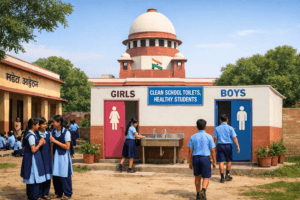
Beyond the Headline: India’s Supreme Court Redefines Dignity, One School Toilet at a Time
In the labyrinthine corridors of India’s legal system, where petitions can languish for years, a quiet revolution was set in motion from a courtroom bench. The recent Supreme Court ruling in Dr. Jaya Thakur v. Union of India wasn’t accompanied by the fanfare of a political rally or the immediacy of a breaking news alert. But for millions of adolescent girls in rural India, its echo will be felt in the most intimate and essential of spaces: the school bathroom.
The Court’s decision, which mandates that all schools must provide adequate toilets and free menstrual products for every menstruating student, is more than a policy update. It is a profound legal and social statement that weaves together the threads of gender justice, public health, and constitutional morality. By anchoring the ruling in Article 21 of the Indian Constitution—the right to life, personal liberty, and dignity—the Supreme Court has done something remarkable: it has declared that a girl’s biology cannot be the barrier that denies her an education, and by extension, her future.
This is a moment not just for India, but for the world to watch.
The Unseen Crisis in the Classroom
To understand the magnitude of this judgment, one must step away from the legal jargon and into the lived reality of a girl in a village in Bihar or a small town in Uttar Pradesh. For her, menstruation is not a clinical event discussed in health class. It is a monthly crisis of logistics, shame, and silence.
The statistics are stark, but they only hint at the human toll. A significant percentage of rural schools still function without functional, gender-separated toilets. Where they exist, they are often locked to prevent maintenance issues, or they are so unclean as to be unusable. For a girl experiencing her period, the lack of a safe, private space to change a cloth or a pad transforms a normal biological function into a source of deep anxiety.
What happens in practice is a quiet, systematic exclusion. Girls begin to miss school for three to seven days every month. They fall behind in their studies. The cumulative effect is staggering: a girl who menstruates for five years of her secondary education can miss nearly an entire academic year. This “period poverty” doesn’t just impact grades; it erodes confidence. The message it sends is insidious: your body is a problem, and education is not a place for you.
The Court’s ruling directly confronts this reality. It affirms that these are not “personal problems” to be solved with makeshift rags and silent suffering. They are systemic failures that violate a citizen’s fundamental rights.
Article 21: The Soul of the Verdict
What elevates this ruling from a simple administrative order to a landmark judgment is its philosophical and legal foundation: Article 21.
Over the decades, India’s Supreme Court has breathed life into this Article, expanding its interpretation far beyond mere physical survival. It has come to encompass the right to a clean environment, the right to livelihood, the right to health, and the right to education. In this case, the Court has woven menstrual health directly into this tapestry of rights.
The logic is both simple and revolutionary. Dignity, the Court argues, is not an abstract concept. It is a tangible experience. A student cannot be expected to maintain her dignity if she is forced to sit in a classroom while stained, or to leave school for days on end, or to manage her period in an open field for lack of a toilet. Denying her the basic infrastructure to manage her body with privacy and safety is an assault on her dignity, and therefore, a violation of her constitutional right to life.
This linkage is powerful because it shifts the onus. The responsibility for a girl’s menstrual health no longer rests solely on her family’s income or her mother’s awareness. It becomes a state obligation. The government is now legally bound to ensure that its schools are not instruments of gender-based exclusion. This transforms advocacy from a plea for charity into a demand for the enforcement of a fundamental right.
The Tangible Impact: From Courtroom to Classroom
The true test of this verdict, however, will not be in the Supreme Court’s records, but in the ground-level execution. The order mandates two critical infrastructure shifts: access to facilities and access to products.
First, the mandate for safe, separate, and functional toilets is a direct challenge to the status quo. It requires state governments to audit schools, release funds for construction and repair, and, crucially, establish systems for regular maintenance. A toilet that is built but never cleaned, or that lacks water, is a violation of the spirit of this order. The ruling implicitly demands a shift in school management culture, where the needs of girls are prioritized.
Second, the provision of free menstrual products is a game-changer. For many families, especially those living below the poverty line, the recurring cost of sanitary pads is a significant burden. This forces girls to rely on unhygienic alternatives like old rags, ash, or hay, which lead to infections and discomfort. By making pads or other products freely available in schools, the state removes a major economic barrier and ensures that a lack of affordability no longer dictates a girl’s right to learn.
This two-pronged approach recognizes that dignity is a product of both infrastructure and material support. A girl needs both a private place and the means to manage her period hygienically. The Court has mandated nothing less than a complete ecosystem of menstrual support within the educational system.
A Global Beacon in the Fight for Equity
While the implications for India are immediate, the judgment’s resonance is global. Nations across South Asia, Sub-Saharan Africa, and Latin America grapple with the same issue: how to keep girls in school when their bodies become a point of vulnerability.
India’s ruling provides a powerful template. It demonstrates that menstrual health is not merely a “women’s issue” to be handled by NGOs, but a core component of human rights law. It challenges other judiciaries to examine their own constitutions and ask whether the right to education and dignity implicitly guarantees the right to menstrual health.
This decision places India at the vanguard of a global movement. It sends a clear message that a nation’s development cannot be measured solely by its GDP growth, but by how it treats its most vulnerable citizens. For global health bodies, women’s rights organizations, and policymakers, India has provided a powerful legal precedent. It moves the conversation from “Why should we provide free pads?” to “How can we, as a state, fulfill our constitutional duty to ensure dignity for all?”
The Diaspora’s Pride and the Unfinished Agenda
For the 32 million-strong Indian diaspora, this ruling is a source of profound emotional resonance. It is a validation of the values they carry with them—the belief in education, the importance of community, and the fight for equality. To see the world’s largest democracy use the full weight of its Constitution to protect its daughters is a powerful affirmation.
Organizations like the Desai Foundation, mentioned in the original piece, represent the bridge between grassroots action and systemic change. For years, they have been doing the slow, painstaking work of building trust in communities, distributing products, and conducting awareness programs to break the culture of silence. The Supreme Court’s ruling is a monumental validation of that work. It shows that when persistent, on-the-ground advocacy meets the force of law, the architecture of society can be fundamentally altered.
But as we celebrate this landmark victory, we must also recognize it as a beginning, not an end. A court order does not magically build toilets overnight. It does not instantly dismantle the deep-seated stigma that surrounds menstruation.
The real work lies ahead. It lies in:
- Implementation and Accountability: Will state governments allocate the necessary funds? Will there be a mechanism for girls to report broken toilets or a lack of supplies? Civil society must now become a watchdog, ensuring the ruling is translated into reality.
- Waste Management: The provision of disposable pads creates a new environmental challenge. The judgment must be accompanied by innovation in sustainable, biodegradable products and safe disposal mechanisms within schools.
- Breaking the Stigma: Infrastructure is only half the battle. The silence and shame surrounding periods must be broken through comprehensive menstrual health education—for boys as well as girls. Normalizing menstruation as a natural part of life is essential to creating a truly dignified environment.
- Extending the Mandate: If the right to dignity under Article 21 guarantees menstrual products in schools, what about in workplaces? What about for women in shelters, or for those who are homeless? The logic of this judgment could pave the way for a much broader expansion of menstrual equity in the future.
A Verdict That Changes the Lens
Ultimately, the true power of the Dr. Jaya Thakur ruling is in how it changes the lens through which we see the world. It forces us to see a school without a girls’ toilet not as an inconvenience, but as a constitutional violation. It asks us to view a girl dropping out of school not as a personal choice, but as a systemic failure.
India has taken a monumental step. It has declared that in the quest for equality, there are no small details. A pad, a lock on a door, and a tap with running water are not just amenities. In the eyes of the law, they are now the building blocks of a dignified life. And for the millions of girls waiting for their chance to learn, to grow, and to lead, that is a future worth fighting for.
You must be logged in to post a comment.