
Beyond the Headline: How India’s Smartphone Export Surge Signals a Strategic Global Pivot
Beyond the Headline: How India’s Smartphone Export Surge Signals a Strategic Global Pivot
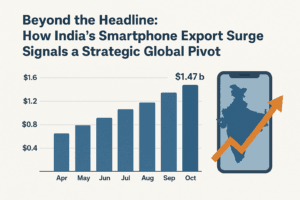
In the often-gloomy narrative of global trade, rattled by protectionist policies and supply chain realignments, a starkly positive figure stands out. In October 2025, India’s smartphone exports to the United States—the world’s most demanding consumer market—did not just grow; they exploded, tripling to a substantial $1.47 billion from $0.46 billion a year prior. This isn’t an isolated spike. It’s the exclamation point on a seven-month sentence of staggering growth, where cumulative exports to the U.S. for April-October 2025 reached $10.78 billion, a near-tripling from $3.60 billion in the same period last year. Simultaneously, India’s global smartphone export story shines, with a 49.35% expansion to $15.95 billion. But to view this as merely a statistical win is to miss the profound, multi-layered story unfolding beneath the surface. This surge represents a calculated and hard-earned strategic victory for India, one that reveals shifts in global manufacturing, geopolitics, and corporate strategy.
Decoding the Numbers: More Than Just a Triple Jump
The raw data, provided by government sources, tells a compelling tale of resilience and scaling. The year-on-year growth for every month from April to October 2025 remained decisively positive, even when monthly figures fluctuated. For instance, a dip from $2.29 billion in May to $0.88 billion in September might seem concerning at first glance, but context is key. Comparing September 2025’s $0.88 billion to September 2024’s $0.26 billion reveals a 238% growth. This pattern indicates seasonal adjustments, inventory cycles, and new model launch timelines, rather than weakness.
The real story is in the comparative scale. The U.S., historically a market dominated by phones manufactured in China and Vietnam, is now sourcing smartphones of unprecedented value from India. This wasn’t accidental. It is the direct result of a concerted, multi-year strategy to alter the electronics manufacturing landscape.
The Pillars of the Export Revolution: Why Now?
Several interlocking factors have converged to make this export boom possible, transforming India from a predominantly domestic-focused assembly hub to a global export powerhouse.
- The Production-Linked Incentive (PLI) Scheme’s Maturation: Launched earlier this decade, the PLI scheme for large-scale electronics manufacturing was a high-stakes gamble. It offered performance-linked incentives on incremental sales of goods manufactured in India. After initial teething problems, the scheme has hit its stride. Major global players like Apple (through its contract manufacturers Foxconn, Wistron, and Pegatron), Samsung, and others have not only met but exceeded investment and production targets. The incentive structure directly makes exporting from India more profitable, creating a powerful economic engine for the surge we’re witnessing.
- Strategic Diversification: The “China+1” Imperative: For global brands, particularly Apple, geopolitical tensions and pandemic-induced supply chain shocks highlighted the critical risk of over-concentration in any single geography. The “China+1” strategy moved from boardroom discussion to operational imperative. India, with its vast domestic market, improving infrastructure, and government push, emerged as the most viable alternative. The tripling of exports to the U.S. is tangible proof that this diversification is operational and scaling rapidly. India is no longer just an assembly line for its own market; it is becoming a strategic export node for the world.
- Deepening Vendor Ecosystems: Manufacturing a smartphone requires hundreds of components. The initial challenge in India was the lack of a local component ecosystem, forcing manufacturers to import parts, which increased cost and complexity. This is changing. The success of final assembly is pulling in suppliers of displays, batteries, casings, and other parts. As this vendor base deepens, the cost and efficiency of manufacturing in India improve, creating a virtuous cycle that further strengthens its export competitiveness.
- Navigating Tariff Uncertainties with Scale: As an official noted, this growth held firm “even as tariff-related uncertainties threatened to weigh on demand and pricing.” This is a critical insight. It suggests that the efficiencies gained from scale, incentives, and a maturing ecosystem are now substantial enough to absorb external pricing pressures. Indian-manufactured devices are becoming cost-competitive not just because of lower labor costs, but because of integrated, at-scale manufacturing.
The Global Context: A Recalibration of Trade Maps
India’s worldwide smartphone export growth of 49.35% is not happening in a vacuum. It signals its growing integration into global supply chains as a reliable partner. The spectacular monthly growth rates—66.54% in May, 66.61% in June, and 82.27% in September—indicate that this is a broad-based phenomenon across multiple destinations, likely including the EU, Middle East, and other regions.
This recalibration is significant. It positions India as a central player in the technology hardware trade, moving up the value chain. We are witnessing a shift from exporting low-value commodity phones to exporting premium smartphones, which brings higher margins, more skilled jobs, and greater technological spillovers into the domestic economy.
Challenges and the Road Ahead: Sustaining the Momentum
Despite the celebratory data, the path forward requires navigating significant challenges:
- Consistency Over Peaks: Smoothing out the monthly volatility in export figures will be key to building long-term confidence among global retailers and planning logistics.
- Moving Up the Value Chain: The next frontier is capturing more of the intellectual property and high-value component manufacturing (like semiconductors and advanced displays), rather than just final assembly.
- Infrastructure and Logistics: Continuous improvement in port efficiency, customs clearance, and domestic freight corridors is essential to handle this growing export volume reliably.
- Global Demand Fluctuations: As the prime export destination, economic conditions in the U.S. and Europe will directly impact demand. Building resilience through market diversification is crucial.
Conclusion: A Defining Shift in India’s Economic Narrative
The headline figure of tripled exports to the U.S. is more than a trade statistic; it is a marker of a defining shift. It validates a policy gamble, rewards corporate investment, and showcases India’s ability to execute complex, large-scale manufacturing integration. This isn’t just about smartphones; it’s a proof-of-concept. If India can achieve this in a highly competitive, fast-paced industry like consumer electronics, it sets a template for other sectors—from electronics components to electric vehicles.
The story here is one of strategic patience yielding results. From policy design (PLI) to geopolitical timing (“China+1”) to corporate execution, the pieces have aligned. For the global economy, it means a more diversified and potentially resilient supply chain. For India, it marks a decisive move towards becoming a trusted, scale manufacturer for the world, turning a long-held ambition into a quantifiable, billion-dollar reality. The momentum has not just rebounded; it has accelerated, charting a new course for India’s role in the global trade order.
You must be logged in to post a comment.