
Beyond the Headline: Hamas’s Gambit and the Fragile Hope for a Technocratic Gaza
Hamas’s announcement that it will dissolve its governing authority in Gaza and transfer control to a Palestinian technocratic committee, operating under a UN-backed “Board of Peace,” represents a pivotal but precarious strategic shift born of devastating conflict and political calculation. While framed as a step toward unity and reconstruction, the move primarily allows Hamas to offload the burden of administering a shattered territory and refocus on its resistance identity, while placing pressure on its rival, the Palestinian Authority. The proposed technocratic model, endorsed by UNSC Resolution 2803 and led by an international appointee, aims to provide stability and oversee reconstruction through a neutral, expert-led administration. However, it risks becoming a permanent caretaker regime that manages humanitarian crisis and security for Israel without addressing core political aspirations, potentially entrenching a “security-first” status quo that perpetuates occupation under a new, internationally sanctioned guise, rather than forging a genuine path to sovereignty and self-determination for Palestinians.
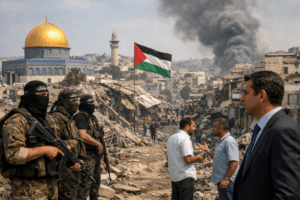
Beyond the Headline: Hamas’s Gambit and the Fragile Hope for a Technocratic Gaza
In a televised address that reverberated across a scarred and weary region, Hamas spokesperson Hazem Qassem delivered a statement of potentially historic proportions. The Islamic Resistance Movement, the de facto governing authority in the Gaza Strip for nearly two decades, declared its readiness to dissolve its administrative entities and hand control to an independent, technocratic Palestinian committee. Framed as a “clear and final” decision, this move is not merely a bureaucratic shuffle; it is a high-stakes gambit that touches the raw nerves of Palestinian unity, Israeli security, and international geopolitics. To understand its true significance, we must look beyond the announcement and into the tangled web of war, diplomacy, and survival that defines Gaza.
A Calculated Relinquishment: Why Hamas Would Cede Control
Hamas’s declaration did not emerge in a vacuum. Since at least February 2025, the group had signaled openness to this model, a timing that is crucial. It follows the devastating conflict that precipitated the October 2024 ceasefire—a conflict that left Gaza’s infrastructure in ruins and its humanitarian crisis at an apocalyptic pitch. For Hamas, governance has become a double-edged sword. While control provided legitimacy and a mechanism to enforce its authority, the practical burdens are now overwhelming. Administering a territory with collapsed utilities, a shattered economy, and a desperate population under the constant threat of renewed warfare is a thankless, resource-draining task.
By proposing a technocratic handover, Hamas achieves several strategic aims. First, it potentially relieves the movement of direct responsibility for Gaza’s day-to-day calamity, shifting the blame for inevitable failures onto an internationalized administration. Second, it allows Hamas to regroup and reassert its primary identity as a “resistance” movement rather than a struggling government. Third, and perhaps most importantly, it is a tactical play within the broader Palestinian political arena. By initiating the move, Hamas seeks to position itself as a flexible actor willing to sacrifice administrative power for national unity, thereby placing political pressure on its rival, the Palestinian Authority (PA) in the West Bank, which has been reluctant to step into Gaza without a clear political horizon.
The “Board of Peace”: Blueprint for Stability or Neocolonial Tool?
The framework for this transition is the United Nations Security Council’s Resolution 2803, which endorsed a U.S.-backed peace plan and established the “Board of Peace.” This body, to be headed by former UN envoy Nickolay Mladenov, is authorized to create a temporary International Stabilization Force. On paper, it presents a model for post-conflict administration: neutral experts, rather than politicians or militants, managing utilities, reconstruction, and civil affairs.
However, as UN Special Rapporteur Francesca Albanese sharply critiqued, this model risks becoming a “security-first, capital-driven model of foreign control.” The fundamental question hangs over the entire endeavor: technocratic for whom, and accountable to whom? A committee of appointed experts, potentially reliant on an international force for security, may efficiently coordinate aid and rebuild infrastructure. But without a clear political pathway to a sovereign Palestinian state or genuine reconciliation between Palestinian factions, it risks becoming an advanced, well-funded caretaker regime—managing the occupation rather than ending it. The rejection of figures like Tony Blair, and the insistence on specific names, as highlighted by Hamas leader Mohammad Nazzal, reveals the intense negotiation over the symbols and substance of this new authority.
The Stakes for Key Players: Israel, the PA, and the “International Community”
The reactions and maneuvers of other actors are equally telling. Israeli Prime Minister Benjamin Netanyahu’s quick announcement of Mladenov’s role indicates Israel’s primary interest: stability without political concession. A depoliticized Gaza administration focused on humanitarian and reconstruction issues, overseen by an international force, could provide Israel with the long-term security calm it desires without having to engage directly with Hamas or make tough decisions about Palestinian statehood.
For the Palestinian Authority of President Mahmoud Abbas, this presents a profound dilemma. Entering Gaza under the umbrella of a Board of Peace backed by a resolution it did not shape could be seen as legitimizing a diminished form of governance, potentially one that sidelines the Palestine Liberation Organization’s (PLO) broader national agenda. However, staying out cedes further ground to Hamas’s narrative of sacrifice and flexibility. The PA’s hesitation is a reflection of this poisoned chalice.
Meanwhile, the “international community” is itself divided. For some Western and Arab states backing the plan, it is a pragmatic exit ramp from cyclical violence. For critics, it enshrines a dangerous precedent of international administration without self-determination, treating Gaza as a humanitarian problem to be managed rather than a political entity with rights.
The Human Ground: A Ceasefire in Name Only?
Amidst these high-political machinations, the brutal reality on the ground continues. The Gaza Health Ministry’s report of 447 killed since the October ceasefire—including journalist Saleh Al-Jafarawi—is a grim testament that the cessation of full-scale war does not mean peace or safety. This statistic underscores the perilous environment into which any technocratic committee would step. Its legitimacy in the eyes of Gazans will not be won in conference rooms in Cairo or New York, but on the ability to stop the violence, allow families to sleep in safety, and ensure that a bag of flour is both available and affordable.
Conclusion: A Bridge to Nowhere, or a First Step?
Hamas’s offer to relinquish control is a seismic event, but it is the beginning of a story, not its conclusion. The transition to a technocratic administration holds a sliver of hope: it could create a neutral space for humanitarian relief, rebuild critical infrastructure, and perhaps lower the temperature for political negotiations. It is a tacit acknowledgment by Hamas that military control does not equal viable statehood.
Yet, the peril is that this “technocratic” model becomes a permanent purgatory. Without a parallel, ironclad commitment to a political process that addresses the core issues of occupation, displacement, and sovereignty, the Board of Peace may simply construct a more orderly cage. The world must be wary of conflating administrative efficiency with justice. The people of Gaza do not need better managers of their deprivation; they need, and deserve, a definitive end to it. The true test of this gambit will be whether it becomes a bridge to a meaningful political future for all Palestinians, or merely a newly painted wall in a tragically familiar prison.
You must be logged in to post a comment.