
Beyond the Headline: Greenzo Energy and Lord’s Mark Industries’ 60MW Green Hydrogen Push in Uttar Pradesh
Indian clean technology firm Greenzo Energy and conglomerate Lord’s Mark Industries have signed an agreement to develop 60MW of green hydrogen projects across four Uttar Pradesh cities (Gorakhpur, Aligarh, Jhansi, and Lucknow), with Greenzo providing the technology and engineering while Lord’s Mark handles development, financing, and commercial structuring. The projects will integrate solar captive power and battery storage, representing a distributed production model that prioritizes execution over hype at a time when India is projected to meet only 6% of its 2030 green hydrogen target. While modest in scale, the partnership is significant for its clear division of responsibilities, realistic project sizing, focus on secondary cities with diverse industrial and agricultural demand, and potential to demonstrate that integrated, smaller-scale developments may prove more viable than the mega-projects dominating headlines, ultimately contributing to India’s hydrogen ambitions one operational megawatt at a time.
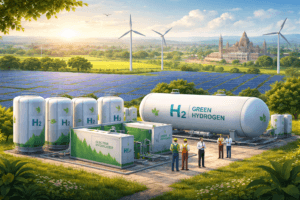
Beyond the Headline: Greenzo Energy and Lord’s Mark Industries’ 60MW Green Hydrogen Push in Uttar Pradesh
Indian Partners Signal Confidence in Distributed Hydrogen Economy with Multi-City Development Plan
Introduction: A Modest Beginning with Outsized Implications
On February 17, 2026, H2 View reported that Indian clean technology firm Greenzo Energy had signed a memorandum of understanding with conglomerate Lord’s Mark Industries to develop 60MW of green hydrogen projects across four cities in Uttar Pradesh. The news arrived with minimal fanfare—no grand press conference, no celebrity ambassadors, no lofty promises about “revolutionizing” India’s energy landscape. Just a straightforward business announcement about two Indian companies deciding to build something together.
But sometimes the most significant developments arrive without fireworks. In the context of India’s ambitious—and increasingly beleaguered—green hydrogen journey, this partnership deserves closer examination. Because while 60MW might seem modest against the country’s 5 million tonnes per annum target by 2030, the structure, geography, and players involved tell a more nuanced story about where India’s hydrogen economy might actually take root.
The Anatomy of the Partnership: Who’s Doing What?
Let’s start with what we know. Under the MoU, Greenzo Energy and Lord’s Mark Industries aim to install green hydrogen projects integrated with solar captive power and battery storage in Gorakhpur, Aligarh, Jhansi, and Lucknow. Greenzo will provide hydrogen technologies and engineering. Lord’s Mark Industries will act as developer and investor, overseeing finance, regulation, and commercial structuring.
This division of labor matters. It suggests a deliberate separation of technical and commercial responsibilities that could serve as a template for similar partnerships across India’s emerging hydrogen ecosystem.
Greenzo Energy: The Technologists
New Delhi-based Greenzo Energy isn’t a household name, but in Indian clean technology circles, it has been quietly building credibility. The company’s current portfolio includes an 8MW solar project in Nepal and a 3MW electrolyser installation with Jindal Stainless Limited—one of India’s leading stainless steel manufacturers. These aren’t headline-grabbing numbers, but they represent actual, operational projects in a sector plagued by announcements that never materialize.
What makes Greenzo interesting is its focus on integrated solutions rather than standalone hydrogen production. The company appears to understand something that many hydrogen advocates overlook: green hydrogen isn’t a product you simply manufacture and ship. It’s an energy carrier that must be produced, stored, and consumed in careful coordination with variable renewable generation and intermittent demand. Hence the emphasis on solar captive power and battery storage integration in the Uttar Pradesh projects.
Lord’s Mark Industries: The Unlikely Hydrogen Player
Lord’s Mark Industries presents a more complex profile. The conglomerate operates across healthcare, paper manufacturing, and solar energy—sectors that don’t obviously converge on green hydrogen. But that diversity might be precisely the point.
A conglomerate with interests in healthcare and paper has something that pure-play energy companies often lack: internal demand. Paper manufacturing requires significant process heat. Healthcare facilities need reliable power and, in some cases, hydrogen for specialized applications. By developing hydrogen projects, Lord’s Mark may be positioning itself to decarbonize its own operations while creating a new business line.
The company’s solar experience is equally relevant. Green hydrogen production requires inexpensive renewable electricity, and Lord’s Mark’s existing solar footprint could provide either generation sites or valuable development expertise. When the company oversees “finance, regulation, and commercial structuring” for these projects, it’s drawing on years of navigating India’s complex renewable energy landscape.
The Geography Question: Why Uttar Pradesh?
The choice of locations—Gorakhpur, Aligarh, Jhansi, and Lucknow—deserves attention. These aren’t obvious hydrogen hubs like Gujarat’s refinery cluster or the industrial corridors around Mumbai and Chennai. They’re secondary cities in India’s most populous state, each with distinct economic profiles.
Gorakhpur: Agricultural Heartland Meets Energy Transition
Gorakhpur, near the Nepal border, sits at the center of a significant agricultural region. For green hydrogen, agriculture presents opportunities that industrial applications don’t. Ammonia production for fertilizers—currently reliant on fossil hydrogen—represents a massive potential market. Agricultural waste could supplement renewable energy generation. And rural electrification challenges might find solutions in hydrogen-based microgrids.
Aligarh: Industrial Heritage
Aligarh is known for lock manufacturing and brass work—small-scale industries that require heat for metalworking. While individual operations are too small for on-site hydrogen production, a centralized facility could supply multiple workshops, creating a distribution model relevant across India’s informal manufacturing sector.
Jhansi: Strategic Crossroads
Jhansi’s location along major transportation routes makes it interesting for mobility applications. The city is a railway junction of historical importance, and Indian Railways has expressed interest in hydrogen traction. A production facility near Jhansi could potentially supply rail refueling points while serving local industrial users.
Lucknow: Administrative and Institutional Demand
As Uttar Pradesh’s capital, Lucknow hosts government buildings, hospitals, universities, and research institutions—all potential hydrogen consumers. Government procurement could anchor initial demand, while institutional partnerships might advance research and workforce development.
The four-city approach suggests distributed production rather than centralized mega-projects. This aligns with hydrogen’s fundamental challenge: transportation is expensive, so production should occur near consumption. It also reflects Indian realities, where land acquisition, grid connectivity, and regulatory approvals are often easier for smaller projects distributed across multiple jurisdictions.
The 6% Problem: Why This Project Matters Now
In January 2026, Wood Mackenzie delivered a sobering assessment: India would meet just 6% of its 2030 green hydrogen production target of 5 million tonnes per annum. The analysis cited “mature projects lag”—industry jargon for announcements that fail to reach financial close and construction.
This creates a credibility problem for India’s hydrogen ambitions. International partners considering offtake agreements, equipment suppliers evaluating market entry, and financiers assessing risk all watch project pipelines. When those pipelines remain filled with announcements rather than construction, confidence erodes.
Against this backdrop, the Greenzo-Lord’s Mark partnership represents something valuable: a project that appears designed for execution rather than headlines.
Characteristics of Executable Projects
What makes a hydrogen project likely to reach completion? Several factors distinguish announcements from actual developments:
Clear ownership structure: Many hydrogen announcements involve multiple partners with undefined roles. When responsibilities blur, projects stall. The Greenzo-Lord’s Mark MoU establishes clear technical-commercial separation.
Captive generation integration: Projects dependent on grid power face uncertainty around renewable availability and pricing. Solar captive power, combined with battery storage, provides more predictable production economics.
Realistic scale: 60MW distributed across four sites means 15MW average per location—large enough to achieve reasonable efficiency but small enough to avoid the financing and permitting challenges of gigawatt-scale complexes.
Experienced developers: Both companies have operational projects, not just PowerPoint presentations. Greenzo’s existing installations and Lord’s Mark’s solar experience suggest they understand project execution realities.
Geographic specificity: Vague announcements about “developing projects in India” rarely proceed. Committing to specific cities creates accountability and enables stakeholders to assess viability.
The Economics: What Makes These Projects Viable?
Green hydrogen economics remain challenging globally. In India, the equation includes both headwinds and tailwinds.
The Cost Challenge
Current green hydrogen production costs in India range from $4-6 per kilogram—significantly above grey hydrogen from fossil fuels. Electrolyser capital costs, while falling, still represent substantial investment. Renewable electricity, despite India’s excellent solar resources, requires backup or storage to provide the high utilization rates that improve electrolyser economics.
The Subsidy Context
India has introduced production-linked incentives for electrolyser manufacturing and green hydrogen production. These schemes can bridge part of the cost gap, but they come with compliance requirements and timelines. Projects must demonstrate progress to retain eligibility.
The Integration Advantage
The Greenzo-Lord’s Mark model of solar captive power plus battery storage addresses a key economic challenge: electrolyser utilization. Solar-only configurations produce hydrogen only when the sun shines, leading to low equipment utilization and high average costs. Adding storage enables some production during non-solar hours, improving capital efficiency.
The Value Proposition
Ultimately, hydrogen projects succeed when they serve specific customer needs rather than generic “decarbonization.” Potential value drivers for the Uttar Pradesh projects might include:
Energy security: Captive production reduces exposure to grid instability and fossil fuel price volatility.
Regulatory compliance: As India implements carbon intensity requirements, industrial consumers may need certified low-carbon products.
Export readiness: While not immediately relevant for domestic projects, establishing production capability positions participants for future export opportunities.
Brand value: For Lord’s Mark Industries, hydrogen projects signal commitment to sustainability across its business portfolio.
The Regulatory Landscape: Navigating India’s Hydrogen Framework
India’s green hydrogen policy has evolved rapidly, creating both opportunities and complexity for project developers.
Key Policy Elements
The National Green Hydrogen Mission, approved in January 2023 with an outlay of ₹19,744 crore (approximately $2.4 billion), established the overarching framework. Key components include:
Incentives for electrolyser manufacturing: Tiered subsidies based on local value addition and production volumes.
Incentives for green hydrogen production: Direct support per kilogram produced, designed to bridge the cost gap with grey hydrogen.
Renewable energy banking: Provisions allowing producers to bank excess renewable generation for later use in hydrogen production.
Waiver of interstate transmission charges: Cost reduction for renewable electricity used in hydrogen production.
Green hydrogen consumption obligations: Proposed requirements for refineries and fertilizer plants to use increasing proportions of green hydrogen.
Implementation Realities
Policy on paper differs from policy in practice. Developers navigating India’s hydrogen landscape report challenges with:
State-level coordination: While central policy provides the framework, state governments control land, water, and local approvals. Uttar Pradesh’s hydrogen policy—if it has one—will influence project timelines.
Banking and financing: Financial institutions remain cautious about hydrogen projects, preferring proven technologies and business models.
Infrastructure gaps: Even with captive solar, projects require grid connectivity for backup and potentially for selling excess renewable generation.
Water access: Electrolysis requires significant water—approximately 9-10 liters per kilogram of hydrogen. In water-stressed regions, securing reliable supply adds complexity.
Beyond Uttar Pradesh: What This Signals for India’s Hydrogen Economy
The Greenzo-Lord’s Mark partnership, while modest in scale, suggests several trends worth watching.
The Rise of Distributed Production
India’s initial hydrogen vision emphasized large production hubs near refineries and ports—think gigawatt-scale electrolysers supplying industrial clusters. While these projects remain important, distributed production serving diverse local users may prove equally significant. Secondary cities and industrial towns lack the infrastructure for massive hydrogen imports but can support local production with reasonable logistics.
Conglomerate Participation
Large Indian business groups are increasingly examining hydrogen’s relevance to their existing operations. Lord’s Mark’s entry follows similar moves by Reliance Industries, Adani Group, and others. For these conglomerates, hydrogen isn’t a standalone bet but an extension of their energy, industrial, and infrastructure portfolios.
Technology Partnerships
Greenzo’s role demonstrates that Indian companies can provide core hydrogen technology rather than simply importing electrolysers. Domestic manufacturing capability, supported by production-linked incentives, could eventually position India as both producer and exporter of hydrogen equipment.
Integration Thinking
The emphasis on solar captive power and battery storage reflects growing recognition that hydrogen isn’t an isolated solution but part of a broader clean energy system. Projects designed with integration in mind—considering generation, storage, and end-use simultaneously—have better prospects than those treating hydrogen as a standalone product.
The Human Element: Who Benefits?
Discussions of green hydrogen often focus on megawatts, tonnes, and policy frameworks—abstractions that obscure the human implications. But projects like those planned in Uttar Pradesh will affect real people in tangible ways.
Workers
Construction and operation of hydrogen facilities will create jobs requiring new skills. Electrolyser maintenance, solar array management, safety systems operation—these roles demand training that doesn’t currently exist at scale. Companies investing in workforce development will build competitive advantage while providing opportunities for local workers.
Communities
Hydrogen projects bring both benefits and concerns to host communities. Potential benefits include tax revenue, improved energy infrastructure, and economic diversification. Concerns may center on water consumption, safety, and land use. How developers address these concerns will shape community acceptance.
Industrial Users
Small and medium enterprises near these facilities could gain access to low-carbon energy previously unavailable to them. A metalworking shop in Aligarh can’t build its own electrolyser but might purchase hydrogen from a nearby plant, enabling cleaner production without massive capital investment.
Future Generations
The ultimate beneficiaries, if hydrogen fulfills its promise, will be those who inherit a less carbon-intensive economy. Every operational project, however modest, advances learning and infrastructure that enable future scale.
The Challenges Ahead
Optimism about the Greenzo-Lord’s Mark partnership must be tempered with recognition of the obstacles.
Technology Risk
While electrolysis is proven, integrated systems combining solar, battery storage, and hydrogen production at distributed scales remain relatively unproven in Indian conditions. Performance will depend on system design, component quality, and operational practices.
Market Development
Producing hydrogen is one challenge; selling it is another. The MoU mentions no proposed end-users, suggesting that commercial arrangements remain to be developed. Without committed offtakers, projects face revenue uncertainty that complicates financing.
Infrastructure Coordination
Even with captive generation, projects require supporting infrastructure: water supply, site access, grid connection for backup power, and potentially hydrogen transport and storage equipment. Coordinating these elements across four cities multiplies complexity.
Policy Stability
India’s hydrogen policies have evolved rapidly, creating incentives for early movers. But policy changes—subsidy adjustments, regulatory shifts, election outcomes—could alter project economics. Developers must build flexibility into their plans.
Conclusion: Small Projects, Big Implications
The Greenzo-Lord’s Mark partnership won’t single-handedly transform India’s energy landscape. 60MW distributed across four cities represents a tiny fraction of the capacity needed to meet national targets. Even if these projects succeed spectacularly, they’ll barely register in aggregate statistics.
But that’s not the right measure of significance. What matters is that two Indian companies have committed to building something real, with clear roles, specific locations, and an integrated technical approach. They’re not waiting for policy perfection or technology breakthroughs. They’re moving forward with what’s available now.
In an industry drowning in announcements, that willingness to build matters. Each operational project creates knowledge, trains workers, demonstrates technology, and establishes supply chains. Each successful installation makes the next project slightly easier, slightly cheaper, slightly more likely.
India will meet its hydrogen targets—or fail to meet them—one project at a time. The 60MW in Uttar Pradesh, if it becomes reality, will be 60MW more than existed before. And in the long journey from ambition to achievement, every megawatt counts.
You must be logged in to post a comment.