
Beyond the Headline: Fractured Bones and the Slow Erosion of Life in Occupied East Jerusalem
A 46-year-old Palestinian man from Biddu, northwest of Jerusalem, was assaulted by Israeli soldiers in Beit Hanina on March 27, 2026, sustaining fractures and bruises—an incident reported in a sparse news brief that belies its deeper significance. The article argues that this seemingly isolated injury is actually a symptom of the systemic violence inherent in Israel’s occupation, where checkpoints, separation walls, and settler expansion in East Jerusalem and the West Bank create a daily reality of humiliation and physical risk. The victim, likely a breadwinner, now faces lost wages, unaffordable medical care, and no path to justice in a system where soldiers act with near-total impunity. His fractures are not just medical events but markers of a slow, grinding erosion of Palestinian life, occurring against the backdrop of far larger tragedies like Gaza’s mounting death toll. Ultimately, the piece reframes the assault as an intimate, systemic act of control—a reminder that the occupation’s violence often arrives not through bombs, but through the crack of a rifle butt on a Friday afternoon.
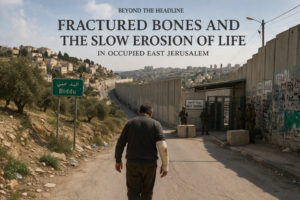
Beyond the Headline: Fractured Bones and the Slow Erosion of Life in Occupied East Jerusalem
BIDDU, Occupied West Bank – The news, as it often arrives, was sparse. A single paragraph from the Jerusalem governorate, picked up by the WAFA news agency on a Friday afternoon: a 46-year-old man from Biddu, northwest of Jerusalem, injured in Beit Hanina after an assault by Israeli soldiers. Fractures and bruises, the report said. No name. No details of the spark that ignited the violence. Just another data point in a long, grim ledger.
But for the people of Biddu, a town perched on a hill overlooking the sprawling Israeli settlement of Giv’at Ze’ev, and for the residents of Beit Hanina, a bustling Palestinian neighborhood now sliced by the concrete teeth of Israel’s separation wall, this was not a statistic. It was a father, a neighbor, a shopkeeper. It was a reminder that in the occupied Palestinian territory, the most mundane of Fridays can suddenly shatter into an encounter with state-backed force.
This incident, which occurred on March 27, 2026, is not an outlier. It is a symptom. To understand what happened to that 46-year-old man—whose identity remains protected by family request but whose experience is painfully universal—one must look beyond the immediate clash and into the machinery of daily life under occupation. This is a story about geography, power, and the quiet violence of a system where a broken bone is never just a broken bone.
The Geography of a Confrontation: Beit Hanina’s Fault Lines
Beit Hanina is a place under siege, though no one calls it that directly. Once a quiet bedroom community for professionals working in Jerusalem, it has been carved up by Israeli infrastructure. The wall—Israel’s controversial separation barrier—cuts directly through the town, separating the side that lies inside the Jerusalem municipal boundary from the side left stranded in the West Bank. To move from one part of Beit Hanina to another, residents must pass through a military checkpoint, presenting permits that are often denied.
It was on one of these contested streets, according to sources close to the governorate’s report, that the 46-year-old man from Biddu found himself on that Friday. He had likely traveled to Beit Hanina for a mundane errand: a doctor’s appointment, a visit to a relative, or perhaps to pray at one of the local mosques when access to the Al-Aqsa Mosque compound in the Old City was restricted—a frequent occurrence, as a related headline from March 29 notes the closure of Al-Aqsa for the 30th consecutive day.
What happened next is a matter of conflicting narratives—as it almost always is. The Israeli military, when contacted for routine comment on such incidents, often cites “suspicious behavior,” “stone-throwing,” or “failure to obey commands.” Palestinian eyewitness accounts, collected by local monitoring groups, paint a different picture: a sudden, unprovoked stop, a shouted order in Hebrew, and then the crack of a rifle butt against flesh before a man can raise his hands.
The resulting injuries—fractures and bruises—are clinical terms that fail to capture the reality. A fractured wrist means a laborer cannot work. A bruised rib means weeks of painful breathing, of sleepless nights on a thin mattress. For a 46-year-old man, likely the primary breadwinner for his family, these “minor” injuries translate into a catastrophic loss of income. There is no social safety net here. There is no worker’s compensation from the Israeli army.
Biddu: The Village That Looks Over the Settlements
To truly grasp the weight of this assault, one must drive 15 minutes west from Beit Hanina to Biddu. The town is a visual lesson in the power imbalance of the occupation. From its highest point, residents can see the red-tiled roofs of Giv’at Ze’ev, a thriving Israeli settlement of over 20,000 people, complete with swimming pools, parks, and a highway system that bypasses Palestinian villages entirely. Biddu, by contrast, is strangled by checkpoints and restricted roads.
The 46-year-old victim is a product of this environment. He has likely spent his entire adult life navigating a matrix of control. He has permits that expire. He has a family registry that dictates where he can live. He has watched his neighbors’ olive trees get uprooted by settlers from the nearby outposts, as reported in the same news cycle detailing colonist bulldozing of lands in Lubban El-Sharqiya.
When an Israeli soldier assaults a man from Biddu in Beit Hanina, the soldier is not just hitting a person. He is enforcing a hierarchy. He is reminding that man that his movement is a privilege, not a right. The physical pain is real, but the psychological message is sharper: You do not belong here. Your safety is not guaranteed.
The Broader Canvas of Violence: More Than Just a Friday
The timing of this injury is critical. Look at the “Related News” published just 48 hours later on March 29. The headlines read like a drumbeat of despair: “Gaza death toll rises to 72,278 since October 2023,” “Palestinian teenager killed by Israeli forces east of Khan Younis,” “89 Palestinian prisoners have died in Israeli prisons.”
This is the ecosystem in which the Beit Hanina assault occurred. It is a low-intensity conflict simmering beneath the high-intensity fires of Gaza. While the world’s attention is focused on the southern Strip, where a humanitarian catastrophe unfolds daily, the West Bank and East Jerusalem are undergoing a slow, grinding annexation by other means.
The assault on the 46-year-old is what human rights lawyers call a “bureaucratic injury.” It is not the result of a rogue soldier acting alone. It is the predictable outcome of a system where Israeli soldiers operate in a near-total impunity in Area C and East Jerusalem. According to Israeli human rights group B’Tselem, thousands of Palestinians have been injured in similar “incidents” over the past three years, with less than 1% of complaints against soldiers leading to indictments.
For the man from Biddu, justice is an abstract concept. What is tangible is the hospital bill. Because he was injured by a state actor, he does not qualify for standard insurance. He relies on the Palestinian Authority’s strained health system or charity from his mosque. His fractures will heal, likely crookedly, because he cannot afford physical therapy. The bruises will fade, but the limp in his gait—and his spirit—may remain.
The Unnamed Human: A Portrait in Silence
News agencies like WAFA often withhold the names of victims in non-fatal incidents at the family’s request. There is a reason for this. In the occupied territories, becoming a “named victim” brings risk. It invites doxxing by online settler groups, potential retaliation by the military (such as the demolition of the family home), or endless administrative detention. Anonymity is a fragile shield.
But we can imagine him. He is 46, which means he came of age during the Second Intifada. He has seen the Oslo Accords fail. He has watched his children grow up under a wall. He is tired in a way that sleep cannot fix. On that Friday, he was likely wearing his best clothes, hoping to cross a checkpoint to pray or to buy supplies for the weekend. He did not expect to end the day in a hospital bed, explaining to a young doctor how the soldier’s boot met his ribcage.
His story is not unique, and that is the tragedy. Across the West Bank on that same day, dozens of other men—and increasingly women and children—suffered similar fates. In a nearby village, Israeli colonists were bulldozing land. In Gaza, families were pulling children from rubble. The assault in Beit Hanina is a microcosm: a single, painful point in a constellation of suffering.
Conclusion: The Value of One Fracture
The international community often speaks in the language of “de-escalation” and “ceasefires.” But what does de-escalation mean for a man with a fractured arm in Biddu? It means nothing. The violence done to him is not the violence of a rocket or airstrike; it is the violence of a knee on the back, a rifle butt on the spine. It is intimate. It is personal. And it is systemic.
As the world scrolls past the headline—”Palestinian man injured in Israeli army assault north of Jerusalem”—it is worth pausing. Behind those 15 words is a man who cannot lift his children. A family calculating how to pay for bread instead of medicine. A village that buries its anger deep, because to show it invites another assault.
The occupation does not always announce itself with bombs. Sometimes, it announces itself with a crack of bone on a Friday afternoon in Beit Hanina. And that, perhaps, is the most devastating truth of all.
You must be logged in to post a comment.