
Beyond the Headline: Decoding Trump’s “Happiness” Demand and India’s Geopolitical Tightrope
Trump’s recent tariff warning to India, framed as a demand for personal diplomatic “happiness,” underscores a fundamental clash between U.S. geopolitical pressure and India’s doctrine of strategic autonomy. While the U.S. seeks to leverage trade to force India into aligning with its efforts to isolate Russia, India’s response is guided by an non-negotiable domestic imperative: securing affordable energy for its massive economy. This tension reveals India’s delicate balancing act, as it pragmatically navigates between a historic defense partner in Russia and a crucial modern ally in the U.S., all while refusing to cede sovereign decision-making to external ultimatums, even at the risk of escalating trade penalties.
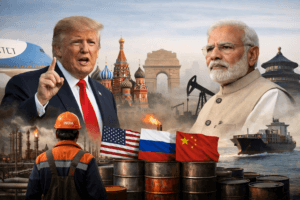
Beyond the Headline: Decoding Trump’s “Happiness” Demand and India’s Geopolitical Tightrope
The recent warning from former U.S. President Donald Trump, framed in characteristically personal terms, reveals far more than a simple trade dispute. His statement that it is “important to make me happy” regarding India’s oil imports from Russia is not merely a narcissistic soundbite—it is a stark lens into the complex geopolitical calculus facing New Delhi in an increasingly polarized world. This situation underscores a critical challenge for India: maintaining its strategic autonomy and national interest while navigating the fierce superpower rivalry between the United States and the Sino-Russian axis.
The Personalization of Geopolitics: A Transactional Ultimatum
Trump’s remarks aboard Air Force One, praising Prime Minister Narendra Modi as a “good guy” while simultaneously wielding the tariff hammer, exemplify a transactional and personalistic approach to foreign policy. This method reduces intricate international relations, built on decades of strategic partnership, to a simple bilateral scorecard of concessions and demands. The subtext is clear: the deepening U.S.-India relationship, often hailed as a “defining partnership of the 21st century,” has a conditional clause based on Washington’s immediate foreign policy objectives.
This creates a precarious dynamic for India. For years, New Delhi has adeptly balanced its relationships, sourcing advanced defense equipment from Russia while engaging in technology and trade partnerships with the U.S. and its allies. Trump’s warning—and the earlier imposition of tariffs linked to Russian oil purchases—signals a demand for alignment that threatens this delicate equilibrium. It frames India’s sovereign decision-making on energy security, crucial for its 1.4 billion people, as an act of loyalty or defiance to the U.S. administration.
India’s Energy Imperative: The Non-Negotiable Logic of Affordability
To understand India’s position, one must look beyond geopolitics to basic economics and domestic stability. As the world’s third-largest oil importer, India’s primary energy imperative is unshakeable: secure the most affordable crude to fuel its economy and shield its consumers from volatile price spikes.
When Russia offered discounted oil following the Ukraine conflict and subsequent Western sanctions, India’s increase in imports was a pragmatic, economically rational move. As Ministry of External Affairs Spokesperson Randhir Jaiswal stated, the government’s “consistent priority [is] to safeguard the interests of the Indian consumer.” This is not a political alignment with Moscow but a fiduciary duty to the Indian populace. The dramatic rise in U.S. oil imports to 540,000 barrels per day in October 2025 shows India’s willingness to diversify, but not at the expense of economic suicide by ignoring cheaper alternatives.
The reported government directive to refiners to increase disclosures and the potential drop in Russian crude below one million barrels per day indicate a nuanced, responsive approach. India is calibrating its imports, likely as a negotiating tactic for the broader trade deal with Washington, but it will not cede control of a fundamental pillar of its national security.
The Historical Context: Why “Strategic Autonomy” Isn’t Just a Slogan
India’s reluctance to fully capitulate to U.S. pressure is rooted in a long and principled history of non-alignment and its evolution into “strategic autonomy.” This doctrine asserts that India’s foreign policy will be determined solely by its national interest. For decades, Russia (and the Soviet Union before it) has been a reliable partner, particularly in defense, during times when Western nations were either unwilling to share technology or had imposed sanctions.
This historical trust creates a complex legacy. Abruptly severing such a longstanding partnership under external pressure would be viewed as a loss of sovereignty and could make India appear an unreliable partner to others. Furthermore, in a multipolar world, maintaining functional ties with all major powers provides diplomatic leverage and ensures India is not overly dependent on a single bloc.
The Stakes of the Trade Deal: More Than Just Tariffs
The ongoing U.S.-India trade discussions are the silent backdrop to this public tariff threat. Trump’s warning is likely a high-pressure tactic to extract concessions in these negotiations. The earlier tariffs of up to 50% on Indian goods have already inflicted economic pain. The threat of raising them further is a potent weapon.
However, New Delhi holds its own cards. India is a massive and growing market, a critical counterweight to China in the Indo-Pacific, and an indispensable partner in forums like the Quad. A purely punitive U.S. approach risks alienating a democratic ally and pushing it into a more ambivalent position. India’s response—calmly reiterating the primacy of its national interest while continuing talks—demonstrates a mature understanding of this mutual dependency.
The Global Chessboard: Venezuela, Ukraine, and the Search for Stability
The article’s mention of the Venezuela crisis is instructive. Experts suggest limited impact on India, as trade with Caracas has already dwindled. This highlights a key Indian strategy: proactive diversification to mitigate risk. The global energy market is in flux, with conflicts in Eastern Europe and Latin America underscoring the fragility of supply chains.
India’s challenge is to navigate this instability without becoming a casualty of it. Reducing over-reliance on any single region—be it the Middle East, Russia, or now increasingly, the Americas—is a sound strategy. The U.S. desire to isolate Russia must be balanced against the reality that forcing a nation like India to abandon cheap energy could trigger global inflationary waves and slow down one of the world’s key economic engines, harming the very Western economies the sanctions aim to protect.
The Path Forward: Negotiation Over Ultimatum
The resolution to this tension will not come from one side capitulating to the other’s “happiness.” A sustainable path forward likely involves:
- Gradual Realignment, Not Sudden Severance: India may continue to slowly reduce its share of Russian oil imports as it negotiates favorable terms for increased access to U.S. energy and technology, but on a timeline that protects its economy.
- The Currency of Concessions: A final trade deal could see India making concessions in other areas (market access, intellectual property) in exchange for the U.S. softening its stance on the Russia oil issue and lifting punitive tariffs.
- A Strategic Understanding: Ultimately, the U.S. must weigh the short-term goal of punishing Russia against the long-term strategic benefit of a strong, prosperous, and genuinely independent India. Forcing a partner into submission is different from building a coalition based on shared democratic values and mutual interest.
Conclusion: Sovereignty in the Shadow of Power
Donald Trump’s warning cuts to the heart of modern geopolitics: can a rising power like India chart its own course in a world dominated by great power rivalry? The “happiness” of a foreign leader cannot be the compass for India’s energy and foreign policy. The real insight from this episode is the demonstration of India’s resilient, if sometimes frustrating, commitment to strategic autonomy. It is navigating a narrow path, acknowledging the immense power and importance of the United States while refusing to surrender the independent judgment that defines a sovereign nation.
The outcome of this delicate dance will resonate far beyond barrels of oil or percentage points in tariffs; it will signal whether true multipolarity is possible, or if the future is merely a choice between rival hegemonies.
You must be logged in to post a comment.