
Beyond the Headline: Decoding the Political and Symbolic Landscape of Article 370’s Repeal and BJP’s Ideological Memorial
Beyond the Headline: Decoding the Political and Symbolic Landscape of Article 370’s Repeal and BJP’s Ideological Memorial
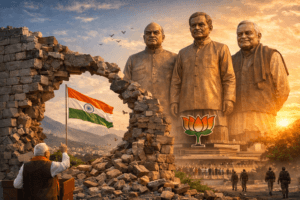
Prime Minister Narendra Modi’s declaration in Lucknow that the BJP is “proud to have torn down the wall of Article 370” was more than a retrospective comment on a historic parliamentary move. Made at the inauguration of the Rashtra Prerna Sthal—a memorial to BJP stalwarts Atal Bihari Vajpayee, Syama Prasad Mookerjee, and Deendayal Upadhyaya—the statement wove together threads of constitutional change, political legacy, and ideological vision. This confluence offers a profound insight into the current Indian political narrative, one that extends far beyond the legalistic dimensions of Article 370’s abrogation.
The “Wall” Metaphor: Constitutional Change as National Unification
By framing Article 370 as a “wall,” PM Modi employed a powerful spatial and emotional metaphor. In the government’s narrative, this was not merely a temporary provision of the Constitution, but a physical and psychological barrier that fostered separatism, hindered integration, and allowed corruption and dynastic politics to flourish in Jammu & Kashmir. The act of “tearing it down” is portrayed as an act of national reintegration, removing an anomaly that contradicted the principle of “Ek Bharat, Shreshtha Bharat” (One India, Superior India).
The historical weight of this claim is significant. The provision, which granted J&K special autonomy, had been a cornerstone of the region’s relationship with the Union since 1947. Its revocation in August 2019, followed by the bifurcation of the state into two Union Territories, was arguably the most consequential domestic policy decision of Modi’s first term. Revisiting it now serves a dual purpose: it reaffirms the government’s commitment to a majoritarian interpretation of national unity and positions it as a decisive break from what the BJP terms the “appeasement and indecision” of previous Congress-led governments.
Rashtra Prerna Sthal: Cementing an Ideological Pantheon
The setting for this remark was equally charged with meaning. The Rashtra Prerna Sthal is not just a park; it is a physical manifestation of the BJP’s ideological genealogy. The 65-foot bronze statues of Mookerjee (founder of the Jana Sangh, BJP’s predecessor), Upadhyaya (proponent of Antyodaya, or upliftment of the last person), and Vajpayee (the moderate face who first brought the party to national power) represent a curated lineage.
By invoking Article 370 here, Modi directly linked his government’s most assertive action to this legacy. Syama Prasad Mookerjee’s famous cry—“Ek desh mein do Vidhan, do Pradhan, do Nishan nahi chalenge” (One country cannot have two constitutions, two prime ministers, two flags)—was used for decades as the ideological precursor to the move against Article 370. The memorial, thus, becomes a site where the promise of the ideological ancestors is presented as fulfilled by the current leadership.
The Contrast: “Single Family” vs. “Antyodaya” Mission
Modi’s sharp dig about a “tendency… to attribute every positive achievement to a single family” is a staple of his political rhetoric, contrasting the BJP’s ideologically-driven project with the Congress’s dynastic politics. However, at this event, it served a specific purpose. It framed the abrogation of Article 370 and the expansion of social security (from 25 crore to 95 crore beneficiaries, as he cited) as achievements of a philosophy, not of a person or family.
This is where the invocation of Deendayal Upadhyaya’s Antyodaya becomes crucial. By marrying a hardline nationalistic move (Article 370) with a welfarist mission (social security for the poorest), the government crafts a holistic narrative. It claims to safeguard national integrity while simultaneously ensuring the fruits of development reach the last person—without discrimination. This dual appeal seeks to unite security-conscious and development-seeking voters under one banner.
The Uttar Pradesh Context: Defense Corridors and Political Grounding
The speech’s location in Lucknow, Uttar Pradesh—India’s most politically significant state—and the mention of the UP Defense Corridor were not incidental. It signified the translation of national policy into regional economic opportunity. The message was clear: decisive national action (like repealing Article 370) creates stability that fosters investment and job creation, even in a heartland state thousands of kilometers from Kashmir. It’s an attempt to make a remote, constitutional change personally relevant to a local audience, promising tangible economic benefits from a fortified national security posture.
The Unspoken Layers and Ongoing Questions
While the event celebrated a “wall” torn down, it silently acknowledged the complex realities that persist. The restoration of statehood to Jammu & Kashmir, promised by the Home Minister, remains a pending question. The region has seen a significant transformation in its administrative and political landscape, with new electoral processes underway, but normalcy and integration are journeys, not single events. The memorialization of the act in Lucknow shifts the discourse from the ongoing challenges on the ground in Kashmir to the domain of national symbolism and ideological victory.
Conclusion: A Narrative of Irreversible Change
PM Modi’s Lucknow speech was a masterclass in political storytelling. It connected a potent legal-constitutional act to a physical site of ideological reverence, tied it to a philosophy of inclusive welfare, and contrasted it with the political past. The “wall of Article 370” is presented as a relic of a bygone era of fragmented thinking, now replaced by a vision of unified, purpose-driven governance championed by the BJP’s foundational figures.
For the Indian electorate, and particularly for the BJP’s base, this narrative reinforces a sense of decisive, transformative action. It suggests that the government is not just administering the country but actively reshaping its historical and constitutional fabric to align with a long-held ideological vision. Whether one views the repeal of Article 370 as a necessary correction or a contentious overreach, its commemoration at the Rashtra Prerna Sthal marks its definitive entry into the pantheon of the ruling party’s defining legacies—a “wall” torn down, both in law and, now, in political memory.
You must be logged in to post a comment.