
Beyond the Headline: Decoding Microsoft’s $17.5 Billion Bet on India’s AI Future
Beyond the Headline: Decoding Microsoft’s $17.5 Billion Bet on India’s AI Future
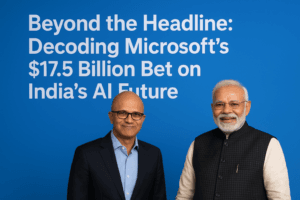
When Satya Nadella, the CEO of Microsoft, stood beside Prime Minister Narendra Modi this week, the image was more than a routine corporate-photo-op. It was a visual testament to a profound strategic alignment. Nadella’s announcement of a historic $17.5 billion investment in India—Microsoft’s largest ever in Asia—isn’t merely a financial transaction. It is a pivotal vote of confidence in India’s technological destiny and a calculated move that will reshape the global AI landscape. This commitment, spread from 2026 to 2029, moves beyond simple infrastructure to architect the very foundations of an “AI-first” nation.
The Scale of Ambition: More Than Money
At first glance, the figure is staggering. $17.5 billion is a sum that dwarfs many national tech budgets. However, to view it merely as capital expenditure is to miss the point. Microsoft’s statement clarifies that this investment will “advance the country’s cloud and AI infrastructure, skilling and ongoing operations.” This three-pronged approach reveals a sophisticated blueprint.
- Building the Physical Backbone: The centerpiece is the new “India South Central” cloud region in Hyderabad, set for mid-2026. Described as Microsoft’s largest hyperscale region in India, its size—analogous to two Eden Gardens stadiums—speaks to anticipated demand. This, alongside the expansion of existing regions in Chennai, Hyderabad, and Pune, directly addresses a critical need: data sovereignty and low-latency access. For Indian businesses, startups, and government entities, the ability to process and store sensitive data within national borders, rapidly and securely, is a game-changer for deploying AI at scale.
- Fueling the Human Engine: Infrastructure is useless without talent. A significant portion of this investment is earmarked for “skilling.” India’s demographic dividend—its vast, young population—is its greatest asset in the AI race. Microsoft’s initiative aims to transform this raw potential into a globally competitive workforce. This likely involves scaling up programs like its “AI Odyssey” and other certifications, embedding AI literacy into higher education, and fostering developer ecosystems. By investing in human capital, Microsoft is ensuring a steady pipeline of talent to not only use its platforms but to innovate on them.
- Empowering Sovereign Capabilities: Perhaps the most insightful term in Nadella’s announcement is “sovereign capabilities.” This goes beyond renting cloud space. It involves collaborating to build India-specific AI models—tools trained on local languages, contexts, and challenges—that can transform agriculture, healthcare, governance, and education. It’s about enabling India to create its own AI solutions for its unique problems, reducing dependency on foreign-developed technologies.
The Strategic Context: Why India, Why Now?
Nadella’s investment is a masterstroke in geopolitical and economic timing.
- The China+1 Calculus: Global corporations are diversifying their supply chains and strategic investments away from an over-reliance on China. India, with its stable democracy, strong digital public infrastructure (like Aadhaar and UPI), and English-speaking technical base, presents the most compelling alternative. Microsoft is placing a foundational bet on this shift.
- A Maturing Digital Economy: India is no longer just a back-office hub; it’s a burgeoning market of digital natives. With over 700 million internet users and a government aggressively pushing digitalization, the demand for cloud and AI services is exploding. Microsoft is building capacity ahead of the curve.
- The Global AI Arms Race: The United States and China are locked in a contest for AI supremacy. India represents a crucial third pole—a massive, neutral market where technological standards of the future could be set. By embedding its Azure and AI stack deep within India’s economy, Microsoft is positioning its technology as the default standard for the nation’s growth.
- The Domestic Giants’ Rush: Microsoft is not alone. Google’s $15 billion commitment for an AI hub in Visakhapatnam and Amazon Web Services’ ongoing investments highlight a consensus among tech titans. As per CBRE, data center investment in India is projected to cross $100 billion by 2027. This is a land-grab moment for cloud market share, and Microsoft is making a decisive move to lead.
The Ripple Effects: Economy, Innovation, and Global Stature
The implications of this investment will reverberate far beyond Microsoft’s balance sheet.
- Supercharging the Startup Ecosystem: Reliable, scalable, and advanced AI infrastructure within the country will be a turbocharger for Indian startups. It lowers the barrier to entry for building compute-intensive AI applications, from generative AI ventures to climate modeling startups. Hyderabad, Chennai, and Pune will see reinforced status as major tech corridors.
- Transforming Public Service Delivery: The leap from “digital public infrastructure to AI public infrastructure,” as Microsoft notes, is key. Imagine AI-enhanced predictive services for farmers, personalized learning tools accessible in regional languages, or intelligent healthcare diagnostics in remote clinics. Microsoft’s partnership could accelerate the government’s ability to deliver these citizen-centric services.
- The Employment Multiplier: While AI sparks fears of job displacement, this investment is fundamentally job-creating. The construction and operation of massive data centers require thousands of engineers, technicians, and security personnel. The skilling initiatives will create a new genre of AI trainers, ethicists, and solution architects. Microsoft’s existing 22,000-strong India workforce, engaged in cutting-edge product engineering and model development, is also set to expand.
- Elevating India’s Global Tech Profile: This investment solidifies India’s position not just as a consumer of technology, but as a co-creator and leader. PM Modi’s vision of making India a “Viksit Bharat” (Developed India) by 2047 gets a substantial technological pillar. The world will now look to India not only for IT services but for groundbreaking AI innovation born out of its unique scale and challenges.
Challenges and the Road Ahead
The path is not without hurdles. The success of this grand vision will depend on consistent policy support, reliable power and water resources for massive data centers, and a continued focus on bridging the digital divide to ensure AI’s benefits are equitable. There are also crucial conversations to be had about AI ethics, bias, and regulation that must run parallel to this infrastructural sprint.
Conclusion: A Partnership Defining a Decade
Satya Nadella’s $17.5 billion commitment to India is more than corporate news. It is a strategic compact between a global tech leader and an aspiring superpower. It marks the moment India’s AI ambition received the infrastructure, validation, and partnership to transition from aspiration to architecture.
This investment isn’t about Microsoft building a closed garden; it’s about helping to cultivate an entire ecosystem. As Nadella and Modi’s meeting symbolizes, it is a fusion of visionary leadership from both the corporate and political spheres. The coming decade will see this capital transform into cloud capacity, skilled talent, and homegrown AI solutions. In doing so, it won’t just shape India’s future—it will play a definitive role in shaping how the world harnesses the power of artificial intelligence.
You must be logged in to post a comment.