
Beyond the Headline Count: The Targeted Silencing of Gaza’s Journalists and the Unraveling of Truth
Beyond the Headline Count: The Targeted Silencing of Gaza’s Journalists and the Unraveling of Truth
The news alert is grimly familiar: “At least 11 Palestinian civilians killed in Israeli strikes across Gaza.” The date changes, the number fluctuates, but the stark, numerical headline remains a constant in the seven-month shadow since the last major ceasefire. On January 21, 2026, the dispatch from WAFA, the Palestinian news agency, carried a particular, devastating weight within its statistical brevity. Among the eleven, it noted, were three journalists, killed when their vehicle was targeted in central Gaza.
To the outside world, this is another tragic datum in a long ledger of loss. But within Gaza, and for anyone committed to the preservation of truth in conflict, this single strike represents something far more sinister: a deliberate erosion of the world’s window into the siege, a direct attack on the very process of documenting reality. The deaths of these three journalists—their names and stories often lost in the broader casualty count—are not collateral damage; they are the focal point of a strategy that understands the power of the narrative.
The Unseen Story Behind the Statistic
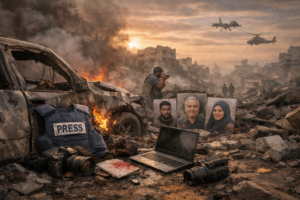
Imagine for a moment the scene omitted from the brief. It is not just a vehicle that is struck. It is a mobile newsroom. Inside are not only three individuals with families, dreams, and fears, but also cameras, memory cards, laptops filled with unpublished footage and interviews—the raw, unvarnished material of history. They might have been en route to cover the aftermath of an earlier strike that claimed the seven lives in central Gaza mentioned in the same report. Their mission: to translate the abstract number “seven” into human stories—the destroyed home, the bereaved father, the orphaned child.
Their work is an act of profound courage. In Gaza, journalism is not a profession chosen for prestige or profit. It is a vocation of witnessing, undertaken with the full knowledge that the press vest and the camera lens are not shields but often beacons for targeting. Since the resurgence of violence post-October, the Committee to Protect Journalists (CPJ) has documented a harrowing pattern: journalists killed, media offices raided, communication networks jammed. Each incident shrinks the spectrum of verified information, leaving a vacuum increasingly filled by propaganda, rumor, and algorithmic amplification from all sides.
A Historical Pattern in a Modern Battlefield
The targeting of journalists in conflict zones is, tragically, not new. From the murders of Marie Colvin in Syria to the countless local reporters killed in Iraq, Yemen, and Ukraine, it represents the oldest play in the authoritarian playbook: if you cannot control the story, eliminate the storytellers. In Gaza, however, this tactic is applied with technological precision and within a uniquely dense information ecosystem.
Israel’s military frequently states it does not target civilians or journalists, asserting that those killed in such strikes were in proximity to militant activity. Yet, the repeated nature of these incidents—the CPJ reports that Palestinian journalists have constituted a disproportionately high percentage of media casualties globally for years—points to a systemic failure of precaution, at best, or a policy of intimidation, at worst. International humanitarian law is clear: journalists are civilians and must be protected as such. Their equipment and vehicles are civilian objects. Knowing their presence and striking them regardless constitutes a potential war crime, a point emphasized by the AFP’s call for a “thorough investigation” into the assassination of its reporter, a separate incident mentioned in the broader news feed.
The killing of these three in central Gaza sends a chilling message to every remaining reporter in the Strip: your credibility, your press pass, your purpose makes you a target. This creates a secondary, invisible casualty—the story that goes untold. How many strikes, how many infant deaths from the severe cold (as another item in the feed notes), how many scenes of sheer deprivation remain confined to survivor testimony because no camera crew can safely navigate the rubble?
The Ceasefire That Never Was: 1,820 Lives in 1,300 Violations
The WAFA report concludes with a crucial, contextual sentence that deserves its own deep analysis: “Since the ceasefire in October, 1,820 Palestinians have been killed or wounded in 1,300 violations of the agreement committed by Israel.”
This figure reframes everything. It reveals the October “ceasefire” not as a peace but as a shift in the scale of violence—from a raging fire to a deadly, persistent smolder. It translates to an average of over three violations per day, each a potential raid, arrest, demolition, or strike like the one on January 21. The human cost is not 11 lives on a Wednesday; it is a rolling, unrelenting trauma of 1,820 souls over three months.
This constant, low-intensity conflict serves a strategic purpose. It prevents societal recovery, maintains a state of perpetual fear and instability, and normalizes the emergency. The parallel news items from the same day paint the comprehensive picture: house demolitions in Jericho, colonist assaults near Salfit, raids in Nablus and east of Jerusalem. Gaza’s agony is not isolated; it is the most intense bleeding from a body under sustained attack across all its limbs.
The Infant in the Cold and the Youth in the Crossfire: The Value of a Life
To truly understand the value of the journalism under attack, one must consider the stories these journalists die trying to tell. The “infant dies from severe cold” is not just a weather report. It is a story of a blockade that prevents adequate shelter and heating fuel, of hospitals destroyed or crippled by power cuts, of a parent’s unbearable choice between warmth and food. The “Palestinian youth killed in Israeli gunfire” is a story of patrols, incursions, and a generation coming of age under the constant shadow of instant, arbitrary death.
A journalist’s job is to connect these dots—to show how the policy of siege, the strategy of targeted strikes, and the tolerance of settler violence create a closed ecosystem of despair. Without their work, each death becomes a disconnected, inevitable statistic, easily dismissed by partisans as “unfortunate collateral” or “terrorist propaganda.”
The Path Forward: Witnessing as an Act of Defiance
In the face of this targeted silencing, the international community’s response—often limited to expressions of “concern”—is grossly inadequate. Concrete action is required:
- Demand Independent Investigations: Every journalist killing must be met with an immediate, transparent, and international investigation, not an internal military review that routinely exonerates its own forces.
- Enforce Protective Measures: States that supply military aid must leverage their influence to demand and verify adherence to protocols that protect journalists, using mechanisms like the UN Plan of Action on the Safety of Journalists.
- Support Independent Journalism: Funding and technologically securing the work of local reporters is a humanitarian and democratic imperative. They are the first drafters of this history.
- Listen to the Witnesses: As readers and consumers of news, we must actively seek out and lend credibility to the reports coming from journalists on the ground, recognizing the immense risk they take to deliver the truth.
The three journalists killed on January 21, 2026, join a long and growing martyrology of truth-tellers. Their final story is their own death, a meta-narrative about the cost of speaking fact to power in the dark. To honor them, we must look beyond the headline count of “eleven.” We must see the specific, targeted extinguishing of three lights meant to guide us through the fog of war. We must recognize that when the witnesses are systematically eliminated, the world is not just losing reporters; it is losing its conscience, its accountability, and ultimately, its capacity to ever find a just and lasting peace. The real war is not just for land, but for memory itself. And in that war, every journalist in Gaza is on the front line.
You must be logged in to post a comment.