
Beyond the Headline Count: Gaza’s Shujayea Incident and the Crumbling Ceasefire
The reported killing of two Palestinian civilians in Gaza City’s Shujayea neighborhood on December 22, 2025, exemplifies the severe fragility of the nominal U.S.-brokered ceasefire, as this single incident contributes to a post-truce toll of over 400 fatalities amid hundreds of reported Israeli violations that have also critically hindered the delivery of lifesaving aid. This ongoing violence occurs within the context of a catastrophic humanitarian crisis, where a decimated healthcare system, widespread starvation, and winter storms are claiming lives daily, pushing a total death toll that has surpassed 70,000 since the war’s start in October 2023. The situation threatens regional escalation, evidenced by cross-border strikes with Hezbollah, underscoring that without a durable political solution addressing the root causes of the conflict, these cycles of violence and profound human suffering will inevitably continue.
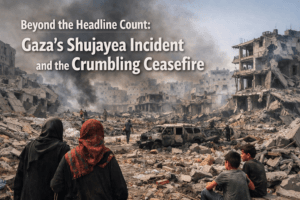
Beyond the Headline Count: Gaza’s Shujayea Incident and the Crumbling Ceasefire
In eastern Gaza City’s Shujayea neighborhood, the killing of two Palestinians on December 22, 2025, was more than another tragic statistic. It was a stark indicator of a ceasefire agreement that exists more in name than in practice, unraveling amidst ongoing violence and a spiraling humanitarian crisis that continues to claim lives daily.
This incident, where the victims were reportedly shot while trying to return to their homes, brings the recorded death toll in Gaza to a staggering 70,937 since the war began in October 2023, with over 171,000 injured. More immediately, it underscores a terrifying reality for civilians: even during a nominal truce, danger is constant, aid is blocked, and the path to recovery is shattered.
A Ceasefire in Name Only: Mounting Violations and Unmet Promises
The U.S.-brokered ceasefire between Israel and Hamas, which took effect on October 10, 2025, was designed to halt the bloodshed and facilitate a massive influx of humanitarian aid. However, reports from the ground paint a picture of systematic failure.
According to Gaza’s Government Media Office, Israeli forces had committed 875 violations of the ceasefire as of December 22. These are not minor infringements but include continued air and artillery strikes, the demolition of homes, and hundreds of incidents of troops firing on Palestinian civilians. The human cost of these violations is precise and devastating: at least 405 to 411 Palestinians killed and over 1,110 wounded since the ceasefire began.
Aid delivery, a cornerstone of the agreement, has also failed catastrophically. Israel agreed to allow 600 aid trucks into Gaza daily. The reality has been an average of just 244 trucks per day. This drastic shortfall means that of the 43,800 trucks supposed to enter Gaza during the ceasefire, only 17,819 have made it through. The UN has repeatedly called for the lifting of all restrictions on aid, warning that the current trickle is insufficient to address the monumental needs of a displaced and starving population.
The following table summarizes the stark contrast between the ceasefire agreement and the reality on the ground:
| Ceasefire Provision (From Oct 10, 2025) | Agreement | Reality as of Dec 22, 2025 | Source |
| Daily Humanitarian Aid Trucks | 600 trucks | 244 trucks (average) | |
| Total Aid Trucks (73-day period) | 43,800 trucks | 17,819 trucks | |
| Reported Ceasefire Violations | 0 | 875 violations | |
| Palestinian Fatalities Post-Ceasefire | 0 | 405 – 411 killed | |
| Palestinian Injuries Post-Ceasefire | 0 | 1,112 – 1,115 injured |
The Unfolding Humanitarian Catastrophe: Winter, Disease, and Collapsed Systems
Beyond the immediate violence, Gaza’s 2.3 million people are trapped in a man-made humanitarian disaster that worsens by the day. The recent winter storms have pummeled the coastal strip, flooding makeshift tents and soaking the belongings of hundreds of thousands of displaced families. Israel’s blockade has prevented adequate supplies of tents, blankets, and winter clothing from entering, a policy rights groups argue is part of a broader, devastating strategy.
The collapse of Gaza’s health system is particularly alarming. The UN reports that 94% of Gaza’s hospitals have been damaged or destroyed. This decimation has had a horrific impact on the most vulnerable:
- Maternal and Newborn Health: By late 2024, women in Gaza were three times more likely to die in childbirth and three times more likely to miscarry compared to pre-war levels. Newborn deaths have surged.
- Targeted Destruction: Israeli strikes have hit maternity wards and neonatal intensive care units. A single shelling of Gaza’s largest fertility clinic in December 2023 destroyed over 4,000 embryos and 1,000 sperm and egg specimens, obliterating future hopes for countless families.
- Medical Personnel Under Fire: At least 1,722 healthcare workers have been killed, with doctors recounting being chased through hospital corridors by quadcopters.
Malnutrition is rampant. As of October 2025, 463 Palestinians, including 157 children, had died from starvation. In just the first two weeks of December 2025, aid groups admitted at least 2,407 children for acute malnutrition treatment. UNICEF workers describe children living in soaking-wet tents, with poor hygiene and a collapsed sanitation system creating a perfect storm for deadly disease outbreaks like acute watery diarrhea.
A Conflict of Decades: Understanding the Roots of the Current War
The war that erupted on October 7, 2023, did not happen in a vacuum. It is the most violent eruption in a conflict spanning over seven decades.
- 1948 & 1967: The establishment of Israel in 1948 (the Nakba or “catastrophe” for Palestinians) and the 1967 Six-Day War, in which Israel occupied the West Bank, Gaza Strip, and East Jerusalem, are foundational events.
- Rise of Hamas: Hamas won Palestinian parliamentary elections in 2006 and violently seized control of Gaza from the Fatah-led Palestinian Authority in 2007. Israel and Egypt imposed a blockade on the territory, which has been in place ever since.
- Cycles of Violence: The years between 2007 and 2023 saw repeated, devastating flare-ups, including major Israeli military operations in Gaza in 2008-09, 2012, 2014, and 2021.
- October 7, 2023: Hamas’s surprise attack into southern Israel killed approximately 1,139 Israelis, with hundreds taken hostage. Israel declared war, vowing to dismantle Hamas, and launched a full-scale invasion of Gaza.
The current phase of the conflict has been the deadliest by an enormous margin. The timeline below outlines key escalations since the war began:
Regional Tinderbox: Escalation Beyond Gaza’s Borders
The war has repeatedly threatened to ignite a wider regional conflict. Most notably, fighting has flared along Israel’s northern border with Lebanon, where the Iranian-backed Hezbollah group has traded fire with Israeli forces in solidarity with Hamas.
This front has seen its own serious ceasefire violations. A U.S.-brokered truce between Israel and Hezbollah, reached in November 2024, has also been strained. In late October 2025, Israeli airstrikes in eastern and southern Lebanon killed at least four people. The conflict escalated significantly in November 2025 when Israel conducted its first airstrike in Beirut since June, targeting and killing Hezbollah’s de facto chief of staff, Haitham Ali Tabatabai. Hezbollah vowed that “the resistance alone… will determine how and when to respond”, highlighting the persistent risk of a broader war.
Conclusion: A Crisis Demanding More Than Temporary Pauses
The deaths of two civilians in Shujayea are a microcosm of Gaza’s macro-tragedy. They occurred under a ceasefire that has failed to stop the violence, failed to deliver lifesaving aid, and failed to protect the most vulnerable. The crumbling truce reveals a simple, brutal truth: without a durable political solution that addresses the root causes of the conflict—including the occupation, the blockade, and the rights and security of both Palestinians and Israelis—the cycles of violence will continue.
The people of Gaza are not just caught in the crossfire of a military campaign; they are besieged by a collapsed healthcare system, engineered famine, and a winter they are ill-equipped to survive. The international community’s calls for aid access and civilian protection must be met with tangible pressure and action. Otherwise, the headline from Shujayea will be rewritten again tomorrow, with only the names changed.
You must be logged in to post a comment.