
Beyond the Headline: A Day of Loss and Strangulation in Palestine
The news from February 23, 2026, paints a multifaceted picture of life under occupation, where drone strikes in Gaza have raised the death toll since the October ceasefire to 614, while the West Bank endures a relentless campaign of military raids causing suffocation and injury, systematic settler violence that includes burning mosques and uprooting thousands of olive trees to displace communities, and the deteriorating health of journalist Mujahed Bani Mufleh—who suffered a brain hemorrhage after having medication withheld in Israeli detention—exposes the brutal conditions inside prisons, all compounded by a 15% increase in the trade deficit that reveals deep economic dependency on Israel, demonstrating that these are not isolated incidents but a coordinated reality of violence, displacement, and strangulation designed to fragment Palestinian existence.
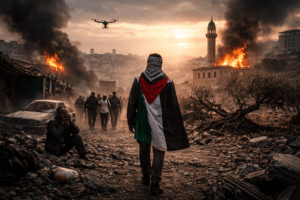
Beyond the Headline: A Day of Loss and Strangulation in Palestine
By [Your Name/WAFA Contributor] February 23, 2026
The news feed from Palestine on any given day is a dense tapestry of tragedy, resilience, and bureaucratic attrition. Monday, February 23, 2026, is no different. While the world’s attention flits from one crisis to the next, the people of the West Bank and Gaza Strip endure a constant, grinding reality. The latest dispatch from WAFA paints a stark picture: drone strikes in Gaza claiming more lives, raids in Hebron and Tulkarm, uprooted olive trees near Ramallah, and a burning mosque near Nablus. But behind these bullet points lie human stories of immense suffering and a systematic erosion of hope.
This report delves deeper than the headlines, weaving together the events of the past 48 hours to illustrate the multifaceted nature of the occupation—from the daily threat of violence in Gaza to the slow-motion strangulation of communities in the West Bank.
The Unending Toll: Two More Names in Gaza
In the southern Gaza Strip, the concept of a “ceasefire” has become a bitter irony. On Saturday, the cycle of violence continued its relentless churn. Medical sources confirmed that two Palestinians were killed in Israeli drone strikes, one targeting Jabalia refugee camp in the north and the other in the Qizan Al-Najjar area south of Khan Yunis .
These are not just numbers. According to Gaza’s health authorities, they represent a grim milestone: the total number of Palestinians killed since the ceasefire began on October 11 has now risen to 614, with another 1,640 wounded. Furthermore, 726 bodies have been recovered from the rubble . Since the conflict’s escalation in October 2023, the overall death toll in Gaza has surpassed a staggering 72,000 .
The term “drone strike” often feels clinical, sanitized. To understand its impact, one must imagine the constant buzz in the sky, the sudden silence before a blast, and the aftermath of collecting fragments of a life. These strikes are not always aimed at military targets. A report from just a week prior detailed how an airstrike hit a tent sheltering displaced people in Jabalia . These are families who have already fled their homes, seeking safety in flimsy canvas structures, only to find that nowhere is safe. The Israeli military frames these actions as responses to “violations of the ceasefire” or threats from armed groups, but for the residents of Gaza, it is a perpetual state of emergency where death can arrive from the sky at any moment .
The West Bank: A Landscape Under Siege
While Gaza endures the acute trauma of bombs, the West Bank is subjected to a chronic, daily assault on its existence. Monday’s briefs highlight several key tactics in this campaign: military raids, settler violence, and economic warfare.
Night Raids and Suffocation
Just last night, the town of Dura, west of Hebron, was subjected to an Israeli raid that caused multiple cases of suffocation among residents due to tear gas. This morning, Israeli forces pushed into the Iktaba suburb east of Tulkarm. These are not isolated incidents but part of a broader, relentless military campaign.
Data from the Colonization and Wall Resistance Commission reveals the sheer scale of this aggression. In January alone, Israeli occupation forces carried out 1,404 attacks across the West Bank . This includes near-nightly arrest campaigns. On Sunday and Monday, at least 18 Palestinians were detained in raids across Hebron, Jenin, Ramallah, Nablus, and Bethlehem . In the town of Ya’bad, south of Jenin, a wedding hall was reportedly converted into a field interrogation center, turning a place of joy into a symbol of subjugation .
In Al-Bireh, a young man was shot in the head with a rubber bullet, a weapon that, despite its name, causes devastating injuries when fired at close range . The International Committee of the Red Crescent has been dealing with these exact cases, treating suffocation from gas and wounds from live fire as routine occupational hazards.
The Quiet Terror of Settler Violence
Perhaps the most effective tool of displacement is the violence perpetrated by Israeli settlers. Monday’s news includes a report of colonists setting fire to a mosque near Nablus and uprooting olive trees near Ramallah. These acts are often dismissed as “price tag” attacks by extremists, but data shows they are a systematic, widespread phenomenon.
In January alone, settlers carried out 468 attacks. These violations included physical assaults, the burning of agricultural crops, and the uprooting or poisoning of 1,245 olive trees . Just last week, a wave of settler attacks left 54 Palestinians wounded across the West Bank. In the village of Talfit, south of Nablus, settlers assaulted farmers on their land while Israeli troops provided cover, firing tear gas at residents who tried to defend their property .
The olive tree is more than a crop; it is a deed to the land, a heritage passed down through generations. To uproot an olive tree is to erase a family’s history and future. This violence has a tangible goal: displacement. The attacks in January alone led to the forcible displacement of 125 Palestinian families, including the complete eviction of the Shallal al-Auja community . In the Jordan Valley, a microcosm of this conflict, settlers attacked shepherds, and when the Palestinians defended their livestock, they were arrested by the army . The message is clear: Palestinians cannot rely on the law for protection.
A Different Kind of Casualty: The Health of Journalist Mujahed Bani Mufleh
Amid the reports of new deaths and demolitions, the Journalists’ Syndicate issued a grave warning about the deteriorating health of journalist Mujahed Bani Mufleh. His case, from just over a month ago, serves as a harrowing insight into the conditions inside Israeli prisons.
Mufleh, a journalist from Beita near Nablus, was released from detention only to suffer a brain hemorrhage two days later . His relative, Wahaj Bani Mufleh, described a chilling ordeal. Suffering from diabetes and high blood pressure, Mufleh had his medication withheld for an extended period during detention. Subsequently, the prison administration reportedly gave him various medications, some of which were inappropriate for his condition .
The physical trauma was equally severe. Witnesses noted that Mufleh was limping upon his release, a sign of violent beatings. His hands were weakened from being bound too tightly in handcuffs and leg irons . The Palestinian Prisoners’ Media Office stated that the combination of withheld and mismanaged treatment exacerbated his hypertension, leading to severe headaches, dizziness, and ultimately, a brain hemorrhage . His story is a testament to the fact that the occupation’s victims extend far beyond the battlefield; they include those who survive the prisons, only to carry the scars and wounds home with them.
The Invisible War: Economic Strangulation
Violence is not the only metric of suffering. The occupation also wages an invisible war on the Palestinian economy. A recent report from the Palestinian Central Bureau of Statistics (PCBS) highlighted a staggering 15% increase in the trade balance deficit . While Monday’s news brief mentioned this figure, a look at the broader economic data reveals a deepening dependency that cripples Palestinian sovereignty.
In November 2025, while exports saw a 30% increase year-over-year, imports surged by 39%, reaching $703.8 million. The vast majority of this trade—87% of exports and 58% of imports—is tied to Israel . This is not free trade; it is the economy of an occupied territory. Israel controls the borders, the ports, and the registry of goods. This dependency means that any Israeli policy decision—a lockdown, a strike, a bureaucratic delay at a checkpoint—can instantly choke the Palestinian economy. The increased deficit signifies that money is flowing out of Palestine faster than it enters, funded by aid or debt, creating a cycle of economic vulnerability that reinforces political control .
Conclusion: A Coordinated Reality
The news from February 23, 2026, should not be read as a collection of disparate events. The drone strike in Gaza, the settler burning a mosque near Nablus, the soldier raiding a home in Hebron, the prison guard withholding medicine from a diabetic journalist, and the customs officer blocking a shipment of goods are all cogs in the same machine.
This is a coordinated reality designed to fragment Palestinian life. In Gaza, it is a siege punctuated by death. In the West Bank, it is a slow-motion annexation through violence, laws, and land theft. As the UN human rights chief recently warned, the world is witnessing “rapid steps to change permanently the demography of the occupied Palestinian territory, stripping its people of their lands and forcing them to leave” .
For the international community, the challenge is to see past the familiar headlines and recognize the cumulative weight of these daily violations. Behind every statistic—the 614 dead since the ceasefire, the 468 settler attacks, the 15% deficit increase—is a human being whose life has been shortened, shattered, or stifled. Until the world moves beyond condemnation and towards accountability, Monday’s news will tragically repeat itself, Tuesday after Tuesday.
You must be logged in to post a comment.