
Beyond the Harvest: How India’s Policy Push at Convergence Expo 2026 is Rewiring Agriculture for Global Dominance
The feature article expands on the 33rd Convergence India Expo’s central theme: India’s agricultural future hinges on shifting from sheer output to value creation through technology and processing. Union Minister Chirag Paswan emphasized the need for a collaborative ecosystem that leverages innovation and startups to make Indian goods globally competitive, moving beyond volume-centric policies. Abhishek Singh of the India AI Mission reinforced this by positioning AI inferencing as a tool to revolutionize quality control, logistics, and market access, all underpinned by robust Digital Public Infrastructure. The showcase of global tech leaders like Qualcomm, Tesla, and Google Cloud highlighted the convergence of hardware, connectivity, and enterprise solutions that can modernize the sector. However, the analysis notes that realizing this vision requires overcoming challenges such as infrastructure gaps, high compliance costs for MSMEs, and ensuring equitable data governance, but the overall trajectory points toward India capturing greater value within its agricultural supply chain.
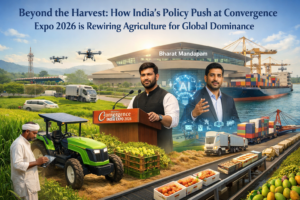
Beyond the Harvest: How India’s Policy Push at Convergence Expo 2026 is Rewiring Agriculture for Global Dominance
As the 33rd Convergence India Expo kicked off at Bharat Mandapam, the narrative shifted from simply feeding the nation to dominating global food supply chains. In a significant departure from the traditional agrarian discourse, the spotlight was firmly on a singular thesis: India’s agricultural future lies not in how much it produces, but in how intelligently it processes, packages, and presents it to the world.
On March 25, 2026, the bustling floors of Bharat Mandapam witnessed a convergence of policy, technology, and industry, setting the tone for what could be a transformative decade for the country’s food processing and agritech sectors. While the Expo showcased cutting-edge gadgets and AI models, the most significant signals came from the dais, where Union Minister for Food Processing Industries, Chirag Paswan, delivered a message that resonated beyond the hallways: the era of subsidized inefficiency is over; the era of value-driven, tech-enabled exports has begun.
The “Value over Volume” Pivot
For decades, Indian agricultural policy has been haunted by the specter of the farm gate—focusing heavily on minimum support prices (MSP) and bumper crop outputs. While this ensured food security, it often resulted in waste, fragmented supply chains, and farmers being price-takers rather than price-makers. Speaking at the Expo, Chirag Paswan articulated a nuanced shift in this paradigm.
“We are working towards creating an ecosystem where global markets become accessible for our goods,” Paswan stated, emphasizing that this ambition will be realized by “integrating technology, innovation, and the dynamism of our startups.”
This statement is more than political rhetoric; it signals a policy roadmap. The “ecosystem” Paswan referred to implies a move away from siloed operations. The insight here lies in the connectivity between government and ground reality. Paswan stressed that “on-ground insights from businesses are vital to shaping responsive policy reforms.” For industry insiders, this is a crucial admission. The food processing sector has long complained about the labyrinth of licensing, the classification of processed foods under high GST slabs, and the logistical nightmares of moving perishable goods across state borders.
What Paswan is proposing is a feedback loop. As India positions itself as the “food factory of the world,” policies are expected to become more agile—potentially simplifying export documentation for processed millets, creating special zones for mega food parks that utilize AI-driven logistics, and recalibrating tax structures to encourage private investment in cold chain infrastructure.
The AI Backbone of the Food Revolution
While Paswan laid out the vision for exports, Abhishek Singh, Additional Secretary at the Ministry of Electronics & IT and CEO of the India AI Mission, provided the engine for that vision: Artificial Intelligence.
Singh’s address was a masterclass in contextualizing technology for the masses. He highlighted India’s potential to become a global hub for AI inferencing—a term that goes beyond the hype of generative AI. Inferencing involves using pre-trained AI models to solve real-world problems with local data. In the context of agriculture and food processing, this is a game-changer.
Consider the journey of a mango from a farm in Uttar Pradesh to a supermarket shelf in Paris. Currently, this journey is riddled with inefficiencies. With AI-driven inferencing:
- Quality sorting that once required human eyes (and was prone to inconsistency) can be automated using computer vision, ensuring that only export-grade produce is processed, reducing rejection rates at foreign ports.
- Predictive logistics can optimize cold chain routes, predicting weather disruptions or port congestions, drastically reducing the 10-15% post-harvest loss that currently plagues the sector.
- Demand forecasting allows processors to know exactly what global markets will want—whether it’s gluten-free snacks or organic spice blends—months in advance, allowing for precision planting.
Singh’s emphasis on deploying AI “responsibly for inclusive and societal impact” is particularly pertinent. The fear of automation displacing labor is valid, especially in a country with a massive agrarian workforce. However, the Expo’s discussions suggested a different trajectory: one where AI augments human capability. For instance, smallholder farmers could use voice-based AI assistants (trained in local dialects) to get real-time price discovery or pest management advice without needing to read a complex manual.
The Convergence of Digital Infrastructure
The Convergence India Expo has always been a barometer for the country’s digital ambitions. This year, the subtext was clear: Digital Public Infrastructure (DPI) is no longer just about UPI payments; it is about creating a unified data fabric for the economy.
The conversations at the expo moved beyond simple digitization. They focused on the interoperability of systems—how a farmer’s land record (linked via the Digital India Land Records Modernization Programme) can seamlessly interface with a bank’s credit assessment algorithm, which then interfaces with a food processor’s supply chain management software.
The goal is to create a “plug-and-play” ecosystem. Imagine a small-scale spice processor in Kerala. With robust DPI, they can:
- Digitally verify the provenance of their turmeric using blockchain-like traceability.
- Access working capital instantly because the bank can see their digital transaction history and supply chain contracts.
- Book export logistics via a connected transport platform that optimizes for fuel efficiency and delivery time.
- List their products on global e-commerce platforms with pre-certified quality tags.
This is the convergence that the Expo highlighted—a future where hardware, software, policy, and infrastructure are no longer distinct lanes but a unified highway.
The Technology Showcase: From Silicon to Soil
The exhibition floor served as the physical manifestation of these policies. The presence of global tech giants like Qualcomm, Tesla, and Google Cloud (via Redington) alongside industrial specialists like Omnicomm and Escort Sensors signaled a maturation of the agritech space.
The Electric Vehicle (EV) and Mobility Link: Tesla’s participation, though often associated with luxury cars, has profound implications for agriculture. The conversation around “smart mobility” and “connected systems” at the expo touched upon the electrification of agricultural transport. With the push for interoperable transport ecosystems, we are likely to see EV tractors and refrigerated three-wheelers that are not just electric but are integrated with the IoT (Internet of Things), allowing real-time tracking of perishable goods.
The Edge of Connectivity: Qualcomm and Realtek’s presence underscores the need for edge computing and robust connectivity in rural areas. For AI to work in a grain silo or a remote sorting facility, you need chips that can process data on-site without relying on constant cloud connectivity. The showcase highlighted that the “chip” is becoming as essential to food security as the seed.
The Startup Synergy: Redington’s role in bringing together global OEMs with ecosystem partners is crucial. It bridges the gap between the scale of multinational corporations and the agility of Indian startups. For a food tech startup, accessing AWS’s cloud infrastructure or Microsoft’s AI tools through a localized partner reduces entry barriers. This synergy allows startups to move from pilot projects in a single district to scalable solutions that can handle pan-India or export-level volumes.
Addressing the Gaps: What the Expo Didn’t Say
While the vision articulated at the Expo was grand, a real human insight analysis must also acknowledge the challenges that lie beneath the surface.
Infrastructure Inequality: The push for tech-led transformation assumes a baseline of infrastructure—reliable electricity, high-speed internet, and logistical hubs. While India has made massive strides, the “last mile” in the Northeastern states or the remote Bundelkhand region still lags. For the vision of accessible global markets to be truly inclusive, the government’s BharatNet project and rural road development must keep pace with the aspirations articulated at Bharat Mandapam.
The Cost of Compliance: While Paswan spoke of industry insights shaping policy, the current reality for many MSMEs in food processing is the high cost of compliance with global standards. Technology can help, but the capital expenditure required for AI-driven quality testing labs or Global GAP (Good Agricultural Practices) certification is prohibitive for small players. There is a risk that the “tech-led transformation” might favor large conglomerates over the small-scale entrepreneurs who form the backbone of the sector, unless targeted subsidy schemes are aligned with this new tech vision.
Data Privacy and Farmer Rights: As the sector becomes increasingly data-driven, the question of data ownership becomes critical. If a farmer’s soil health data, crop yield data, and selling patterns are aggregated by large tech platforms or corporate processors, who owns that data? The “inclusive and societal impact” that Abhishek Singh mentioned will depend on how India drafts its data governance frameworks. If farmers are empowered with the data (data as an asset), the transformation will be revolutionary. If they become mere data points in a corporate algorithm, the rural divide could widen.
The Road Ahead: A $1 Trillion Opportunity?
The discussions at the 33rd Convergence India Expo occurred against a backdrop of shifting global supply chains. As geopolitical tensions force nations to look beyond traditional sources for food security, India is uniquely positioned to step up. The combination of a vast agricultural base, a young demographic skilled in digital technologies, and a government willing to use DPI as a tool for economic transformation creates a rare moment of convergence.
Chirag Paswan’s call for “value creation” is essentially a call to capture more value within India. Instead of exporting raw agricultural commodities (which account for a large portion of current agri-exports), the goal is to process them—turning wheat into pasta, fruits into concentrates, and spices into ready-to-cook blends. This not only increases the export value multiple times but also creates formal sector jobs in processing hubs, stemming the tide of rural-to-urban migration.
As the three-day expo continues, the takeaway is clear: India is not just looking to adopt technology; it is looking to architect a new economic reality. The convergence of AI, digital infrastructure, and progressive policy is laying the groundwork for a future where the Indian farmer is not just an annadata (food provider) for the nation, but a key supplier to the world. The path is fraught with challenges of infrastructure and equity, but if the energy at Bharat Mandapam is any indication, India’s agritech story is finally moving from the pages of policy documents to the reality of the factory floor and the global marketplace.
You must be logged in to post a comment.