
Beyond the Handshakes: Decoding the Strategic Earthquake of Putin’s India Visit
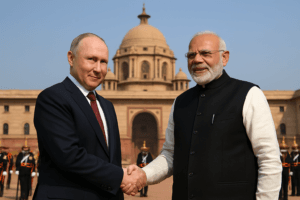
Beyond the Handshakes: Decoding the Strategic Earthquake of Putin’s India Visit
Russian President Vladimir Putin’s departure from New Delhi on December 5th, 2025, marked the end of a mere 48-hour visit, but its geopolitical aftershocks will resonate far longer. More than a routine diplomatic exchange, this 23rd India-Russia Annual Summit was a masterclass in nuanced, high-stakes statecraft. While headlines captured the ceremonial welcomes—the guard of honour at Rashtrapati Bhavan, the tribute at Rajghat, the state banquet—the true story unfolded in the subtle protocol breaks, the carefully chosen phrases, and the silent strategic calculus. This wasn’t just a meeting; it was a statement to the world.
The Unspoken Protocol: A Message in the Gestures
The first signal came even before the formal agenda began. Prime Minister Narendra Modi’s decision to personally welcome President Putin at Palam Airport, followed by a private dinner at his residence, 7 Lok Kalyan Marg, was a significant departure from standard diplomatic protocol. In the language of diplomacy, such gestures are deliberate. They signaled a relationship that operates on a tier beyond the transactional—a personal investment between leaders at a time when Russia faces intense international isolation.
This personal touch established the summit’s tenor: one of “Special and Privileged Strategic Partnership,” a phrase both leaders reiterated. PM Modi’s declaration that “trust is the biggest strength” was not mere rhetoric. It was a public affirmation of a ties that have endured for decades, subtly underscoring India’s independent foreign policy amidst Western pressure. Putin’s reciprocal praise for the “strong groundwork” highlighted a partnership moving with purpose, not nostalgia.
The Substantive Core: Building Bridges Beyond Defence
For years, the India-Russia relationship has been stereotyped as a buyer-seller defence dynamic. This summit aggressively worked to shatter that mold, pivoting towards a future-built on three key pillars:
- Trade & Economic Rebalancing: The elephant in the room was the lopsided trade balance, heavily skewed by India’s massive imports of Russian crude oil. The push here was for diversification. The spotlight on joint Electric Vehicle (EV) manufacturing is a visionary leap. It proposes marrying India’s booming market and production prowess with Russian technological expertise in critical minerals and heavy industry, aiming to create a new export corridor. Similarly, discussions on connectivity—likely revisiting the International North-South Transport Corridor (INSTC)—aim to de-bottleneck trade and reduce dependency on traditional, congested routes.
- Energy & High-Tech Frontiers: While oil remains a staple, the mention of civil-nuclear possibilities points to long-term energy security. Cooperation in this sector, including on advanced reactor designs and fuel cycle management, represents deep, irreversible technological partnership. Putin’s emphasis on “high technology” partnerships extends to sectors like space, cybersecurity, and artificial intelligence—realms where both nations seek sovereign capabilities away from Western-dominated ecosystems.
- The Defence Evolution: Defence cooperation was undoubtedly discussed, but the narrative evolved from hardware purchases to co-development and joint production. The focus is likely shifting towards next-generation systems—hypersonics, AI-driven platforms, and niche naval technologies—aligning with India’s “Make in India” and “Atmanirbhar Bharat” (self-reliant India) goals. This transforms Russia from a vendor to a partner in India’s indigenous defence industrial complex.
The Ukraine Elephant: A Delicate Diplomatic Dance
No analysis is complete without addressing Ukraine. Putin’s expression of hope for a “peaceful settlement” delivered from Indian soil was calculated. India, for its part, reiterated its consistent position in favour of dialogue and diplomacy. Notably, India did not join Western condemnations, nor did it offer unequivocal endorsement. This balancing act is the essence of India’s strategic autonomy. By providing a platform for a peace message without altering its own neutral stance, India reinforced its role as a potential diplomatic bridge, a voice of the Global South calling for resolution over escalation.
The Geopolitical Signal: A New Axis of Convenience?
The summit’s most profound outcome is symbolic. At a time when the G7 seeks to isolate Russia, India hosted its leader with conspicuous warmth and public fanfare. The launch of a new India-focused Russian state media channel further indicates a long-term intent to shape narratives and foster cultural-affective ties.
This does not spell a formal alliance against the West. Instead, it underscores the rise of a multipolar world order where nations pursue complex, overlapping interests. For India, Russia remains a crucial partner for energy security, strategic balance in Asia (especially vis-à-vis China), and a source of non-Western military technology. For Russia, India is an economic lifeline, a diplomatic legitimizer, and a gateway to the Global South.
Conclusion: More Than a Visit, a Waypoint
President Putin’s wrapped-up visit is a waypoint in an enduring relationship being meticulously retooled for the 21st century. It moved the dialogue from “what we have done” to “what we will build together.” The agreements on EV manufacturing, civil nuclear energy, and connectivity are seeds planted for a forest of interdependence that will take years to grow.
The world watched as two civilizational states, each navigating its unique challenges in a turbulent world, reaffirmed a partnership based on mutual respect and strategic necessity. The message was clear: in a fragmented global landscape, some bridges are not only maintained but are being reinforced with new cables of trade, technology, and trust. The silent diplomatic earthquake in New Delhi wasn’t about shaking the world order; it was about proving that its foundations are more multipolar than ever before.
You must be logged in to post a comment.