
Beyond the Handshakes: Decoding the Strategic Depth of the US Congressional Visit to India
In late January 2026, a rare bipartisan U.S. Congressional delegation, led by House Armed Services Committee leaders Mike Rogers and Adam Smith, concluded a significant visit to New Delhi, marking a deliberate deepening of the U.S.-India strategic defense partnership beyond rhetoric and into the realm of integrated industrial and technological collaboration. The high-level meetings focused on accelerating co-development and co-production of defense systems, directly supporting India’s “Make in India” modernization goals while shifting the relationship from a buyer-seller dynamic to one of shared innovation in areas like munitions, undersea awareness, and space. The unified bipartisan presence underscored enduring U.S. institutional commitment, aiming to align both nations’ defense industrial bases to bolster mutual security and create a more capable, interdependent partnership designed to enhance deterrence and stability across the Indo-Pacific region.
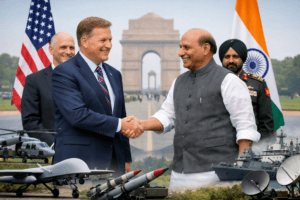
Beyond the Handshakes: Decoding the Strategic Depth of the US Congressional Visit to India
The recent five-day visit to New Delhi by a high-powered US Congressional delegation, led by House Armed Services Committee Chairman Mike Rogers and Ranking Member Adam Smith, was more than a routine diplomatic exchange. It was a potent signal, etched in bipartisan ink, of a strategic partnership maturing from shared interests into shared capabilities. While headlines capture the meetings and the mutual affirmations of a “Major Defence Partnership,” the true significance lies in the subtext: a conscious, concerted push to intertwine the defense industrial and technological futures of the world’s oldest and largest democracies.
The Bipartisan Imperative: A Rare Unifier in a Divided Washington
In an era of stark political polarization in Washington, the unified front presented by Rogers (Republican) and Smith (Democratic) is itself a statement of strategic clarity. The House Armed Services Committee is the engine room for US defense policy and spending. When its top leaders speak in unison on India, it translates Congressional intent into tangible budgetary and policy support. This bipartisan consensus effectively insulates the India defense relationship from the vagaries of electoral cycles, providing a stable foundation for long-term, complex initiatives that span decades, not just administrative terms. It signals to Indian counterparts that American commitment is institutional, not merely personal.
The Pivot from Buyer-Seller to Co-Creator
For decades, the defense relationship was largely transactional: India as a buyer of US platforms like the C-130J, P-8I, and Apache helicopters. The dialogue has now decisively shifted, as evidenced by the delegation’s focus on “co-development and co-production.” This is a direct response to India’s core strategic drivers: the “Make in India” initiative and its quest for strategic autonomy in defense manufacturing.
The discussions aimed to breathe life into existing frameworks like the Initiative on Critical and Emerging Technology (iCET) and the Roadmap for US-India Defense Industrial Cooperation. The goal is to move beyond assembling kits (ToT) to genuinely collaborating on designing, engineering, and manufacturing next-generation systems. Potential areas include:
- Advanced Munitions: Co-developing smart, precision-guided weapons.
- Intelligence, Surveillance, and Reconnaissance (ISR): Joint development of drones or sensor systems tailored for the diverse Indo-Pacific theater.
- Undersea Domain Awareness: A critical area in countering submarine threats, leveraging US technology and Indian geographical advantage.
- Cybersecurity and Space: Protecting critical infrastructure and ensuring secure space-based communications.
This shift benefits both nations. India gains access to cutting-edge technology, accelerates its defense modernization, and builds a more self-reliant industrial base. The US gains a more capable security partner, access to India’s innovative talent pool and cost-competitive manufacturing, and a strategic counterweight to an increasingly assertive China in the Indo-Pacific.
The Indo-Pacific Anchor: Shared Deterrence, Not Just Dialogue
The timing and location of the visit are inseparable from the broader geopolitical canvas. The “evolving regional security challenges” mentioned are a clear, though unstated, reference to China’s military expansionism and its destabilizing actions along its periphery. For the US, a strong, self-reliant India is a linchpin for a free, open, and balanced Indo-Pacific. For India, strategic collaboration with the US enhances its deterrence capability and provides a technological edge.
The delegation’s meetings, therefore, were as much about coordinating strategic assessments as they were about technology. When Chairman Rogers speaks of “enhancing regional stability,” it is code for building a networked deterrence where India’s strength in the Indian Ocean complements US presence in the Pacific. This requires not just interoperable equipment (which India already operates), but interoperable mindsets, shared situational awareness, and seamlessly integrated technology—all of which are nurtured through the deep industrial collaboration discussed.
The Road Ahead: Navigating the Challenges
The optimism, however, must be tempered with realism. Translating these high-level discussions into production lines and deployed systems involves navigating significant hurdles:
- The Bureaucratic Labyrinth: Both the US International Traffic in Arms Regulations (ITAR) and India’s own procurement bureaucracy are notoriously complex. Streamlining processes for collaborative projects is a monumental task.
- Intellectual Property (IP) Rights: Finding equitable IP sharing models that satisfy US commercial concerns and India’s desire for operational sovereignty and export potential remains a delicate negotiation.
- Private Sector Integration: True co-development requires deep partnerships between US primes (Lockheed Martin, Boeing, etc.) and Indian private giants (Tata, L&T, Mahindra) as equals, moving beyond the traditional government-to-government or prime-to-public-sector model.
The Congressional delegation’s engagement with industry leaders alongside government officials was a crucial step in addressing these very challenges from the ground up.
Conclusion: A Partnership Forged in the Digital Age
The January 2026 visit was not about announcing new flashy deals, but about solidifying the plumbing and wiring of the US-India defense relationship. It was a working visit focused on the unglamorous, yet vital, work of aligning standards, incentivizing private capital, and building trust at the human and industrial levels.
In essence, the message was clear: The United States and India are no longer just partners who agree on strategic ends; they are becoming partners who will jointly build the means to secure those ends. They are moving to create a shared technological language for defense. If successful, this collaboration will produce more than just advanced weapons; it will forge a resilient, innovation-driven alliance capable of upholding a balance of power in the 21st century’s defining theater. The handshakes in New Delhi were not just diplomatic formalities—they were the quiet beginning of a new, more profound chapter in strategic interdependence.
You must be logged in to post a comment.