
Beyond the Handshake: Unpacking the India-Israel Alliance as Modi Returns to Tel Aviv
Beyond the Handshake: Unpacking the India-Israel Alliance as Modi Returns to Tel Aviv
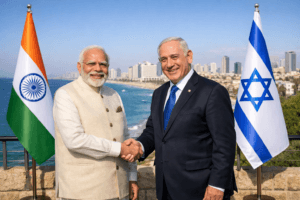
The photograph is carefully staged, as these things always are. Two leaders in tailored suits, hands clasped, smiles calibrated for history. Behind them, the Mediterranean gleams under the July sun. It could be any diplomatic photo op—except for the Hebrew caption looming above on a massive Likud Party banner: “Netanyahu, in another league.”
When Indian Prime Minister Narendra Modi steps onto Israeli soil this week for the second time since 2017, he enters a political theatre where symbolism and substance have become so tightly interwoven that separating them feels almost pointless. This is, after all, a relationship that Netanyahu himself now describes with a phrase previously reserved for Washington: “special relationship.”
But what does “special” actually mean when 72,000 Palestinians have been killed in Gaza, when a genocide case lingers at The Hague, and when India—once a champion of the Palestinian cause—now stands as one of Israel’s most reliable allies? The answer reveals less about diplomacy than about the profound transformation of both nations under leaders who see in each other a mirror of their own ambitions.
The Architecture of Affection
Netanyahu’s office released a statement ahead of the visit that deserves careful reading. “We waded together in the waters of the Mediterranean, and much water has flowed since then in the Mediterranean, the Ganges, and the Jordan, though less in the Jordan.”
The joke about the Jordan River—dried and diminished—was probably meant as levity. But it unwittingly captures something essential about this relationship. What flows between India and Israel is not sentiment alone. It is weapons, technology, intelligence, and diplomatic cover. It is, in other words, the practical architecture of power.
When Hamas launched its attack on October 7, 2023, Modi was reportedly the first world leader to call Netanyahu. That single phone call, placed in the chaos of those early hours, told a story more directly than any communiqué could. India had chosen its side, and it had done so immediately, instinctively, without the agonizing that characterized responses from other capitals.
For Netanyahu, facing international isolation and domestic turmoil, that phone call mattered. It mattered again when India continued supplying labourers to replace banned Palestinian workers. It mattered when Indian ports received Israeli ships without question. It mattered when Delhi voted against ceasefire resolutions or simply stayed silent.
Now Modi comes to receive his reward: a speech before the Knesset, a showcase of Israeli innovation, a tour of Yad Vashem. The itinerary is carefully designed to avoid complication. No trip to Ramallah. No meeting with Palestinian representatives. No public mention of Gaza’s destruction or the West Bank land seizures announced just weeks ago.
This is what “de-hyphenation” looks like in practice—the Modi doctrine that India’s relationships with Israel and Palestine need not be connected. For seven decades, Indian foreign policy treated them as inseparable. Support for the Palestinian cause was foundational to India’s non-aligned identity, a position articulated by Nehru and maintained by every prime minister until 2014. Modi simply severed the link.
The Weapons Bazaar
Behind the pageantry lies an industry. Between 2015 and 2019, Indian purchases of Israeli weapons increased by 175 percent. For nearly a decade, India has been Israel’s largest arms customer, buying drones, missile systems, surveillance technology, and border-control equipment with a consistency that few other nations match.
The numbers tell only part of the story. What matters more is the nature of the relationship. India under Modi has moved from being a buyer to a co-producer, integrating Israeli technology into its “Make in India” defense industrialization push. This is not transactional. It is structural.
Consider what was discussed in September 2025, even as human rights organizations documented Israeli military operations in Gaza. India’s defense secretary met with his Israeli counterpart in New Delhi and they “agreed to further strengthen bilateral defense cooperation with a long-term perspective.” The phrase “long-term perspective” matters here. It signals continuity beyond any single government, any single conflict, any single election.
The numbers being discussed now are staggering. Reports suggest the two countries may explore joint development of anti-ballistic missile systems, long-range standoff missiles, and laser-based defense technology—a package potentially worth $10 billion over several years.
To understand what this means, one must visit the border regions of Punjab or Kashmir, where Israeli surveillance technology monitors movement. One must attend the military parades where Israeli-made drones fly overhead. One must read the tender documents where “Israeli specifications” appear as requirements. The relationship has been normalized to the point of invisibility, embedded in the everyday machinery of Indian security.
The High-Tech Imaginary
Defense alone cannot explain the warmth between these leaders. There is also a shared vision of what modernity looks like—and here, technology provides the vocabulary.
Modi’s itinerary includes an event focused on tech and innovation with Israeli companies in Jerusalem. This is not window dressing. For the Indian prime minister, Israel represents a particular kind of success story: a nation that turned scarcity into abundance, that built world-class institutions from desert and conflict, that proved post-colonial countries could leapfrog into the future through science and entrepreneurship.
This narrative resonates deeply with Modi’s domestic political project. His “Digital India” campaign, his celebration of startups, his emphasis on innovation as national destiny—all find confirmation in the Israeli example. When Netanyahu speaks of cooperation in “hi-tech, artificial intelligence, and quantum computing,” he is speaking Modi’s language.
But there is another layer here, less discussed but equally important. Both leaders have built their political identities around the idea of strength—strength as masculine virtue, as national necessity, as moral clarity. In each other, they recognize a kindred spirit: leaders who present themselves as defenders of civilization against barbarism, who frame every conflict as existential, who demand loyalty and punish dissent.
This is why the personal friendship between Modi and Netanyahu matters beyond ordinary diplomatic camaraderie. It signifies a meeting of worldviews, a recognition that they are fighting similar battles against similar enemies—whether those enemies are named as terrorists, radicals, or simply the forces of chaos that threaten ordered society.
The Hexagon Dream
Netanyahu’s most intriguing pre-visit statement concerned what he called a “hexagon of alliances”—a formation including India, Arab nations, African countries, Mediterranean states like Greece and Cyprus, and unspecified Asian partners. The geometry was vague, but the intent was clear: build a bloc that can counter Iran and its allies while integrating Israel into regional economic architecture.
This vision builds on existing frameworks. The India-Middle East-Europe Economic Corridor, announced with much fanfare in 2023, already imagines transportation and communication links connecting Mumbai to Europe via UAE, Saudi Arabia, Jordan, and Israel. That project, like so much else, has been complicated by the Gaza war. But its underlying logic survives: India needs access to European markets, Gulf states need investment and technology, Israel needs normalization, and all need alternatives to Chinese infrastructure projects.
The “hexagon” idea expands this logic into security cooperation. If India can work with Israel on missile defense, and if both can coordinate with Gulf states facing similar Iranian threats, and if Mediterranean nations provide naval access, and if Asian partners contribute intelligence—the possibilities multiply.
For Netanyahu, presenting this vision alongside Modi serves multiple purposes. Domestically, it burnishes his credentials as a statesman building coalitions beyond the usual Western allies. Regionally, it signals to Arab states that normalization remains valuable even amid Gaza’s destruction. Globally, it positions Israel as an indispensable node in emerging economic-security networks.
For India, the calculation is more pragmatic. Delhi has long pursued a “multi-alignment” strategy, maintaining relationships with all major powers while avoiding formal alliances. The hexagon offers benefits without binding commitments—access to technology, intelligence sharing, economic integration—while preserving strategic autonomy.
The Domestic Audience
Every diplomatic gesture contains multiple messages addressed to multiple audiences. Modi’s Israel visit speaks to Indians as much as Israelis.
At home, images of the prime minister being welcomed warmly by Israeli leaders reinforce his carefully cultivated image as a global statesman. The contrast with his predecessors is implicit but unmistakable: where they stayed home or visited with hesitation, he travels confidently, received as an equal by powerful nations. The symbolism matters enormously in a country where international recognition validates domestic authority.
But there is a more specific audience: India’s Hindu nationalist base, which has long admired Israel for reasons that have little to do with technology or defense. For many in the Sangh Parivar—the family of Hindu nationalist organizations—Israel represents a model of what a strong, ethno-religious state looks like. A nation that privileges the majority’s identity, that secures its borders ruthlessly, that refuses apologetics for its existence. The admiration is mutual; Israeli right-wing figures have frequently expressed solidarity with Hindu nationalist projects.
This ideological affinity creates space for policies that might otherwise face opposition. When Modi’s government cracks down on pro-Palestine protesters—as it has done repeatedly since October 2023—it does so with the confidence that such actions will be approved by its base. When Indian diplomats vote against ceasefire resolutions at the UN, they know they will be praised rather than questioned at home.
The opposition Congress party has offered only muted criticism. Jairam Ramesh’s statement that Modi’s office lacked transparency about the visit, or that Netanyahu “has reduced Gaza to rubble,” was notable mainly for its mildness. Even the opposition, it seems, has accepted the new normal.
The Human Cost
Amid the talk of strategic partnerships and technology transfers, it is worth remembering what this relationship enables. Every Indian-made component of an Israeli weapons system, every jointly developed missile, every intelligence-sharing agreement—all of it becomes part of the machinery that has killed 72,000 Palestinians and displaced millions.
This is not to assign unique blame to India. Many nations supply Israel. Many provide diplomatic cover. Many look away. But India’s role is distinctive because of its historical position. For decades, India was a leading voice for Palestinian rights at the UN, in the Non-Aligned Movement, across the Global South. That voice has fallen silent, and its silence matters.
In Kashmir, where Indian security forces use Israeli surveillance technology, the resonance is even sharper. Some Kashmiris have noted the irony: technology developed to monitor Palestinians now monitors them. The occupation of one land provides tools for the occupation of another.
None of this will be discussed during Modi’s visit. The itinerary includes no meetings with Palestinians, no visits to refugee camps, no acknowledgment that another people exists in this land with claims and grievances and dreams of their own. The de-hyphenation is complete.
The Future of the Relationship
What comes next? The most likely answer is more of the same: more weapons deals, more technology partnerships, more high-level visits, more statements about shared values and common challenges. The relationship has proven remarkably resilient, surviving changes in government in both countries and major regional conflicts. It is institutionalized now, woven into the fabric of both states.
But resilience should not be confused with permanence. Several factors could strain the relationship in coming years.
The first is Iran. If conflict between Israel and Iran escalates—and the current trajectory suggests it might—India will face difficult choices. It has significant economic and diplomatic interests in Iran, including the strategic Chabahar port project. It also has deep relationships with Gulf states that would be drawn into any major war. Balancing these competing pressures while maintaining its Israel partnership will require diplomatic agility that Delhi has not always demonstrated.
The second is domestic politics in both countries. Neither Modi nor Netanyahu is immortal. Successors may not share their personal chemistry or ideological affinity. The “special relationship” label, so heavily personalized around these two leaders, may not survive their departure.
The third is the Palestinian question. However thoroughly India de-hyphenates its policy, however completely it ignores Palestinian suffering, the reality of occupation and war will occasionally intrude. Another Gaza-style conflict, another round of images showing dead children, another UN resolution—these things have a way of forcing themselves onto agendas. When they do, India will face renewed pressure to explain its silence.
For now, though, the focus is on the visit itself—the handshakes, the speeches, the photo opportunities. Netanyahu will welcome Modi as a friend. Modi will praise Israel as a partner. Both will speak of ancient civilizations and modern innovation, of shared challenges and common solutions. The Mediterranean will sparkle behind them. The banners will flap in the breeze.
And somewhere, in Gaza or the West Bank, Palestinians will watch and remember when India stood with them. That memory, like the Jordan River, is drying up. But unlike the river, it may yet flow again.
You must be logged in to post a comment.