
Beyond the Handshake: How India and Europe Are Forging a New Blueprint for a Divided World
Beyond the Handshake: How India and Europe Are Forging a New Blueprint for a Divided World
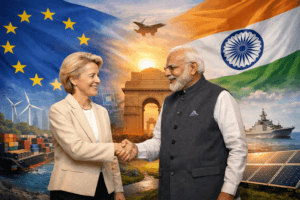
The arrival of European Commission President Ursula von der Leyen in New Delhi on a January evening was more than a diplomatic formality. Against a backdrop of simmering global conflicts, economic decoupling, and rising geopolitical tensions, her visit represents a deliberate and powerful statement. In her own words, the goal is to demonstrate that India and the European Union, together, can “heal a fractured world.” This isn’t merely aspirational rhetoric; it is the core of a rapidly crystallizing strategic partnership that seeks to offer a tangible alternative to the binary confrontations defining our era.
The Republic Day Symbolism: More Than a Parade
The significance of von der Leyen and European Council President Charles Michel attending India’s Republic Day as chief guests cannot be overstated. This honour, rarely extended to institutional leaders from a bloc, is a profound gesture. It signals a shift from a transactional, episodic relationship to one of deep mutual respect and shared symbolic space. Republic Day celebrates the enactment of India’s Constitution—a document enshrining democratic ideals, pluralism, and fundamental rights. By standing as witnesses, EU leaders are implicitly acknowledging a foundational alignment of values with the world’s largest democracy.
This sets the stage not for an alliance against any other power, but an alliance for a specific vision of the international order: one predicated on rules, openness, and strategic autonomy. In a world where democracies are perceived to be under pressure, this visual solidarity carries substantial weight.
The “Mother of All Deals”: Unpacking the Potential
At the heart of the practical negotiations lies the long-pending India-EU Free Trade Agreement (FTA), now rebranded ambitiously as the “mother of all deals.” Stalled for over a decade, renewed momentum is driven by a starkly changed global landscape. The deal aims to create a combined market of nearly 2 billion people, representing about a quarter of global GDP.
The potential transformative impact is multi-sectoral:
- For India: Key gains are projected in sectors like garments, pharmaceuticals, engineering goods, and IT services. Easier access to the sophisticated EU market would incentivize Indian manufacturers to move up the value chain, adhering to high quality and sustainability standards. The removal of tariffs on over 90% of goods could be a game-changer for Indian exports.
- For the EU: It offers access to a vast, youthful consumer market and a chance to diversify supply chains away from over-concentration. European luxury goods, automotive parts, machinery, and chemical products would find a eager market in India’s growing economy.
- The Sticking Points: Past hurdles remain, including EU demands for stringent environmental and labour standards (which India views as potential non-tariff barriers) and India’s asks for easier mobility for its professionals (a sensitive topic within Europe). The success of these talks will hinge on a spirit of compromise and a recognition of the larger strategic prize beyond mere trade balances.
The Strategic Core: Technology, Security, and Resilient Supply Chains
While trade headlines, the partnership’s true depth lies in its strategic pillars. Both India and the EU are acutely aware of vulnerabilities exposed by recent global events—from pandemic-induced disruptions to over-reliance on single geographies for critical resources.
- Technology & Digital Sovereignty: Collaboration on semiconductors, AI, and digital public infrastructure (like India’s celebrated India Stack) is a priority. The EU seeks partners in its quest for “digital sovereignty,” while India offers scale, innovation, and a tested model of inclusive digital governance. Joint research and development projects can pool resources and intellectual capital to compete on the global stage.
- Clean Energy & Climate Action: This is a natural convergence zone. With ambitious net-zero targets, both need to scale up renewable energy, green hydrogen, and smart grid technologies. Europe’s capital and technology can complement India’s implementation scale and renewable potential, creating a template for sustainable development.
- Security & Defence: The discussions in 2026 are expected to cautiously expand into maritime security in the Indo-Pacific, cyber defence, and counter-terrorism. While India maintains its strategic autonomy, there is growing scope for practical collaboration, such as joint naval exercises in the Indian Ocean Region, information sharing, and co-development of defence technologies. This reflects a shared interest in maintaining open and secure sea lanes and a stable regional balance.
The “Von der Leyen Doctrine”: Partnership as an Antidote to Fragmentation
President von der Leyen’s framing of the partnership is its most insightful aspect. She positions the India-EU model as the “other way” in contrast to a world veering toward protectionism, bloc politics, and zero-sum games. This philosophy rests on three principles:
- Strategic Partnership through Dialogue: Rejecting coercion or exclusivity, it emphasizes continuous engagement even amidst differences.
- Leveraging Complementary Strengths: It moves beyond donor-recipient dynamics to a partnership of equals where Europe’s technological prowess meets India’s demographic dividend and scaling capability.
- Building Mutual Resilience: This is the operational heart. By intertwining economies and supply chains in critical areas, both become less vulnerable to external shocks and geopolitical manipulation.
The Road Ahead: From Intent to Implementation
The optimism is palpable, but the path forward requires meticulous navigation. The FTA must be concluded with fairness. Technology transfers need to be genuine. Defence cooperation will evolve slowly, respecting India’s non-aligned history. Both bureaucracies must learn to work with each other’s complexity—the EU’s consensus-driven model and India’s vibrant federal democracy.
Ultimately, the India-EU partnership’s greatest value may be as a proof of concept. It demonstrates that civilizational powers with distinct histories and occasional disagreements can build a relationship based on economic interdependence, technological collaboration, and shared democratic values. In a “fractured world,” this model of constructive, multi-alignment offers a compelling narrative. It suggests that the future may not belong to any single hegemony, but to a networked web of responsible, interconnected partnerships. Von der Leyen’s visit to Delhi wasn’t just about deals; it was about planting the flag for this very idea. The world will be watching to see if it grows.
You must be logged in to post a comment.