
Beyond the Handshake: Decoding the Tech Blueprint from the Modi-Netanyahu Jerusalem Visit
The February 2026 technology exhibition in Jerusalem, attended by Prime Ministers Modi and Netanyahu, symbolized a strategic evolution in India-Israel relations, shifting from a buyer-seller dynamic to a partnership focused on co-creation and scalable solutions. The curated showcase of cutting-edge innovations in fields like quantum computing, AI-driven healthcare, gravity-powered micro-irrigation, and alternative protein technology highlighted a shared commitment to tackling global challenges such as water scarcity, food security, and road safety. By engaging directly with entrepreneurs and inviting them to invest and manufacture in India, PM Modi underscored the core objective of leveraging Israel’s startup ingenuity with India’s vast market and manufacturing scale to build a resilient, tech-enabled future for both nations.
Beyond the Handshake: Decoding the Tech Blueprint from the Modi-Netanyahu Jerusalem Visit
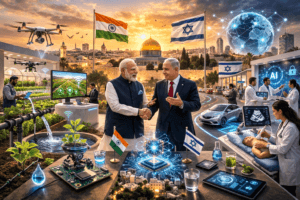
The image is a familiar one to geopolitical observers: Prime Minister Narendra Modi and his “friend,” former Israeli Prime Minister Benjamin Netanyahu, walking side-by-side, engaged in deep conversation. But the setting on February 25, 2026, was not a diplomatic summit hall or a ceremonial tarmac. It was the bustling, high-energy floor of a technology exhibition in Jerusalem. And the handshake wasn’t just a symbol of enduring friendship; it was a catalyst for a meticulously planned future.
While the world often views state visits through the lens of signed treaties and grand communiqués, this particular walk-through, covered in an official Ministry of External Affairs release, offered a far more granular and telling narrative. It was a live-action showcase of the “India-Israel Innovation Bridge” in full swing, a masterclass in how two ancient civilizations are attempting to leapfrog into the future by merging Israeli ingenuity with Indian scale.
This wasn’t a passive tour. It was a high-stakes pitch meeting, a classroom for a Prime Minister known for his tech-savviness, and a strategic mapping of how to solve some of humanity’s most pressing problems—from water scarcity and road safety to food security and cyber warfare.
Let’s move beyond the press release bullet points and decode what this exhibition truly signified. We’ll explore the “why” behind the technologies presented, the subtle shifts in partnership strategy, and what it means for the average citizen in both nations and beyond.
The Unspoken Strategy: From “Buying” to “Co-Creating”
For decades, the India-Israel relationship, formalized in 1992, was defined by a clear dynamic: Israel was a source of advanced defense technology and agricultural expertise, and India was a major buyer. This visit signaled a definitive evolution of that partnership.
The exhibition was curated not just to showcase what Israel can sell India, but what both countries can build together. The emphasis was on scalable, deployable solutions to shared global challenges. PM Modi’s reported comment, inviting companies to “explore opportunities in India to invest, manufacture and build technology partnerships,” is the key takeaway here. The buzzwords are “invest” and “manufacture”—signaling a shift toward joint ventures, technology transfer, and co-production under India’s ‘Make in India’ 2.0 and production-linked incentive (PLI) schemes.
This is a mature, symbiotic relationship. Israel, a “Startup Nation,” possesses the breakthrough ideas but lacks a massive domestic market and large-scale manufacturing capacity. India offers precisely that: a vast market of over 1.4 billion people, a growing pool of engineering talent, and the manufacturing ecosystem to take a pilot project from an Israeli lab and deploy it across an entire subcontinent.
Deep Dive into the Demonstrations: Solutions, Not Just Science Projects
The list of participating companies is a fascinating window into the future priorities of both nations. Let’s analyze a few key sectors and the real-world impact they promise.
1. The Quantum Leap and the AI Revolution (Quantum Machines, Classiq, AISAP, Tech Scout)
The inclusion of Quantum Machines and Classiq at the very top of the briefing list is significant. Quantum computing is the ultimate strategic technology, poised to revolutionize drug discovery, material science, and cryptography. By showing interest in the Israeli Quantum Computing Centre (IQCC) , PM Modi signaled India’s intent to be a player in this nascent but critical field. India’s National Quantum Mission, with a significant budget outlay, finds a natural partner in Israel’s entrepreneurial quantum ecosystem. The partnership isn’t about one country teaching the other; it’s about two nations running a relay race toward a common, complex goal.
Similarly, the focus on AI was deeply practical. The demonstration by AISAP is a prime example of “frugal innovation” with global potential. Imagine a rural primary health center in India or a remote village in Africa. A trained ultrasound technician is a rarity. AISAP’s AI-powered point-of-care ultrasound acts as a “copilot” for a general physician or even a nurse. It guides the user on where to place the probe and, more importantly, provides real-time diagnostic assistance, flagging potential issues like internal bleeding or cardiac abnormalities. This isn’t a futuristic dream; it’s a deployable tool that can democratize healthcare access overnight.
Then there was the “Tech Scout” from the Israeli Ministry of Science and Technology. This is a tool for governments. In an era of poly-crises—from pandemics to supply chain disruptions and cyber warfare—nations are blind without predictive analysis. Tech Scout uses AI to scan global data streams for strategic risks. For a country like India, with its complex geopolitical neighborhood and massive infrastructure projects, such a tool can be invaluable for proactive, rather than reactive, governance.
2. Reimagining Mobility and Safety (Mobileye)
Mobileye is already a household name in the automotive world, but its presence here was a powerful statement. Road accidents are a silent pandemic in India, claiming hundreds of thousands of lives annually. Mobileye’s technology, which uses cameras and sensors to anticipate and mitigate collisions, offers a technological layer of safety that can be retrofitted into existing vehicles or integrated into new ones.
The discussion likely went beyond mere product demonstration. It probably revolved around how this technology can be adapted for Indian driving conditions—the chaotic mix of high-speed traffic, pedestrians, and livestock. It’s about creating a safety net not just for luxury cars, but for the millions of commercial trucks and buses that form the backbone of India’s economy. A partnership could involve localizing the manufacturing of these sensor systems, making them more affordable and ubiquitous.
3. The New Agriculture: Water, Food, and Sustainability (N-Drip, WaterGen, NOF)
This was perhaps the most emotionally resonant section of the exhibition, touching upon the fundamental needs of survival.
N-Drip’s gravity-powered micro-irrigation system is a masterstroke of Israeli innovation. Traditional drip irrigation, while efficient, requires high pressure, which needs energy and expensive pumps. N-Drip’s genius is using precise hydraulics to allow its system to work with gravity alone. For a smallholder farmer in India, this is transformative. It means they can switch from wasteful flood irrigation to hyper-efficient drip irrigation without a capital-intensive investment in electricity or diesel pumps. It conserves water and increases yield, directly impacting farmer income and food security.
WaterGen’s technology, which extracts drinking water from air, sounds like science fiction, but it’s a proven reality. While not a solution for mass agricultural irrigation, it is a game-changer for providing clean drinking water in off-grid areas, disaster relief zones, or urban neighborhoods plagued by contaminated piped water. Imagine a school in a water-stressed part of India having its own atmospheric water generator, ensuring every child has access to safe, pure drinking water.
The inclusion of Natural Offset Farming (NOF) was a subtle but crucial nod to the massive problem of post-harvest loss. In India, a significant percentage of perishable produce rots before reaching the market due to a lack of cold storage. NOF’s solution—in-field post-harvest treatment without electricity—addresses this at the very first mile of the supply chain. If this technology can be scaled and adapted for Indian crops like tomatoes, mangoes, and leafy greens, it could revolutionize farmer incomes without building expensive cold-storage infrastructure overnight.
4. The Future of Food and Materials (Remilk, BarAlgae, Mynora Bio)
This cluster of companies points to a shared future where biology is the new manufacturing.
Remilk’s technology, creating milk proteins through precision fermentation, is a response to the global demand for sustainable protein. India is the world’s largest milk producer, but its dairy industry is also resource-intensive. Remilk offers a way to produce the building blocks of dairy—like cheese or yogurt—without the animal, potentially freeing up land and water resources. This isn’t about replacing the traditional dairy farmer overnight, but about creating a parallel industry for a new generation of climate-conscious consumers and export markets.
BarAlgae and Mynora Bio represent the circular economy in action. BarAlgae uses AI to optimize the cultivation of microalgae, which can be used for everything from biofuels to nutritional supplements. Mynora Bio tackles the plastic waste crisis by using bio-conversion additives that help plastic break down faster in landfills. For India, which generates massive amounts of plastic waste, such biological solutions are not just innovative; they are essential.
The Human Element: Modi, the Tech-CEO-in-Chief
The description of PM Modi interacting with “scientists, tech-entrepreneurs and CEOs” is not just diplomatic boilerplate. Modi has consistently positioned himself as a leader who understands technology as a tool for empowerment, or “tech-enabled development,” as his government often terms it.
His engagement at the exhibition was likely that of a seasoned product manager. He wasn’t just asking for a demo; he was likely probing on scalability, cost of deployment, and adaptability to the Indian context. For the Israeli entrepreneurs, a nod from Modi is more than a photo op; it’s a potential gateway to the world’s most exciting growth market. His personal brand adds a layer of credibility and expedites introductions that might otherwise take years.
Conclusion: A Partnership of Consequence
The February 25th exhibition in Jerusalem was a microcosm of a new kind of international alliance. It’s not based solely on shared enemies or historical grievances, but on shared aspirations and a pragmatic approach to problem-solving. It’s a partnership where one nation’s survival instincts (Israel’s need to innovate to exist) meet another’s developmental ambitions (India’s need to scale to progress).
The technologies on display—from quantum computers that will shape the next century to drip irrigation systems that will impact the next harvest—share a common thread: they are all about resilience. They are about building a world that can withstand climate change, feed its growing population, and secure its digital frontiers.
As PM Modi and PM Netanyahu moved from one stall to the next, they were not just observing gadgets. They were curating a portfolio of solutions for the future. The real success of this visit won’t be measured by the headlines it generated on February 26, but by the number of these technologies that successfully make the journey from a Jerusalem lab to the bustling, demanding, and transformative Indian market. The handshake was for the cameras, but the real work—the co-creation of the future—has just begun.
You must be logged in to post a comment.