
Beyond the Handshake: Decoding the New Momentum in Canada-India Trade Relations
The recent meeting between Canadian Minister Maninder Sidhu and Indian Minister Piyush Goyal in Yaoundé marks a pivotal reset in Canada-India trade relations, highlighted by the successful conclusion of the first round of Comprehensive Economic Partnership Agreement (CEPA) negotiations and building on Prime Minister Mark Carney’s visit to India earlier this month. The discussions signal a shift from past geopolitical friction toward pragmatic economic diversification, with both nations seeking to deepen bilateral investment, align on WTO priorities like digital trade, and pave the way for Minister Goyal’s upcoming trade mission to Canada this spring. While challenges such as agricultural sensitivities and domestic political tensions remain, the sustained high-level engagement and planned Canada–India Trade and Investment Forum suggest a mature, forward-looking partnership aimed at capitalizing on supply-chain realignments and mutual strategic interests in the Indo-Pacific.
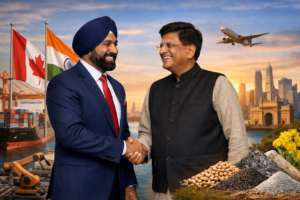
Beyond the Handshake: Decoding the New Momentum in Canada-India Trade Relations
In the bustling corridors of Yaoundé, Cameroon, where the global community is gathering for diplomatic engagements, a meeting took place this past weekend that signals a potential paradigm shift in one of the more complex bilateral relationships in the Indo-Pacific region. The encounter between Canada’s Minister of International Trade, Maninder Sidhu, and India’s Minister of Commerce and Industry, Piyush Goyal, might have been formally categorized as a “readout” by Global Affairs Canada, but the subtext of the March 28, 2026, meeting tells a story of strategic recalibration, economic pragmatism, and a mutual desire to move past geopolitical friction.
For observers of Canada-India relations, the location—Yaoundé—is notable. That the two ministers chose to meet on the sidelines of an international gathering rather than waiting for a state visit underscores a sense of urgency. This was not a ceremonial meet-and-greet; it was a working session designed to capitalize on what the official release describes as “the momentum generated by recent high-level engagements,” specifically the visit of Prime Minister Mark Carney to India earlier this month.
To understand the weight of this moment, one must look back at the recent history. For years, the Canada-India relationship was characterized by what diplomats euphemistically call a “challenging period.” Stalled trade talks, political disagreements, and a general sense of missed opportunities defined the landscape. Yet, the readout from this weekend, combined with the high-level visits, suggests that both governments have come to a pragmatic conclusion: the economic cost of estrangement is simply too high to ignore.
A First Round Completed: The CEPA Reset
The most substantive takeaway from the Sidhu-Goyal meeting is the confirmation of progress on the Canada–India Comprehensive Economic Partnership Agreement (CEPA). According to the release, the ministers reviewed progress and “welcomed the conclusion of a first round of negotiations.”
This is a significant milestone. The pursuit of a CEPA has been a will-they-won’t-they saga for over a decade. Previous attempts were shelved due to diverging priorities and political headwinds. The fact that a first round has not only been initiated but concluded signals that the groundwork has been laid. Negotiations of this scale do not happen overnight; the “first round” implies that technical teams have been exchanging documents, identifying low-hanging fruit, and mapping out the sensitive sectors long before ministers shook hands in Cameroon.
What makes this attempt different is the context. Prime Minister Carney’s visit to India earlier this month was crucial. Carney, a former central banker with a globalist mindset, brings a different lens to trade than his predecessors. His presence in New Delhi likely served as a circuit-breaker, signaling to the Indian government that Canada is willing to engage on India’s terms—focusing on investment security, supply chain resilience, and the long-term horizon.
For India, a CEPA with Canada is about diversification. As global supply chains fragment, India is positioning itself as an alternative manufacturing hub. Canada offers more than just a market of 40 million people; it offers a gateway to the USMCA (United States-Mexico-Canada Agreement) market for Indian firms, as well as critical resources—from potash, which India needs for its agricultural self-sufficiency, to critical minerals essential for India’s green transition.
For Canada, the logic is even more compelling. With the United States increasingly turning inward under protectionist pressures, Ottawa is scrambling to diversify its trade portfolio. India, with its 1.4 billion people and rapidly expanding middle class, represents the ultimate “Plan B.” A CEPA would allow Canadian agricultural producers—pulses, lentils, and canola—to compete more effectively against Australian and American competitors. It would also open doors for Canadian pension funds and infrastructure investors to participate in India’s massive growth story, which has traditionally been dominated by Asian and European capital.
The Carney Factor: Stability and Reform
The readout explicitly mentions “building on the momentum generated by recent high-level engagements, including the visit of Prime Minister Mark Carney to India.” This is a crucial thread. In international diplomacy, the relationship between heads of government sets the tone for the bureaucrats and ministers below.
Prime Minister Carney’s profile carries significant weight in India. Having steered the Bank of Canada through the 2008 financial crisis and later the Bank of England through Brexit, he is viewed in New Delhi as a safe pair of hands and a credible steward of the economy. His visit likely focused less on specific trade irritants and more on the macro picture: the stability of Canada’s regulatory environment, its commitment to open investment, and its alignment with India’s ambitions in the Indo-Pacific.
The inclusion of a discussion on the World Trade Organization’s (WTO) 14th Ministerial Conference (MC14) in the readout confirms this alignment. The ministers discussed “advancing reform efforts” and maintaining a “stable and predictable environment for digital trade, including through the renewal of the e-commerce moratorium.”
This is where the Carney influence is most visible. Both Canada and India, despite their differing positions on certain WTO reforms, share a fundamental interest in keeping global trade rules functional. India has historically been wary of the e-commerce moratorium, fearing it erodes customs revenue. However, as India’s digital economy—fueled by UPI payments and a booming tech sector—grows, the need for predictable digital trade rules aligns more closely with Canada’s priorities. The fact that they are finding common ground on this front suggests that the technical discussions are moving beyond old grievances into forward-looking policy alignment.
The Human Element: Trade and Investment Mission
One of the most promising aspects of the readout is the forward-looking operational detail: “Minister Sidhu welcomed Minister Goyal’s planned visit to Canada later this spring, including a trade and investment mission and a Canada–India Trade and Investment Forum.”
This is where the rubber meets the road. High-level political statements are important, but trade is ultimately conducted by business owners, supply chain managers, and entrepreneurs. Minister Goyal, known in India as a reformist dealmaker, bringing a delegation of Indian business leaders to Canada is a powerful signal.
The planned “Trade and Investment Forum” serves a dual purpose. For Canadian businesses, it is an opportunity to showcase capabilities in sectors where Canada genuinely leads—agri-tech, clean technology, artificial intelligence, and infrastructure finance. For Indian businesses, it is a chance to scout opportunities in a Canadian market that is actively seeking to diversify its sources of foreign investment and manufactured goods.
Furthermore, the timing of this spring visit is strategic. It allows the Canadian government to highlight its own economic strengths following the recent leadership transition. It also allows the Indian government to demonstrate to its domestic business community that it is serious about expanding its footprint in North America beyond the traditional California-Texas corridor.
Navigating the Unspoken Challenges
While the readout is optimistic, any analysis that adds “genuine human insight” must acknowledge the elephants in the room. The path to a finalized CEPA is not without landmines.
First, there are the domestic political realities in Canada. Trade negotiations with India are often complicated by Canadian domestic politics concerning Khalistani extremism. The Indian government has made it clear in the past that it expects its partners to take action against anti-India activities on their soil. For the Carney government, balancing the imperative of trade diversification with the sensitivities of a multicultural electorate and the rule of law remains a tightrope walk. The fact that Minister Sidhu—a prominent Indo-Canadian voice—is leading the charge is a strategic choice, intended to bridge that cultural and political divide.
Second, there are the protectionist instincts. In any CEPA negotiation, agriculture is always the sticking point. Canadian dairy and poultry supply management systems are sacred cows (pun intended) in domestic politics, while India is equally protective of its small-scale farmers. Finding a mechanism that allows for increased market access without triggering political backlash in either country will require creativity—perhaps through phased tariff reductions or quotas that don’t threaten domestic industries.
Third, there is the global context. The world of 2026 is not the world of 2014. Geopolitical tensions, supply chain fragmentation, and the lingering effects of inflation mean that both countries are negotiating from a position of national interest first. However, the very instability of the global order may be the strongest catalyst for this deal. In an era where reliability is becoming more valuable than pure cost-efficiency, Canada and India are natural partners. Canada offers resource security and political stability; India offers a massive market and a democratic counterweight to authoritarian state-led capitalism.
Looking Ahead: The Spring Forum as a Bellwether
As we look toward the spring, the upcoming visit of Minister Goyal and the Canada–India Trade and Investment Forum will serve as a critical barometer. Will it be a showcase of genuine enthusiasm, with CEOs announcing concrete investments and joint ventures? Or will it be a cautious affair, reflecting the lingering hesitancy that has plagued the relationship?
The readout from Yaoundé suggests the former. By focusing on “regular dialogue,” “shared ambition,” and “new opportunities for collaboration,” Minister Sidhu and Minister Goyal are signaling that they are moving past the era of sporadic engagement. They are institutionalizing the relationship.
For Canadian businesses, the message is clear: the federal government is laying the groundwork for a major pivot toward India. The conclusion of the first round of CEPA talks means that the technical frameworks are being built. For Indian investors, the message is equally clear: Canada is open for business, and it is willing to engage with the complexities of the Indian market to make it happen.
In conclusion, the meeting in Cameroon was more than just a diplomatic readout; it was a status report on a relationship that is finally being treated with the strategic seriousness it deserves. The combination of Prime Minister Carney’s recent visit, the concrete progress on the CEPA, and the planned high-profile trade mission this spring paints a picture of two nations that have decided that the future of the Indo-Pacific economic order is too important to be left to geopolitics alone.
The real work now lies ahead, as negotiators move from the first round to the gritty details of market access, and as business leaders from both sides test the waters of deeper integration. But for the first time in years, the handshake between Sidhu and Goyal in Yaoundé feels less like a gesture of courtesy and more like the start of a genuine partnership.
You must be logged in to post a comment.