
Beyond the Handshake: Decoding the High Stakes of PM Mark Carney’s Inaugural Visit to India
Prime Minister Mark Carney’s inaugural four-day visit to India marks a pivotal strategic reset in bilateral relations, transitioning from recent diplomatic strains toward a “forward-looking partnership” grounded in economic realism and mutual respect. The carefully structured itinerary reflects this calibrated approach, with Carney—a former central banker uniquely suited to the task—spending two days in Mumbai engaging with CEOs, financial experts, and Canadian pension funds to signal that private capital and innovation, not just government dialogue, will drive the relationship forward.
The visit culminates in Delhi talks where both leaders will leverage their third meeting in under a year to inject political will into stalled areas like the Comprehensive Economic Partnership Agreement, while pursuing transformative collaboration in critical minerals and green energy—sectors where Canada’s resource wealth and India’s consumption demands create natural synergy. Ultimately, the summit tests whether both nations can maturely “compartmentalize” their partnership, cooperating deeply on trade, climate, and investment even as they manage differing global perspectives, with success measured not by diplomatic fanfare but by tangible outcomes in jobs, supply chain resilience, and people-to-people ties.
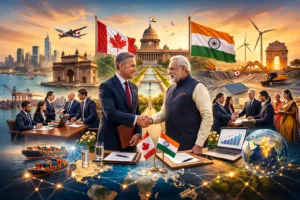
Beyond the Handshake: Decoding the High Stakes of PM Mark Carney’s Inaugural Visit to India
By [Your Name/Publication Name] February 26, 2026
In the meticulously choreographed world of diplomacy, an official visit is rarely just a visit. It is a signal, a statement of intent broadcast to the world. When Canadian Prime Minister Mark Carney lands in Mumbai tomorrow for his first official visit to India, the signal emanating from New Delhi and Ottawa will be one of profound recalibration. The visit, spanning four days from February 27 to March 2, 2026, is being framed as a cornerstone in the “normalization” of a relationship that, until recently, resembled a supertanker navigating treacherous straits: slow to turn, burdened by momentum, and vulnerable to the rocks of geopolitical friction.
This is not merely a diplomatic meet-and-greet. It is a calculated attempt to steer that supertanker into clearer, more prosperous waters. The invitation from Prime Minister Narendra Modi to his Canadian counterpart, The Right Honourable Mark Carney, sets the stage for a summit in New Delhi that carries the weight of years of stalled momentum and the promise of a future defined not by discord, but by deep-seated economic and strategic complementarity.
The Carney Factor: A Different Kind of Diplomat
To understand the unique texture of this visit, one must first look at the man at its center. Mark Carney is not a conventional politician. A former Governor of the Bank of Canada and the Bank of England, he arrives in India with the intellectual heft of an economist and the global network of a financial statesman. His presence fundamentally shifts the center of gravity of the bilateral conversation.
While a career politician might focus on the headlines and the talking points, Carney’s strength lies in the fine print—the regulatory frameworks, the sustainable finance taxonomies, the intricate mechanisms of cross-border investment. This is a prime minister who can speak the language of the Reserve Bank of India as fluently as that of a Bay Street CEO. His itinerary reflects this predisposition. Before the political pageantry of Delhi, Carney will spend two crucial days in Mumbai, India’s financial and commercial heart.
Mumbai: The Marketplace as a Messenger
The choice of Mumbai as the entry point is deliberate and insightful. From February 27 to 28, Carney will be immersed in “separate business engagements,” a phrase that belies the intense activity that will unfold. He is scheduled to interact with Indian and Canadian CEOs, industry leaders, financial experts, innovators, and crucially, representatives of Canadian Pension Funds based in India.
This is where the “human insight” of the relationship truly lies. For years, the India-Canada story has been one of immense untapped potential. Canadian pension funds—like CPP Investments, Ontario Teachers’, and Caisse de dépôt et placement du Québec—are global behemoths, managing trillions of dollars in assets. They have long viewed India as a premier destination for long-term, stable returns. However, their engagement has often been cautious, navigating bureaucratic hurdles and seeking clearer policy signals.
Carney’s direct engagement with these funds is a powerful signal from the Canadian government that it not only supports but champions their deepening involvement in India. It’s a tacit acknowledgment that the real engine of the bilateral relationship isn’t just government-to-government dialogue, but the flow of capital and innovation between its private sectors. For the Indian CEOs and innovators in the room, Carney represents a developed-world leader who understands that the future of energy, technology, and finance will be shaped in partnership with a rising India. Discussions in Mumbai are expected to go beyond traditional trade and delve into the frontiers of the economy: green hydrogen, digital public infrastructure, and the financial engineering required to fund India’s ambitious growth trajectory.
The Delhi Summit: From Strategic Ambiguity to Strategic Partnership
The scene then shifts to the grand, sandstone corridors of Hyderabad House in New Delhi. On March 2, the two Prime Ministers will sit down for delegation-level talks. This will be their third meeting in less than a year, following engagements at the G7 summit in Kananaskis (June 2025) and the G20 summit in Johannesburg (November 2025). This frequency of contact is itself a news story. It signals a concerted effort to build a personal and professional rapport that can weather political storms.
The official readout mentions a review of the “India–Canada Strategic Partnership” across key pillars. But the genuine value for readers lies in unpacking what these pillars truly represent in the current global context:
- Trade and Investment: This is the perennial big-ticket item. The long-negotiated India-Canada Comprehensive Economic Partnership Agreement (CEPA) has seen its share of ups and downs. The visit provides an opportunity to inject new political will into the process. With global supply chains fracturing and diversifying away from China, both nations see an opportunity. India needs reliable partners for its manufacturing ambitions; Canada needs resilient markets for its resources and a destination for its capital. The talks won’t just be about tariffs on lentils or chickpeas, but about creating a framework for a resilient economic corridor.
- Energy and Critical Minerals: This is arguably the most transformative pillar. As the world races towards net-zero, the demand for minerals like lithium, cobalt, nickel, and graphite—essential for EV batteries and renewable tech—has skyrocketed. Canada is a mining superpower with vast, untapped reserves of these critical minerals. India, with its burgeoning EV market and ambitious renewable energy targets, is a massive future consumer. The conversation is no longer just about Canada exporting raw ore; it’s about co-creating value chains. Imagine Canadian lithium processed in India, with Indian capital investing in Canadian mines, to power electric vehicles sold in both countries. This is the high-value, job-creating partnership both nations are seeking.
- Education, Research, and Innovation: The people-to-people ties mentioned in the release are the bedrock of this relationship. Over 1.6 million people of Indian origin call Canada home, and Indian students have become a vital part of Canadian campuses and communities. The conversation here will likely extend beyond just student numbers. It will focus on fostering deeper research collaborations between premier institutions like the IITs and Canadian universities, particularly in areas like AI, agri-tech, and clean technology. The goal is to create a two-way street of talent and ideas, moving beyond a one-way flow of students.
A New Chapter, Written with Care
The press release candidly states that the visit comes at an “important juncture in normalization.” This is diplomatic language for a period of undeniable strain that chilled relations in recent years. The two Prime Ministers have previously “agreed to pursue a constructive and balanced partnership grounded in mutual respect for each other’s concerns and sensitivities.”
This is the most crucial sentence in the entire announcement. It is an acknowledgment that while the economic and strategic logic for partnership is overwhelming, it cannot be pursued in a vacuum. For the relationship to be “forward-looking,” it requires a stable foundation of mutual understanding and a mechanism to manage differences without letting them derail the entire partnership.
The meetings in Kananaskis and Johannesburg were the initial steps in building this mutual respect. The Delhi summit is the first major test of whether that foundation is solid. It is about demonstrating to their respective domestic audiences and to the world that both nations are mature enough to compartmentalize their relationship—to cooperate deeply on trade, climate, and energy, even when perspectives on other issues diverge.
Conclusion: The Sound of a Reset
As Prime Minister Carney and Prime Minister Modi walk the red carpet at Hyderabad House, the cameras will capture a moment of diplomatic normalcy. But beneath the surface, the visit represents a significant geopolitical reset. It’s a bet on a future where the India-Canada axis becomes a defining feature of the Indo-Pacific landscape.
For the average citizen in both countries, the success of this visit won’t be measured by the joint communiqué, but by tangible outcomes: more diverse and affordable goods on store shelves, new job-creating investments in critical industries like battery manufacturing, smoother pathways for students and professionals to contribute to both economies, and a stronger, collective voice on global challenges like climate change.
The visit of Mark Carney is more than a first; it is a foundation-laying exercise. It is an opportunity to transform a relationship long defined by its potential into one defined by its performance. The world, and particularly the dynamic Indo-Pacific region, will be watching closely to see if this handshake in Delhi marks the beginning of a truly new chapter.
You must be logged in to post a comment.