
Beyond the Handshake: Decoding Modi’s Israel Visit as a Blueprint for India’s Tech Future
Prime Minister Narendra Modi’s visit to a technology innovation exhibition in Israel transcends a standard diplomatic engagement, serving as a strategic bid to forge a deep-rooted “future-tech alliance” between the “Startup Nation” and the world’s most dynamic emerging economy. By directly inviting Israeli firms to invest in India, Modi is leveraging a powerful complementarity: Israel’s renowned prowess in frugal innovation—born of necessity in AI, cybersecurity, agritech, and clean energy—combined with India’s massive scale, diverse datasets, and policy-driven push for digital transformation. The visit signals a pivot from a traditional buyer-seller relationship to a collaborative partnership focused on co-building solutions, where Israeli technology can be tailored and deployed to solve India’s grand challenges in agriculture, healthcare, and infrastructure. Ultimately, this is a pitch for a ground-up collaboration between the two startup ecosystems, positioning India not merely as a consumer market, but as the ultimate laboratory for technologies that can define the 21st century.
Beyond the Handshake: Decoding Modi’s Israel Visit as a Blueprint for India’s Tech Future
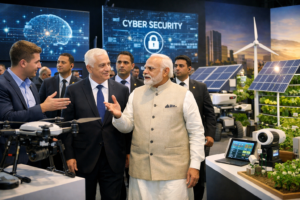
The image is a familiar one in the landscape of modern diplomacy: a world leader, flanked by eager entrepreneurs and stern security personnel, walking past rows of gleaming technological marvels. Today, that leader is Prime Minister Narendra Modi, and the venue is a high-octane technology innovation exhibition in Israel. On the surface, the news is a straightforward bulletin of international relations—a visit, an invitation, a handshake. But to view it merely as a diplomatic photo-op is to miss the forest for the trees.
This wasn’t just a visit; it was a strategic reconnaissance mission. It was a clear signal that as the global economic order recalibrates, India is aggressively positioning itself not just as a consumer of technology, but as the world’s most promising laboratory for it. Prime Minister Modi’s personal pitch to Israeli tech giants to “invest in India” is a narrative rich with subtext, geopolitical strategy, and a shared human obsession with problem-solving through innovation.
To understand the true weight of this moment, we must look beyond the press release and delve into the symbiotic relationship between the “Startup Nation” and the world’s most dynamic emerging economy.
The “Why” Behind the Visit: A Meeting of Complementary Minds
India and Israel formalized their diplomatic relations relatively late, in 1992. For decades, the relationship was defined by defense and agriculture—two critical, yet narrow, pillars. Israel supplied India with cutting-edge military technology to bolster its security, and drip irrigation systems to help it fight drought.
Fast forward to 2026, and the relationship is undergoing a profound metamorphosis. The foundation remains strong, but the superstructure is now being built with bits and bytes. The visit to the tech exhibition is a testament to this pivot from a strategic partnership to a future-tech alliance.
Why Israel? The answer lies in the unique character of Israeli innovation. It is born not of abundance, but of necessity—scarcity of water, land, and natural resources. This has forged a culture of “frugal innovation,” where startups are adept at doing more with less, creating robust, scalable solutions under pressure. This mindset is a perfect complement to India’s own burgeoning startup ecosystem.
Human Insight: For the Israeli entrepreneur, the Indian market represents the ultimate scale. An agritech startup that has perfected a method to grow vegetables in the arid Negev desert has a powerful proof-of-concept. But in India, that same technology isn’t just a proof-of-concept; it’s a solution for millions of farmers across the Indo-Gangetic plains. The opportunity isn’t just about profit; it’s about impact. The Prime Minister’s invitation is a promise of that scale.
The Three Pillars of the Pitch: AI, Cyber, and the Green Future
The article mentions key sectors: artificial intelligence, cybersecurity, agritech, and clean energy. Let’s dissect why these specific areas are the cornerstones of this new India-Israel tech corridor.
1. Artificial Intelligence: From Code to Countrywide Impact
In India, AI is not a futuristic luxury; it is an imminent necessity. From predicting crop yields for millions of farmers to diagnosing diseases in understaffed rural clinics, and from personalizing education for a billion students to managing the load on the world’s second-largest internet user base, AI is the only way to deliver services at scale.
Israel, on the other hand, is a global powerhouse in AI research and development, particularly in its application to cybersecurity and autonomous systems. The collaboration being forged here is about integrating Israeli core AI capabilities with India’s massive, diverse datasets. Data is the new oil, and India has it in abundance. The partnership aims to refine that oil into high-octane fuel for the economy.
2. Cybersecurity: Fortifying the Digital Fort
India is in the midst of a digital revolution. The Unified Payments Interface (UPI) has democratized finance, the Open Network for Digital Commerce (ONDC) is democratizing e-commerce, and the India Stack is creating a public digital infrastructure that is the envy of the world. But this digitization creates an enormous, attractive target for malicious actors.
Israeli cybersecurity firms are legendary. They protect the world’s largest corporations and most sensitive government networks. By inviting these firms to India, the government is not just looking to buy products off the shelf. The vision, as highlighted by the emphasis on “ease of doing business” and “startup development,” is to encourage them to set up R&D centers, partner with Indian engineering talent, and co-develop solutions that are tailored to the unique challenges of the Indian digital ecosystem. It’s about building the fort, not just hiring the guards.
3. Agritech and Clean Energy: The Human Face of Innovation
This is where the partnership becomes deeply personal and human. For an Indian farmer, climate change is not a debate; it is a lived reality of unseasonal rains, pest attacks, and depleting water tables. For a clean energy startup in Tel Aviv, the goal is to power a city without choking the planet.
The interaction at the exhibition is a bridge between these two worlds.
- Agritech: Israeli precision agriculture, drone technology for crop monitoring, and advanced water management systems can directly translate into higher incomes and lower risk for Indian farmers. This isn’t just about economic growth; it’s about rural resilience.
- Clean Energy: India’s commitment to net-zero is ambitious. Israeli innovations in energy storage, grid management, and alternative energy sources (like bio-gas from organic waste) are crucial pieces of the puzzle. The partnership here is about accelerating India’s green transition while providing Israeli companies with a massive testing ground and market.
The Indian Promise: More Than Just a Market
The Prime Minister’s pitch is not just “come and sell,” but “come and build.” This is a crucial distinction. He is selling the idea of India as a partner in innovation. The “policy support for ease of doing business” and “digital transformation” mentioned in the report are not just buzzwords; they represent a fundamental shift in the country’s operating system.
Initiatives like the Production Linked Incentive (PLI) schemes, the establishment of deep-tech incubation centers at IITs and IIMs, and a regulatory environment that is slowly but surely becoming more startup-friendly are the bedrock of this promise.
Human Insight: For a young Israeli engineer or entrepreneur, the allure of India today is similar to what the United States offered in the late 20th century—a land of opportunity where ambition meets a massive, willing market. But unlike the US of that era, India offers a head start in solving the most complex problems of the 21st century. An Israeli startup working on water purification can find its first major client not just in a municipality in Europe, but in an Indian smart city being built from scratch.
A Partnership of Startups, Not Just States
The most exciting long-term prospect of this visit is the potential for cross-pollination between the two countries’ startup ecosystems. The article mentions “deeper engagement between Indian and Israeli startups.”
Imagine an Indian healthtech startup partnering with an Israeli medtech firm to create affordable diagnostic devices. Or an Indian fintech company integrating Israeli cybersecurity protocols to make digital payments safer for the poorest of the poor. This is the “innovation-led growth” the report speaks of. It’s a ground-up collaboration where young, hungry minds from both countries work together, sharing risks and rewards.
This people-to-people connect through technology is a powerful stabilizer in international relations. It creates business and cultural ties that are much harder to break than government-to-government memorandums of understanding.
The Road Ahead: Challenges and the Path to 2030
Of course, the path to a thriving tech partnership is not without its hurdles. Issues of intellectual property rights, data localization laws, and differing business cultures will need to be navigated with care. Israeli firms, used to a fast-paced, direct business environment, will need to understand the nuances of the Indian market. Indian regulators, in turn, will need to provide the policy stability and clarity that long-term R&D investment demands.
However, the momentum is undeniable. Prime Minister Modi’s visit is a powerful reaffirmation that India sees technology as the ultimate lever for its economic transformation. By turning to Israel, it is choosing a partner that mirrors its own journey—a nation that has used innovation not just to prosper, but to survive and thrive against the odds.
As the Prime Minister walked through that exhibition hall in Israel, he wasn’t just looking at gadgets and gizmos. He was looking at potential solutions for India’s biggest challenges. And for the Israeli innovators watching him, they weren’t just seeing a visiting dignitary; they were seeing a nation of 1.4 billion people, ready and waiting to write the next chapter of the technological revolution with them. The invitation has been extended. The real work is just about to begin
You must be logged in to post a comment.