
Beyond the Gulal: Decoding Delhi’s Warmest Holi and the New Normal of North Indian Summers
Delhi experienced its warmest day of March so far on Holi, with temperatures at the Safdarjung observatory reaching 33.2 degrees Celsius, significantly above normal, as the city celebrated the festival of colours under an unseasonal early summer heat that blended with poor air quality to create a challenging environment for residents. The oppressive warmth, driven by clear skies, the urban heat island effect, and the absence of pre-Holi rains, transformed the traditional celebration—with colours drying quickly on skin and cold drinks replacing hot tea—while outdoor workers like vendors and construction labourers bore the brunt of the conditions, serving as a stark reminder that Delhi’s once-gentle spring is shrinking and forcing both residents and administrators to confront the reality of a warming planet and the urgent need for earlier heat action plans.
Beyond the Gulal: Decoding Delhi’s Warmest Holi and the New Normal of North Indian Summers
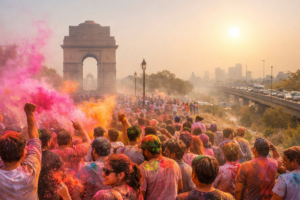
The streets of the national capital were awash in a riot of colour on Wednesday as Delhiites came together to celebrate Holi, the festival of colours. But this year, the canvas of the city wasn’t just painted with vibrant pinks, blues, and reds. An invisible, yet overpowering, hue was added to the mix: the shimmering, hazy tint of unseasonal heat.
As families gathered on rooftops, friends chased each other in neighbourhood parks, and the scent of gujiyas wafted from kitchens, the India Meteorological Department (IMD) recorded a milestone that added a layer of concern to the festivities. The mercury at the city’s base station, Safdarjung Observatory, soared to 33.2 degrees Celsius, marking the hottest day of the month so far and painting a vivid picture of a metropolis celebrating spring under the nascent blaze of an early summer.
While the IMD’s data—a maximum temperature 1.7 degrees above normal and a minimum of 15.7 degrees Celsius, a significant 2.3 degrees above average—provides the scientific backbone, the story of this warm Holi lies in the lived experiences of Delhi’s residents, the silent struggle of its vast working class, and the pressing questions it raises about the changing rhythm of the seasons in a warming world.
The Festival of Colours, Painted with Sweat
For the uninitiated, Holi in North India is a sensory explosion. It is a day when social hierarchies are momentarily blurred under a shower of colour, when water balloons become weapons of mass affection, and when the air fills with a cacophony of laughter, drumbeats, and the occasional cry of “Holi hai!”
This year, that air was also thick with heat.
“The colours dried on our skin in minutes,” said Ananya Sharma, a 24-year-old graphic designer from GK-2, who celebrated with her college friends. “Usually, after playing, you crave a hot cup of tea. Today, all we wanted was cold drinks and to stand under the fan. We had to refill our water pistols with chilled water just to feel a semblance of relief.”
Her sentiment was echoed across the city. The traditional post-Holi lethargy, usually attributed to the combination of physical exertion and the consumption of bhang-infused thandai, was this year amplified by the oppressive warmth. The delightful chill of the morning, often the best part of a Delhi spring, was conspicuously absent.
The data from other observatories tells a similar, albeit nuanced, story of the city’s microclimates. At the Ridge area, known for its green cover, the maximum touched 33.0 degrees Celsius. At Ayanagar on the outskirts, it was 32.9 degrees Celsius. Even Lodhi Road, with its sprawling gardens and tree-lined avenues, recorded a high of 32.8 degrees Celsius. Palam, closer to the airport and with more concrete expanse, saw a comparatively lower 30.7 degrees Celsius, reminding us that even within a heat event, pockets of relative respite exist, largely dictated by green cover and land use.
The Human Toll: From Street Vendors to Construction Workers
For the millions who call Delhi home, a “warm day” is a relative term. For the city’s vast workforce that operates outdoors, the 33.2-degree Celsius reading was not just a statistic; it was a direct challenge to their livelihood and well-being.
Consider Ramesh, a 45-year-old vendor selling pakoras and chai from his handcart in the bylanes of Chandni Chowk. Holi is one of his busiest days. But by noon, the flames from his stove felt unbearable.
“People were eating, but they didn’t want to stand and wait,” Ramesh said, wiping his brow with a stained gamcha. “The heat from the sun and my fire was too much. I had to keep a separate bucket of water just to dip my feet in between customers. We need the business, but days like this make you question if it’s worth the risk.”
His story is the reality for thousands of auto-rickshaw drivers, construction workers, and sanitation staff. While the city celebrated, they worked, their bodies becoming the first barometers of a shifting climate. The construction sites across Noida, Gurugram, and Delhi, which had enjoyed a productive winter, were once again sites of exhausting labour under a relentless sun. The respite of a cool evening, a hallmark of March, was replaced by the lingering warmth of a day that refused to cool down.
AQI: The Uninvited Guest at the Party
As if the heat wasn’t enough, Delhi’s perennial party crasher—poor air quality—decided to make an appearance. The 24-hour average Air Quality Index (AQI) settled at a ‘moderate’ 161, according to the Central Pollution Control Board (CPCB). However, this average masked a grimmer reality.
By evening, data from the CPCB’s SAMEER app revealed a more troubling picture. While 40 stations reported ‘moderate’ air, four were in the ‘poor’ category, and one—Punjabi Bagh in west Delhi—plummeted into the ‘very poor’ category with an AQI of 320.
This spike is a classic Delhi phenomenon. The combination of light winds, which the IMD has forecast to strengthen, and the burst of anthropogenic activity—the burning of Holi bonfires (Holika Dahan) the previous night, the use of synthetic colours and大量 water usage, and increased vehicular movement—all contribute to a temporary deterioration in air quality.
For health experts, the combination of rising heat and poor air is a worrying cocktail. “High temperatures cause the skin vessels to dilate, and the body works harder to cool itself,” explained Dr. Piyush Saxena, a pulmonologist at a leading Delhi hospital. “Add to that an AQI in the ‘poor’ or ‘very poor’ category, and you are forcing your respiratory system to work overtime, pulling in more pollutants. It’s a double whammy for the vulnerable—the elderly, children, and those with pre-existing heart or lung conditions.”
The Science of the Spike: Why Was This Holi So Warm?
To understand why the mercury climbed so high, we have to look beyond the simple “temperature above normal” statement. March is a transitional month for North India. The western disturbances—storm systems originating in the Mediterranean region that bring winter rain to North India—begin to wane. As they do, the influence of the north-westerly winds from the snow-capped Himalayas diminishes, and the region starts to come under the influence of the blazing sun.
However, the 2026 Holi heat spike was accentuated by a few key factors.
- Clear Skies and Intense Solar Radiation: With no western disturbance active over the region, the skies remained largely clear. This allowed uninterrupted solar radiation to heat the land surface throughout the day. The Earth’s surface absorbs this heat and re-radiates it, warming the atmosphere from the ground up.
- The Urban Heat Island (UHI) Effect: Delhi, with its concrete, asphalt, and lack of permeable surfaces, is a textbook example of an urban heat island. Buildings and roads absorb heat during the day and release it slowly at night. This is why the minimum temperatures were also significantly above normal (2-3 degrees). The city didn’t get a chance to cool down sufficiently overnight, leading to a higher starting point for the next day’s heat. The 33.2°C reading at Safdarjung is not just the sun’s doing; it’s the city’s own infrastructure amplifying the heat.
- Absence of Pre-Holi Rains: A traditional precursor to Holi in many parts of North India is a light shower, often caused by a feeble western disturbance. These rains settle the dust and provide a temporary cooling effect. This year, the pre-Holi week was dry, allowing heat to accumulate in the atmosphere.
Looking Ahead: A Glimpse of the Summer to Come?
The IMD’s forecast for Thursday offers little respite, predicting similar temperatures with a minimum around 17 degrees Celsius and a maximum of 33 degrees Celsius, accompanied by strong surface winds. While these winds might provide some relief from the stuffiness, they also carry the risk of kicking up dust, potentially further impacting air quality.
This early-season heatwave (even if not officially classified as one) serves as a stark reminder for Delhiites. The comfortable, two-month-long spring that residents once took for granted is shrinking. The transition from winter to summer is becoming increasingly abrupt.
For the city’s administration, it’s a call to action. The heat action plans, typically rolled out in April, may need to be activated earlier. Ensuring power grids can handle the load of fans and air conditioners, providing public cooling centres, and adjusting working hours for outdoor labour are conversations that need to happen now, not when the mercury hits 40.
But beyond policy, the warm Holi of 2026 is a personal story for every Delhi resident. It’s the story of colours that didn’t last as long on the skin because of the heat. It’s the story of a favourite winter jacket being put away for good in the first week of March. It’s the story of looking at the fan switch with a sense of longing usually reserved for June.
As the last of the gulal was washed off and the city returned to its routine, the memory of the day lingered—not just as a festival of joy, but as a date on the calendar when the changing climate made its presence felt in the most tangible way possible. It was a Holi celebrated not in the gentle warmth of spring, but in the assertive, almost aggressive, heat of an early summer, leaving one to wonder: if this is March, what will May bring?
You must be logged in to post a comment.