
Beyond the Guideline: How the UGC Backlash Laid Bare India’s Unfinished Revolution
The UGC guidelines aimed to enforce constitutional equality on campuses, but the ensuing backlash from dominant caste groups exposed the enduring chasm between India’s legal framework and its social reality—a contradiction that Dr. B.R. Ambedkar warned would threaten political democracy. The outrage, cloaked in defenses of “merit,” actually reflected a society still governed by caste-bound loyalties, where rights guaranteed by law are only real if society permits their exercise. This episode revealed that universities, rather than nurturing fraternity as a mode of associated living, have become battlegrounds for preserving hierarchy. Ultimately, the state’s attempt at corrective action highlighted that without a cultural revolution that embeds constitutional morality into everyday social relations, Indian democracy will remain an incomplete and fragile project.
Beyond the Guideline: How the UGC Backlash Laid Bare India’s Unfinished Revolution
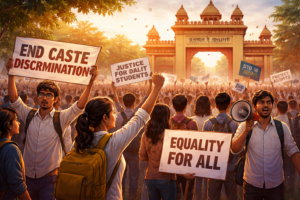
On a crisp February morning in Varanasi, students of Banaras Hindu University (BHU)—an institution once envisioned as a microcosm of a unified Hindu identity—marched not in celebration of tradition, but in defense of a document. They were protesting in support of the University Grants Commission’s (UGC) new regulations aimed at preventing caste-based discrimination on campuses. The scene was emblematic of a deeper schism that has plagued the Indian republic since its inception: the violent clash between what the law commands and what society permits.
The recent UGC guidelines, which mandated that universities take proactive measures against caste discrimination, were intended to be a bureaucratic course correction. Instead, they ignited a political firestorm. Dominant caste groups, student unions affiliated with right-wing ideologies, and a swath of social media pundits erupted in outrage. The accusations were familiar: the guidelines were “anti-national,” they would “destroy merit,” they were a ploy to divide students.
But beneath the rhetoric lay a more disturbing truth. The episode was not merely a debate about university policy; it was a litmus test for Indian democracy. When the state, however imperfectly, attempts to enforce the constitutional promise of equality, the reaction of civil society reveals whether that promise has taken root. In this case, the results were damning. They confirmed that for large sections of Indian society, the constitution remains a foreign imposition, a legal veneer over a social structure still governed by the ancient, unforgiving logic of caste.
The State vs. The Society: A Colonial Hangover?
To understand the fury, one must understand the fundamental contradiction at the heart of modern India. We live in two Indias simultaneously. The first is the India of the Constitution—a modern, rational, and legally defined entity that promises liberty, equality, and fraternity to all citizens regardless of birth. The second is the India of society—a pre-modern, hierarchical, and ritualistic structure where one’s place is determined by caste, and where the boundaries of community, charity, and even morality are defined by that hierarchy.
The philosopher and architect of the Indian Constitution, Dr. B.R. Ambedkar, foresaw this collision with terrifying clarity. On the eve of the Republic’s birth in 1950, he warned the nation that it was entering a “life of contradictions.” Politically, India would be a democracy; socially and economically, it would remain a feudal oligarchy. He cautioned that if this contradiction was not resolved, those who suffered from social inequality would eventually “blow up the structure of political democracy.”
Seventy-six years later, the UGC episode proved that the bomb has not been defused; it has merely been ticking.
The state, represented by the UGC, attempted to act as a corrective mechanism. It sought to enforce the constitutional morality that Dr. Ambedkar spent his life building. But the moment the state intervened to protect the most vulnerable sections of the academic community—students from Scheduled Castes (SCs), Scheduled Tribes (STs), and Other Backward Classes (OBCs) who face daily humiliation, exclusion, and violence in hostels and classrooms—the “society” reacted with collective outrage.
Why? Because caste, as Dr. Ambedkar noted, “has killed public spirit.” In a caste-ridden society, a Hindu’s public is his caste. His loyalty, his sympathy, and his sense of justice are restricted to the boundaries of his own group. The suffering of a Dalit student in a university hostel does not register as a “public” concern for the dominant castes; it is seen as a problem of the “other.” When the state attempts to force that concern into the public sphere, it is met with resistance, not because the policy is flawed, but because it violates the unwritten social contract of hierarchy.
The Myth of the “Merit” Argument
The loudest argument against the UGC guidelines was the defense of “merit.” Critics argued that by cracking down on “atrocities” and demanding accountability from faculty and administration, the state was creating an atmosphere of fear that would undermine academic excellence.
This argument is intellectually dishonest and sociologically ignorant. It presupposes that Indian universities have been functioning as pure meritocracies, where only intellect determines success. The reality, documented in countless reports from the National Commission for Scheduled Castes and the National Crime Records Bureau, is that campuses like BHU, Allahabad University, and Jawaharlal Nehru University (JNU) have become sites of institutionalized terror for marginalized students.
Merit does not exist in a social vacuum. It is cultivated. A student who is denied hostel accommodation, whose food is poisoned in a common mess (as seen in several documented cases), or who is subjected to slurs and intimidation by a professor or upper-caste peer is not competing on a level playing field. The “merit” argument is often a smokescreen for the desire to preserve a status quo where the fruits of education are reserved for those who have historically held social power.
When Dr. Ambedkar spoke of “fraternity” as the root of democracy, he defined it not as a vague sentimentality, but as a radical form of “Maitree”—a fellow feeling that compels one to recognize the humanity of another, even if they belong to a different caste. The backlash against the UGC guidelines demonstrated the absence of this fraternity. If there was a genuine, fellow feeling among the student community, the response to guidelines protecting Dalit students would have been solidarity. Instead, the response was fear—fear that the subjugated were finally gaining the tools to assert their rights.
The Reality of Rights
Perhaps the most sobering lesson from this episode is the fragility of rights. The Constitution of India is a magnificent document. It guarantees freedom of speech, equality before the law, and the abolition of untouchability. But as Dr. Ambedkar noted, “The Law may guarantee various rights, but only those can be called real rights which you are permitted by the society to exercise.”
This is the core of the Indian dilemma. A Dalit student has the legal right to sit in a classroom, but if society—represented by the professor, the classmates, and the local administration—makes that classroom hostile, the legal right is rendered meaningless. The UGC guidelines were an attempt to bridge this gap between legal guarantee and social reality. They aimed to ensure that the right to education was not just a line in the constitution, but a lived experience for every student.
The backlash revealed that the dominant sections of society are not yet ready to grant this permission. They are not ready to permit the full exercise of constitutional rights to those at the bottom of the caste hierarchy. This is not about political ideology; it is about the deep, visceral discomfort that arises when the social order is challenged.
Democracy as a Mode of Living
Ambedkar understood that democracy could not survive if it remained merely a form of government. He insisted that democracy is “primarily a mode of associated living.” It is a set of habits, behaviors, and relationships that must permeate the family, the neighborhood, and the educational institution.
The Indian state, with all its flaws, has largely maintained the mechanics of political democracy. We have elections, a judiciary, and a constitutional framework. But the social democracy—the “mode of associated living”—is in a state of crisis. The UGC episode showed that universities, which should be the nurseries of democratic values, are often the battlegrounds where caste hierarchy fights to maintain its last bastion.
When we look at the vitriol directed at the guidelines, we see a society that has learned to speak the language of the constitution while still practicing the rituals of caste. This duality creates a society that is perpetually on edge. Every time the state attempts to enforce the social principles of the constitution—whether through reservations, anti-discrimination laws, or land reforms—it triggers a cultural war.
The Path Forward: From Contradiction to Harmony
The UGC episode was not a defeat, nor was it merely a scandal. It was a diagnostic. It reminded us that the “life of contradictions” Dr. Ambedkar spoke of is not a relic of the 1950s; it is the defining feature of India in the 2020s.
If the project of Indian democracy is to survive, we must stop pretending that the contradiction doesn’t exist. We must accept that the state cannot simply legislate social harmony; it can only create the conditions for it. The rest must be fought for in the arena of society.
This requires a cultural revolution that goes beyond politics. It requires that citizens, particularly those from dominant castes, confront their own inherited prejudices. It requires that the concept of “fraternity” moves from the preamble of the constitution to the dining halls of universities and the common rooms of hostels.
The anger against the UGC guidelines was not just anger at a policy; it was the anger of a social order that felt its sovereignty challenged. It was the realization that for the first time, the state was signaling that the private tyranny of caste would no longer be tolerated in public institutions.
As the students marched in Varanasi, they were not just marching for a set of guidelines. They were marching for the soul of the Republic. They were demanding that the promise of 1950 be finally fulfilled in 2026. Whether Indian democracy passes this litmus test will depend not on what the UGC writes, but on whether the citizens of this country—across castes and communities—choose to build a society where rights are not just guaranteed, but respected. Until then, the state will continue to push against the weight of society, hoping that one day, the two will finally converge into a true democracy.
You must be logged in to post a comment.