
Beyond the Green Horizon: Why India’s Energy Future Demands a Multi-Path Approach
India stands at a pivotal juncture, aiming to achieve developed-economy status by 2047 while simultaneously working towards its net-zero by 2070 target, a challenge that requires powering massive growth and decarbonizing at an unprecedented scale. Rather than following a single, prescribed path, the nation’s success hinges on embracing technology neutrality—a pragmatic policy framework that focuses on outcomes like reduced emissions and energy security without mandating the specific technologies to get there.
This approach allows for a diversified and resilient energy portfolio, where renewables, natural gas (like LNG for long-haul trucking), nuclear, and future innovations can all compete and complement each other based on economics and feasibility. This strategy acknowledges the continued, though evolving, role of fossil fuels like coal in the near term as a bedrock for grid stability and rising demand, while using cleaner options like LNG as an immediate bridge to significantly cut emissions in hard-to-abate sectors.
Ultimately, by empowering multiple technological pathways to flourish in parallel, India is not slowing its green ambition but ensuring a pragmatic, secure, and inclusive transition that avoids locking into a single solution and is prepared to adopt the breakthroughs of tomorrow.
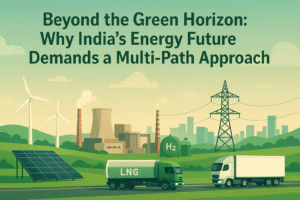
Beyond the Green Horizon: Why India’s Energy Future Demands a Multi-Path Approach
India stands at a crossroads of unprecedented scale. With an ambition to become a developed economy by 2047 and a commitment to achieve net-zero emissions by 2070, the nation is attempting a feat no other has accomplished: to industrialize at breakneck speed while systematically decarbonizing its massive energy system. This isn’t merely an energy transition; it is a complete re-engineering of the nation’s economic engine mid-flight.
The conventional wisdom often paints a linear path—a straightforward switch from dirty fossil fuels to clean renewables. But for a continent-sized civilization with over 1.4 billion people, a complex economy, and skyrocketing demand, the reality is far more nuanced. The true compass for this journey isn’t a single-minded focus on one technology, but a principle often overlooked in polarized energy debates: technology neutrality.
This philosophy moves beyond dictating “how” to achieve sustainability, instead focusing on the “what”—the desired outcomes of lower emissions, enhanced security, and economic viability. It empowers industry and innovators to deploy the most efficient, cost-effective, and context-appropriate solutions, whether that’s solar, wind, green hydrogen, nuclear, or cleaner fossil fuels like LNG.
The Scale of the Challenge: Growth Versus Green
To appreciate the necessity of a multi-pronged strategy, one must first grasp the sheer magnitude of India’s energy appetite. The target of 500 GW of non-fossil fuel capacity by 2030 is not just ambitious; it is a logistical marvel, requiring the nation to nearly double its current renewable base in just a few years.
Yet, beneath this green ambition lies a stubborn reality. Coal, the bedrock of India’s industrial rise, still accounts for over 74% of power generation. It provides grid stability, baseload power, and affordability that the economy currently relies upon. According to the International Energy Agency (IEA), despite retiring older plants, India is expected to add about 60 GW of new coal-fired capacity by 2030. Coal-based electricity generation is projected to grow by over 15% by 2035.
This isn’t a contradiction; it’s a reflection of a multi-faceted transition. Energy transitions of this scale are not light switches. They are more akin to a heart transplant on a marathon runner—the new system must be integrated without stopping the race. Demand is growing too rapidly to simply turn off existing supply. The transition, therefore, must be pragmatic, acknowledging the current role of fossil fuels while aggressively building the infrastructure for their eventual phase-down.
The Pragmatic Bridge: The Strategic Role of Natural Gas and LNG
In this complex landscape, natural gas, particularly in its liquefied form (LNG), emerges as a critical and pragmatic bridge fuel. Its value lies in its flexibility and its immediate environmental benefits.
- Grid Stability: As India ramps up its share of intermittent solar and wind power, the grid requires flexible, dispatchable power to balance supply and demand. Gas-fired power plants can be ramped up and down quickly, making them the ideal partner for renewables, ensuring the lights stay on when the sun doesn’t shine or the wind doesn’t blow.
- Decarbonizing Hard-to-Abate Sectors: Perhaps the most compelling case for LNG lies beyond the power sector, in areas where electrification remains a distant prospect.
A Case Study in Tech-Neutrality: The Trucking Dilemma
Consider India’s heavy-duty trucking sector. Over 4 million trucks form the backbone of the nation’s logistics, moving goods across vast distances. This segment is a carbon-intensive behemoth, contributing an estimated 12–14% of India’s energy-related CO₂ emissions.
The obvious, long-term solution seems to be electrification. However, the physics and economics of today’s battery technology present formidable hurdles for long-haul freight:
- Range and Payload: The batteries required to power a 40-ton truck for 800-1000 km would be prohibitively heavy and large, significantly reducing the payload capacity—the very reason the truck exists.
- Charging Infrastructure and Time: Building a nationwide network of mega-chargers and the grid to support them is a decade-long project. The hours required to recharge a massive battery pack are incompatible with the “just-in-time” demands of freight logistics.
This is where a tech-neutral policy delivers immediate dividends. The government’s target to transition a third of the long-haul trucking fleet to LNG by 2030 is a masterstroke of pragmatism. The data is compelling: compared to diesel, LNG can cut:
- CO₂ by up to 30%
- Carbon Monoxide (CO) by up to 70%
- Sulphur Oxides (SOx) by up to 100%
- Nitrogen Oxides (NOx) by up to 59%
- Particulate Matter by up to 91%
This isn’t a theoretical improvement; it’s a tangible, near-term air quality and public health victory. It allows the economy to keep moving while making a massive dent in emissions and pollution today, not in a distant future.
Crucially, this does not mean abandoning electric trucks. Instead, it’s about deploying the right tool for the right job. Electric trucks, with their current capabilities, are perfectly suited for short-haul, intra-city logistics and last-mile delivery, where daily range is predictable and charging can be done at a depot overnight. In this vision, LNG and electric powertrains are not adversaries; they are complementary allies in the same war against carbon, each dominating the segment where it is most effective.
The Innovation Engine: How Competition Fuels the Future
The deepest value of technology neutrality is its power to foster innovation. When policies pick a single winner—say, by offering subsidies only for solar—they can inadvertently stifle investment in other promising areas like green hydrogen, advanced nuclear, or biofuel.
A neutral framework, focused on outcomes like “lowest levelized cost of energy” or “greatest emissions reduction per rupee,” creates a competitive marketplace for ideas. It tells entrepreneurs and researchers: “We don’t care how you solve the problem, just solve it.” This accelerates a Darwinian process where the most efficient, scalable, and cost-effective technologies survive and thrive, driving down costs for everyone.
Furthermore, this approach builds systemic resilience. A grid powered by 80% solar and wind is a grid vulnerable to weather patterns and diurnal cycles. A diversified portfolio that includes firm renewables (like geothermal or hydropower), a range of energy storage solutions (from batteries to pumped hydro), flexible natural gas, and emerging baseload contenders like hydrogen or small modular reactors (SMRs) is a grid that can withstand shocks and deliver reliable, round-the-clock power—the non-negotiable foundation of a modern economy.
Leapfrogging the Legacy: India’s Unique Opportunity
Unlike Western nations that built their wealth on fossil fuels and are now grappling with the costly retrofitting of their energy systems, India has a unique, albeit challenging, opportunity. It can integrate clean and efficient technologies from the ground up as it builds new infrastructure.
This is the chance to leapfrog the legacy systems of the 20th century. It’s not just about replacing coal plants with solar farms; it’s about designing smart, decentralized microgrids for rural areas; building EV-ready cities from their inception; and creating an industrial base that is efficient and low-carbon by design.
Technology neutrality is the engine of this leapfrog development. It prevents the nation from locking into a single, potentially sub-optimal technology path and keeps it agile, ready to adopt the next breakthrough, whether it originates in a Silicon Valley lab or a Bengaluru startup.
Conclusion: The Compass is Set
India’s energy transition is the most complex orchestration of policy, technology, and economics the world has ever witnessed. The goal is clear: a prosperous, developed nation living in harmony with its environment. The path, however, is not a single, well-paved highway.
By embracing technology neutrality, India is equipping itself with a robust compass, not a rigid map. It acknowledges that the journey to 2070 will be traversed by a fleet of different vehicles—some electric, some hydrogen-powered, some running on LNG as a bridge, and others on technologies yet to be invented. True leadership in the 21st century lies not in choosing one path, but in creating the conditions for all viable paths to converge toward a cleaner, more secure, and more inclusive energy future for all.
You must be logged in to post a comment.