
Beyond the Gavel: Reimagining India’s Dispute Resolution Framework for a 21st Century Democracy
India’s colonial-era adversarial legal system, built on binaries of right and wrong and reliant on overcrowded courts, has resulted in over 48 million pending cases and an annual economic loss of 1.5% of GDP, demonstrating its fundamental unsuitability for the country’s culturally diverse and communitarian fabric. While legislative reforms like the Arbitration Act and Mediation Act have attempted to introduce alternative mechanisms, they remain hampered by an entrenched litigation mindset and lack of institutional infrastructure. The path forward lies in embracing hybrid models like Med-Arb and Arb-Med-Arb, establishing specialized expert tribunals for technical disputes, ratifying the Singapore Convention on Mediation, and fundamentally reorienting legal education away from adversarial combat toward collaborative resolution. This transformation requires not merely legal reform but a cultural shift that reclaims India’s pre-colonial traditions of dialogic justice, creating a pluralistic ecosystem where courts, arbitration, mediation, and hybrid processes coexist to offer citizens truly appropriate pathways to resolution.
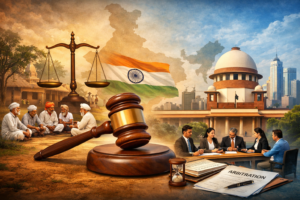
Beyond the Gavel: Reimagining India’s Dispute Resolution Framework for a 21st Century Democracy
The courtroom falls silent as the judge raises the gavel. For the litigants who have waited seven years for this moment—passing through 47 adjournments, three changes of counsel, and countless hours in overcrowded corridors—the impending judgment represents either vindication or devastation. But here’s the uncomfortable question that lingers long after the court disperses: Has justice actually been served?
India’s colonial inheritance—an adversarial legal system built on binaries of right and wrong, winner and loser—has brought the world’s largest democracy to a precipice. With over 48 million cases pending across courts and an estimated economic cost of 1.5% of GDP annually, the system designed to deliver justice has instead become its most formidable obstacle . The stress fractures are visible everywhere: in the 180,000 cases pending for over three decades, in the 75% of prisoners who are undertrials, in the ₹14.18 lakh crore locked in tax disputes .
But perhaps the deepest wound is invisible—the gradual erosion of a cultural truth about this civilization: that for millennia before the British arrived, Indians resolved disputes not through adversarial combat but through dialogue, consensus, and community wisdom.
The Pre-Colonial Tapestry: When Dialogue Was Justice
Long before the first British ships landed on Indian shores, the subcontinent operated sophisticated dispute resolution mechanisms that bore little resemblance to the Westminster model. The kula (clan assemblies), sreni (guilds of traders and artisans), and puga (neighborhood assemblies) formed a multi-layered ecosystem where disputes were addressed through deliberation rather than determination .
In village India, the panchayat—literally an assembly of five elders—held sway over everything from boundary disputes to matrimonial discord. These were not courts in the modern sense. They did not operate on precedent or rigid procedural codes. They functioned on something far more powerful: social cohesion and the understanding that a village divided against itself cannot thrive.
What makes these traditional institutions remarkable is not their informality but their orientation. They were fundamentally restorative rather than punitive, focused on preserving relationships rather than assigning blame. When two families brought their grievance to the panchayat, the elders understood that whatever decision they rendered would have to allow these same families to share the village well the next morning, to attend each other’s weddings, to coexist.
This was not naive idealism. It was practical wisdom encoded into institutional memory.
The Colonial Imposition: When Justice Became a Battlefield
The British did not merely colonize Indian territory; they colonized Indian conceptions of justice. The adversarial system they imported was predicated on a fundamentally different worldview—one where truth emerges from conflict, where opposing parties present polarized versions of reality, and where a neutral arbiter chooses between them.
This model, developed in the crucible of English common law, reflected a society that had undergone very different historical experiences. It presumed a level of social atomization that simply did not exist in India’s communitarian fabric.
As Srđan Šimac, the Croatian jurist and mediator, observed, “Litigation produces one form of justice—the justice of a judicial decision. It is necessary, legitimate, and in many situations indispensable. But it comes at a cost: the reduction of reality and truth, the loss of party voice, and the transformation of complex human conflicts into legal questions with one winner and one loser, and too often, two losers.”
The colonizers understood that law was an instrument of control. A population trained to see justice as something dispensed from above, mediated through complex procedures and foreign languages, was a population rendered dependent. The adalat system did not replace traditional mechanisms overnight—the two operated in parallel for decades—but over time, the formal system’s prestige and power drew disputes away from community forums .
The Numbers That Scream: Why the System Is Failing
Today’s crisis cannot be understood without grappling with its scale. India has approximately 15-21 judges per million people, compared to 150 in the United States and 220 in Europe . An average district judge handles 2,200 cases simultaneously. Some High Court judges face workloads of up to 15,000 cases.
The National Judicial Data Grid paints a grim picture:
- District Courts: Over 4.7 crore pending cases
- High Courts: More than 63 lakh pending matters
- Supreme Court: Approximately 90,000 cases awaiting hearing
But raw numbers tell only part of the story. Contract enforcement takes an average of 1,445 days in India—placing the country among the slowest jurisdictions globally . For businesses, this translates to uncertainty that the World Bank estimates costs India 1.4% of GDP annually. For ordinary citizens, it means justice perpetually deferred.
The government itself is the largest litigant, responsible for nearly half of all pending matters . When the state cannot resolve its own disputes efficiently, it sends a devastating signal about the rule of law.
The Arbitration Paradox: Reform Without Transformation
India has not been idle in the face of this crisis. The Arbitration and Conciliation Act of 1996, based on the UNCITRAL Model Law, represented a serious attempt to create a parallel track for commercial dispute resolution . Amendments in 2015, 2019, and 2021 sought to address emerging challenges—time limits, institutional promotion, reduced judicial interference.
Yet the results have been decidedly mixed. As Mohit Saraf, founder of Saraf & Partners, noted at the London International Disputes Week in 2025, “A client once told me Indian arbitration is where the operation is successful but the patient dies. That is where we are headed with unclear drafting” .
The problem is conceptual. India has attempted to graft arbitration onto a litigation mindset. Section 29A’s 12-month deadline for domestic arbitration was intended to accelerate proceedings, but practitioners report that arbitrators now slash caseloads to avoid default, and delays have simply shifted to the challenge stage . The law increasingly treats arbitration “as if it is a delegated judicial function, not a private contract,” undermining the party autonomy that is arbitration’s lifeblood .
Even more concerning is the recent policy shift reflected in the Ministry of Finance’s June 2024 guidelines, which direct that “arbitration as a method of dispute resolution should not be routinely or automatically included in procurement contracts/tenders, especially in large contracts” . For disputes exceeding ₹10 crore, government entities are now encouraged to litigate rather than arbitrate.
This is not reform; it is retreat. In a country where two-thirds of civil cases relate to land and infrastructure projects, removing arbitration from public procurement—precisely where technical expertise matters most—is a step backward .
The Mediation Moment: Legislative Progress and Cultural Resistance
The Mediation Act of 2023 represents India’s most ambitious legislative foray into non-adversarial dispute resolution. By requiring pre-litigation mediation for certain disputes and ensuring mediated settlements are enforceable as court decrees, the Act creates a robust legal foundation for mediation .
Yet legislation alone cannot effect cultural transformation. India’s legal profession has been trained for generations in adversarial combat. Mediation requires an entirely different skill set—active listening, interest identification, creative problem-solving—that has never been part of the bar’s curriculum or the bench’s orientation .
The Parliamentary Standing Committee’s 2022 report on the Mediation Bill recognized this gap, emphasizing the need for training and institutional capacity building. But capacity cannot be built overnight, and the notion that “we cannot resolve our disputes without an authoritative court” remains deeply embedded in the Indian legal psyche .
Hybrid Horizons: The Promise of Med-Arb and Arb-Med-Arb
If pure arbitration has struggled and pure mediation faces cultural resistance, perhaps the path forward lies in hybridization. The Med-Arb and Arb-Med-Arb models offer precisely this synthesis—combining the flexibility and relational focus of mediation with the finality and enforceability of arbitration .
The Arb-Med-Arb (AMA) process operates in three stages:
- Arbitration commencement: Parties submit their dispute to arbitration, establishing jurisdiction and creating the framework for a binding resolution if needed.
- Mediation intervention: At an agreed stage, arbitration pauses, and parties attempt mediation with a neutral mediator—often someone other than the arbitrator to avoid concerns about bias or improper influence.
- Resolution or resumption: If mediation succeeds, the settlement is recorded as an enforceable arbitral award. If it fails, arbitration resumes and proceeds to a binding decision .
Section 30 of the Arbitration and Conciliation Act already empowers arbitral tribunals to encourage settlement through mediation, and Section 31 allows mediated settlements to be recorded as arbitral awards . The legal architecture exists. What India lacks is the institutional infrastructure to operationalize these hybrid processes at scale.
Learning from Singapore and China: The Institutional Imperative
Singapore offers perhaps the most instructive model. The SIAC-SIMC Arb-Med-Arb Protocol provides a structured pathway that integrates mediation within arbitration while maintaining clear procedural boundaries. Crucially, Singapore’s ratification of the Singapore Convention on Mediation ensures that mediated settlements enjoy international enforceability .
China’s experience with CIETAC (China International Economic and Trade Arbitration Commission) demonstrates how hybrid models can handle large-scale, cross-border commercial disputes efficiently. CIETAC’s role in resolving disputes arising from the Belt and Road Initiative shows that AMA processes can be streamlined for complex, multi-jurisdictional matters .
What both examples share is institutional sophistication. They are not merely legal frameworks but ecosystems—with trained neutrals, clear protocols, quality assurance mechanisms, and international connectivity.
The Specialization Challenge: When Law Meets Engineering
Construction and infrastructure disputes present a particular challenge that illuminates the broader problem. These matters involve not just legal questions but engineering design, project scheduling, cost escalation, and performance management issues. The traditional courtroom, with judges trained exclusively in law, is structurally ill-equipped to engage with such technical complexity .
As Alisha Mehta of Dhirubhai Ambani University’s School of Law argues, “What India urgently needs is not the abandonment of arbitration, but rather its reformation through specialization. Establishing statutory arbitral tribunals comprising experts with backgrounds in construction law, civil engineering, and contract management could provide a balanced and pragmatic solution” .
This insight extends far beyond construction. Family disputes require different expertise than commercial contracts. Intellectual property matters demand different sensibilities than shareholder disagreements. A mature dispute resolution ecosystem recognizes that one size fits none.
A Blueprint for Transformation
Reimagining India’s dispute resolution framework requires moving beyond the binary of “courts versus ADR” to embrace a genuinely pluralistic vision where multiple pathways exist and parties can choose the route best suited to their specific situation.
First, India must formalize and institutionalize hybrid processes like Arb-Med-Arb. This means developing clear protocols akin to Singapore’s SIAC-SIMC model, training a cadre of neutrals competent in both arbitration and mediation, and ensuring that institutional rules provide clarity about role separation to prevent concerns about bias .
Second, India should ratify the Singapore Convention on Mediation. This would dramatically enhance the international enforceability of mediated settlements, making India a more attractive venue for global dispute resolution and signaling serious commitment to mediation as a legitimate alternative .
Third, specialized tribunals must be established for technical domains. Construction, intellectual property, taxation, and infrastructure disputes require adjudicators who understand both the law and the subject matter. These tribunals should draw from interdisciplinary pools—engineers, accountants, architects, and project managers alongside lawyers .
Fourth, legal education must be fundamentally reoriented. The adversarial mindset is not innate; it is taught. Indian law schools and professional training programs should introduce mandatory courses in negotiation, mediation, and conflict resolution. The bar must be trained not only to fight cases but to resolve disputes .
Fifth, judicial vacancies must be filled as a matter of national urgency. With approximately one-third of High Court judge positions and 21% of trial court judgeships unfilled, the system operates with one hand tied behind its back . The collegium system requires reform to ensure timely appointments without compromising independence.
Sixth, the government must lead by example. As the largest litigant, the state’s dispute resolution behavior sets norms for the entire system. The recent retreat from arbitration in public procurement is precisely the wrong signal. Instead, government entities should embrace mediation, institutional arbitration, and hybrid processes—demonstrating that resolving disputes is not a sign of weakness but of wisdom .
The Cultural Challenge: From Fighting to Resolving
Ultimately, the transformation India requires is not merely legal but cultural. Abraham Maslow’s observation remains apt: “I suppose it is tempting, if the only tool you have is a hammer, to treat everything as if it were a nail.” For too long, adjudication has been the only hammer in India’s justice toolbox.
The adversarial psyche conditions people to fight rather than resolve, to dig trenches rather than build bridges. It teaches that compromise is weakness, that settlement is surrender. This worldview is profoundly at odds with India’s civilizational heritage of dialogue and consensus.
The panchayats of old understood what modern legal systems often forget: that justice is not merely about applying rules to facts but about enabling human beings to coexist, to cooperate, to create together. A judgment that destroys a relationship is, in many cases, not justice at all.
The Road Ahead
India stands at a crossroads. One path continues the current trajectory—incremental reforms within an adversarial paradigm, courts groaning under impossible caseloads, litigants waiting decades for resolution, economic potential squandered in legal quicksand.
The other path leads toward a genuinely pluralistic dispute resolution ecosystem—where courts do what courts do best (authoritative determination of rights in appropriate cases), where arbitration provides efficient and expert resolution for commercial matters, where mediation restores relationships and uncovers interest-based solutions, and where hybrid processes combine the strengths of multiple approaches.
This second path requires more than legislative amendments. It demands a fundamental reimagining of what justice means and how it can be delivered in a vast, diverse, complex democracy. It requires humility to learn from other jurisdictions and courage to reclaim India’s own traditions of dialogic resolution.
The gavel will continue to fall in courtrooms across India. But it need not be the only sound of justice. The voices of mediators, arbitrators, and disputants themselves—talking, listening, understanding, agreeing—can create a richer, more harmonious symphony.
For a nation aspiring to first-world status by its centenary of independence in 2047, the question is not whether India can afford to transform its dispute resolution framework. The question is whether India can afford not to.
You must be logged in to post a comment.