
Beyond the Gate: What the Rafah Crossing’s Fragile Reopening Reveals About Gaza’s Long Road Ahead
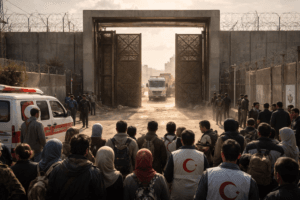
Beyond the Gate: What the Rafah Crossing’s Fragile Reopening Reveals About Gaza’s Long Road Ahead
On February 3, 2026, a heavily fortified gate on the southern edge of the Gaza Strip swung open, not fully, but just enough to allow a sliver of light to pass through. The partial reopening of the Rafah border crossing, heralded in official statements from capitals like Paris, represents more than a logistical update. It is a fragile symbol, a tactical maneuver, and a Rorschach test for the future of a shattered territory. While France rightly welcomes it as an “important first step,” a deeper examination reveals a landscape fraught with peril, promise, and the profound weight of what comes next.
A Gate of Lifelines and Geopolitics
For nearly two decades, the Rafah crossing has been more than a border checkpoint; it is a barometer of the Israeli-Palestinian conflict. Operated under a complex agreement since 2005, its functioning has been erratic, often subject to the political winds of the moment. Its closure has meant imprisonment for Gaza’s 2.3 million residents; its opening, a vital conduit for people, medicine, and hope.
France’s statement underscores two critical operational developments: the first medical evacuations and the redeployment of the EU Border Assistance Mission (EUBAM Rafah) and Palestinian Authority (PA) personnel. The medical evacuations are not merely a humanitarian footnote. Each individual transported represents a life-saving intervention delayed by conflict, a tangible human outcome of the ceasefire’s “second phase.” It is a direct, if limited, response to a healthcare system described for years as being on the brink of collapse.
The return of EUBAM and PA officials, however, is the true geopolitical heartbeat of this move. EUBAM’s presence, even with the initial six French Gendarmerie members cited, provides a veneer of international oversight and technical legitimacy. More significantly, the PA’s return to the Gazan side of the gate is a tentative, yet crucial, stitch in the torn fabric of Palestinian governance. It is a fragile attempt to begin re-connecting Gaza with the West Bank institutionally, a foundational requirement for any future cohesive Palestinian statehood. France’s insistence that these personnel “must be able to fully perform their duties” is a clear, pre-emptive message to all actors who might seek to undermine their authority.
The Ceasefire’ Brittle Foundation
France’s welcome is immediately tempered by a stark reality check: it “deplores the ceasefire violations… including the Israeli airstrikes on January 31, which killed numerous civilians.” This juxtaposition, within a single paragraph, lays bare the immense fragility of the moment. A crossing opens for evacuations while airstrikes elsewhere shatter the very peace that made the opening possible.
This is the central, agonizing contradiction of post-conflict Gaza. Reconstruction cannot begin in earnest under the threat of renewed violence. Donor conferences stall, engineers hesitate, and traumatized populations cannot envision a future when the present remains so volatile. The “second phase” of the ceasefire plan, which this step initiates, appears less like a linear path and more like a tightrope walk over a canyon. The violations underscore that hardline factions on all sides see this period of calibration not as a bridge to peace, but as a strategic opportunity to reposition or protest through violence.
France’s call for “massive, unhindered delivery of humanitarian aid through all crossing points” (emphasis added) is a critical clarification. Rafah alone is insufficient. The economic and logistical lifelines of Kerem Shalom and the now-closed Erez crossing are essential for the scale of need. Aid must flow not as a trickle of charity, but as a flood of sustenance for reconstruction. This requires a fundamental shift from a siege mentality to a rehabilitation imperative—a shift that powerful security constituencies in Israel remain deeply reluctant to make.
France’s Role: Strategic Patronage and the “Political Horizon”
Paris positions itself here not just as a commentator, but as an active, invested player. The deployment of Gendarmerie officers to EUBAM is a tangible commitment. These are not frontline troops but specialists in border management, security institution-building, and police diplomacy. Their mission—to support securing the crossing and the PA’s redeployment—is a classic French foreign policy tool: projecting influence through technical assistance and support for multilateral frameworks.
The most forward-looking, and arguably most challenging, part of the statement is the call for “the re-establishment of a political horizon.” This diplomatic phrase carries the weight of failed decades. It is an acknowledgment that gates, aid convoys, and even ceasefires are ultimately temporary unless they lead to a credible, irreversible process toward a two-state solution. For France and the EU, the Rafah reopening must be leveraged to reinvigorate the political process. The fear is that the world will become consumed by the mechanics of Gaza’s rubble-clearing and forget the underlying political crisis that produced the rubble in the first place.
The Unseen Challenges: Trust, Governance, and the Ghosts of War
Beyond the official statement lie profound challenges. First is the issue of trust. Can the PA, viewed by many in Gaza as corrupt and out of touch, effectively and legitimately reassume administrative control? Or will its presence at Rafah be seen as a proxy for other powers, fueling resentment? EUBAM’s success depends on the cooperation of Israel, Egypt, the PA, and Hamas de facto authorities—actors with wildly divergent interests.
Second is the sheer scale of destruction. Rebuilding Gaza is not a construction project; it is the genesis of an entirely new urban entity. It requires not just cement and steel, but a functioning banking system, clean governance to prevent diversion of funds, and a generation of skilled labor. The crossing of a few trucks is a pathetic symbol against the need for a sustained, industrial-level influx of materials.
Finally, there are the human ghosts. The civilians killed in the January 31 airstrikes, mourned in the French text, represent the ever-present shadow. The psychological trauma, the loss of family homes and histories, the erosion of any sense of safety—these wounds will not be healed by an open border. They require a lasting peace that feels permanent to a child in Gaza City.
Conclusion: A Step, But Toward What?
The partial reopening of Rafah is a necessary, welcome, and profoundly fragile development. It is a test balloon for cooperation, a relief valve for human suffering, and a chess piece in a larger geopolitical game. France’s statement correctly frames it as the beginning of a journey, not the destination.
The true measure of success will not be found in the number of EVAC patients or EU monitors, but in what follows. Does this become a confidence-building measure that leads to the opening of other crossings and the steady demilitarization of daily life? Or does it become an isolated gesture, whittled away by the next violation, the next provocation, the next round of violence?
The gates of Rafah are now slightly ajar. The world must ensure they open onto a road leading away from the ruined past, not just a temporary pause before its repetition. The “political horizon” must be more than a diplomatic mirage; it must become the clear and agreed destination for all those now stepping tentatively through the opening. The journey of a thousand miles begins with a single step, but only if that step is followed by a relentless, unwavering march toward peace.
You must be logged in to post a comment.