
Beyond the Furnace: How India’s LPG Crisis is Threatening the Very Backbone of Heavy Industry
The Indian refractory industry, essential for steel, cement, and other high‑temperature sectors, faces a critical threat from ongoing LPG shortages. Refractory manufacturing requires stable, high‑calorific fuel for firing materials above 1,200°C, and kilns are designed for specific fuels, making immediate switching to alternatives technically and financially impractical. Disruptions have forced production delays and partial shutdowns, raising concerns of cascading impacts on core industries that depend on refractories for daily operations and maintenance. The Indian Refractory Makers Association has urged the government to prioritise LPG supply for the sector alongside domestic consumers to avert a systemic industrial crisis.
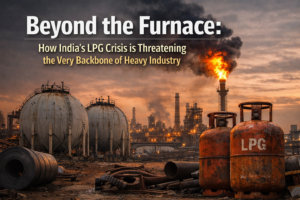
Beyond the Furnace: How India’s LPG Crisis is Threatening the Very Backbone of Heavy Industry
Beneath the glow of India’s booming infrastructure and the roar of its steel mills lies an invisible, often overlooked industry that makes modern manufacturing possible: refractories. These are the specialized ceramic linings that line the insides of kilns, furnaces, and reactors, allowing them to withstand molten metal and temperatures exceeding 1,500°C. Without refractories, there is no steel, no cement, no glass, and no non-ferrous metals like copper and aluminum.
Yet, as of March 2026, this “silent enabler” of industrial growth is facing an existential operational threat. It is not a lack of demand or a labor dispute that is causing panic in boardrooms across the country, but a shortage of a seemingly unrelated household commodity: Liquefied Petroleum Gas (LPG).
While the nation’s attention has been focused on domestic cooking gas supplies, the refractory manufacturing sector is sounding a high-decibel alarm. The ongoing disruptions to LPG supply are no longer a logistical inconvenience; they have become a systemic risk capable of halting the production lines that keep core industries alive.
The Invisible Hand in High-Temperature Manufacturing
To understand the gravity of the situation, one must first appreciate the technical brutality of refractory manufacturing. This is not a simple process of mixing clay and baking bricks. Refractory products are engineered materials designed to perform under extreme thermal stress, chemical corrosion, and mechanical abrasion.
The manufacturing process requires “firing”—the act of heating raw materials like alumina, magnesia, and fireclay to temperatures often surpassing 1,200°C. This process is not just about applying heat; it is about controlled transformation. The microstructure of the refractory, its porosity, its thermal shock resistance, and its final strength are all determined during this firing phase.
This is where LPG becomes indispensable. For decades, the industry has leaned heavily on LPG and natural gas because they are “clean fuels.” Unlike coal or heavy oil, LPG burns without leaving ash or residual sulfur that can contaminate the high-purity ceramics. More importantly, LPG offers a consistent calorific value and precise flame control.
Parmod Sagar, Chairman, MD and CEO of RHI Magnesita India, a global leader in the space, aptly described the current predicament as a matter of “process integrity.” In high-temperature manufacturing, consistency is king. A fluctuation in pressure or a change in the chemical composition of the fuel can ruin an entire batch of specialized bricks, which can cost lakhs of rupees and take days to produce. When the fuel supply becomes erratic, manufacturers are forced into a reactive mode—tinkering with firing cycles, slowing down production to conserve fuel, or in worst-case scenarios, allowing kilns to cool down unexpectedly, which can cause physical damage to the kilns themselves due to thermal contraction.
The Myth of the Quick Fix
When industries face fuel shortages, the natural public policy question is: Why don’t they just switch to an alternative fuel?
The answer, according to industry veterans, lies in the physics of industrial kiln design. A refractory kiln is not a generic oven. It is a bespoke piece of engineering calibrated for a specific fuel type. The length of the flame, the velocity of the combustion air, and the placement of burners are all designed around the properties of the fuel being used.
Sunanda Sengupta, Chairman of the Indian Refractory Makers Association (IRMA) and Executive Director at TRL Krosaki Refractories, explains that the diversity of the product range adds another layer of complexity. “There is a wide range of refractories, each with its own specific firing requirements,” he noted. Switching from LPG to, say, furnace oil or petcoke is not merely a matter of flipping a valve. It requires significant capital expenditure to retrofit burners, install new safety systems, and recalibrate control systems. Moreover, it would necessitate requalification of the products—a process that can take months, as customers like steel plants will not accept untested refractories for critical applications like blast furnace linings.
In the current scenario, where the disruption is immediate, the luxury of time required for such a transition simply does not exist.
A Cascading Economic Threat
The ramifications of this LPG crunch extend far beyond the boundaries of the refractory plants. The refractory industry sits at the very base of the industrial supply chain. It is the quintessential “B2B enabler.”
Consider the steel industry, which alone accounts for nearly 70% of refractory consumption. Indian steel plants operate on a continuous-cast model. If a steel plant’s refractory lining in a Basic Oxygen Furnace (BOF) or a Continuous Caster fails because replacement refractories are delayed or substandard due to production issues, the entire steel plant risks a “shut down.” The cost of a single day of lost steel production runs into hundreds of crores of rupees.
Similarly, the cement industry relies on refractories to protect the rotating kilns where clinker is formed. The glass industry uses refractory tanks that must be replaced every few years; a delay in manufacturing these specialty shapes can halt glass production lines for weeks.
If the LPG shortage persists, the industry warns of a “curtailment” of production. This would trigger a domino effect: delays in maintenance schedules for steel plants, increased import dependency on finished refractories (which erodes the country’s Atmanirbhar Bharat ambitions), and ultimately, inflationary pressure on infrastructure costs.
The Appeal for ‘Industry Status’ in Fuel Allocation
In a bid to stave off this crisis, the Indian Refractory Makers Association has escalated the matter to the Union Ministries of Steel, and Petroleum and Natural Gas. Their primary demand is deceptively simple yet critical: prioritize LPG supply for refractory manufacturers alongside domestic consumers.
Currently, in times of supply-side crunches—whether due to global geopolitical tensions, logistical bottlenecks, or domestic production fluctuations—the government’s priority has historically been household consumers. While this is politically and socially necessary, the IRMA is arguing that the definition of “essential” must be expanded to include the manufacturing industries that sustain the economy.
The industry is not asking for subsidies; they are asking for reliability. In a letter to the ministries, the association highlighted that the refractory sector is a “captive consumer” of energy. Without a predictable fuel supply, just-in-time manufacturing—the bedrock of modern industrial efficiency—collapses.
A Systemic Risk to Manufacturing Ambitions
The current LPG disruption serves as a stress test for India’s industrial resilience. As the nation pushes toward becoming a global manufacturing hub, the fragility of its industrial fuel supply chain is being exposed.
India’s refractory sector, though often out of the public eye, is a sophisticated industry with a strong domestic manufacturing base. Companies like RHI Magnesita, TRL Krosaki, and IFGL Refractories have invested heavily in technology and capacity. However, capital investment is rendered useless if the operational fuel to run the kilns is unreliable.
The situation is a classic case of supply chain myopia. Economies often focus on the final output—the steel beam, the cement bag, the car—forgetting that the tools and linings required to make those outputs are manufactured in separate, equally vulnerable facilities.
Looking Ahead
As the LPG shortage tightens its grip, the refractory industry is bracing for a difficult quarter. While some larger players with diversified fuel capabilities (like those using natural gas pipelines or having captive power plants) may weather the storm, smaller and mid-sized manufacturers—who form the backbone of the supply chain for specialized products—are on the brink of operational shutdowns.
The coming weeks will be crucial. The government’s response to the IRMA’s plea will set a precedent for how India manages industrial energy security amidst fluctuating global energy markets. If the administration moves swiftly to reclassify industrial fuel priorities, the sector might stabilize. If not, the country could face a hidden but potent industrial crisis—one where the furnaces of India’s largest steel plants remain hungry, not for iron ore, but for the refractory bricks that allow them to burn.
In the high-stakes world of manufacturing, the battle for India’s industrial future is often fought not in boardrooms, but in the supply chain. Right now, that battle hinges on a steady flow of LPG to the kilns that keep the nation’s core sector running. The message from the refractory makers is clear: ignore the enabler at your own peril.
You must be logged in to post a comment.