
Beyond the Forecast: Unpacking North India’s Weekend Weather Whiplash
Over the coming weekend, North India will experience contrasting weather patterns driven by two Western Disturbances: while Delhi enjoys clear, sunny skies with daytime temperatures of 23-25°C and brisk winds, the mountainous regions of Jammu & Kashmir, Ladakh, Himachal Pradesh, and Uttarakhand are set for isolated to widespread snowfall and rainfall, particularly from February 9-11. Concurrently, dense morning fog will continue to disrupt visibility in isolated pockets of Punjab, Uttar Pradesh, and Odisha, while a separate cyclonic circulation brings scattered rain to Lakshadweep and rough conditions to southern coastal areas.
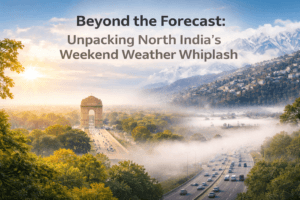
Beyond the Forecast: Unpacking North India’s Weekend Weather Whiplash
If you’re in Delhi this weekend, glance out your window. That crisp, golden sunshine bathing the city isn’t just a pleasant interlude—it’s the calm between two atmospheric storytellers, known as Western Disturbances, scripting dramatically different scenes across the subcontinent. While the capital bundles up for sunny but cool days, the hills of the north are bracing for a fresh coat of snow, and the plains continue to navigate patches of dense, disruptive fog. This isn’t merely a weather report; it’s a glimpse into the dynamic dance of climate systems that define an Indian winter, affecting everything from travel plans to agricultural rhythms.
Delhi’s Winter Reprieve: Sunshine with a Side of Caution
For Delhiites weary of the chill, the forecast for the weekend offers a welcome respite. According to the India Meteorological Department (IMD), the city is set for predominantly clear skies on February 7th, with maximum temperatures climbing to a pleasant 23-25°C. Mornings will still be cool, with minimums dipping to 9-11°C, but the stark winter bite seems to be retreating momentarily.
However, this sunshine comes with its own character. The IMD warns of strong surface winds, potentially reaching up to 25 km/h during the afternoons. These winds, while sweeping away pollutants and offering that “crisp” feel, can significantly amplify the perceived cold. That jacket you might be tempted to leave at home? You’ll likely need it, especially after sunset when the temperature drops rapidly. Over the next four days, a gradual rise of 2-4°C in minimum temperatures is anticipated across northwest India, signalling a slow, steady shift towards warmer days. This pattern is typical of late winter, where sunny spells often precede or follow active weather systems in the hills.
The Hills Come Alive: A Twin Dose of Western Drama
The real meteorological action is unfolding over North India’s mountainous spine, orchestrated by two consecutive Western Disturbances (WDs). For the uninitiated, a Western Disturbance is not a local storm, but a travelling wave of low-pressure originating from the Mediterranean or Caspian Sea. As it rides the westerly jet streams across the Middle East and into the Indian subcontinent, it collides with the Himalayas, forcing moist air upward and triggering precipitation.
The first of these systems is currently active over northern Afghanistan. Its influence is already being felt in the form of isolated rainfall and snowfall in the high-altitude regions of Jammu & Kashmir, Ladakh, Gilgit-Baltistan, and Muzaffarabad. This is just the opening act.
The main event is a fresher, more potent WD expected to arrive on the night of February 8th. This system is predicted to energise a more widespread and active wet spell from February 9th to 11th. The states of Himachal Pradesh and Uttarakhand are now squarely in the forecast, alongside the ongoing activity in J&K and Ladakh. For residents and travellers in these regions, this translates to:
- Fresh Snowfall: Key passes, mountain roads, and tourist destinations like Shimla, Manali, Gulmarg, and Auli could see significant fresh snow accumulation.
- Travel Advisories: Those planning road trips, especially to higher reaches, must check conditions carefully. Snowfall often leads to blocked passes (like Rohtang, Nathu La) and requires chain fittings on vehicles.
- Avalanche Risk: After a dry spell, a fresh load of snow can increase avalanche susceptibility on vulnerable slopes.
For the agricultural community in the hills, this snowfall is a vital “winter recharge” for glaciers and groundwater, promising better water security for the spring and summer months.
The Persistent Veil: Fog Continues to Challenge the Plains
While the mountains prepare for snow, the plains of North India are grappling with a more insidious weather phenomenon: dense fog. The IMD has issued warnings for isolated pockets of Uttarakhand (until Feb 7) and Himachal Pradesh (until Feb 8) during the morning and night hours.
The situation in the broader Indo-Gangetic plains remains challenging. In the past 24 hours, visibility dropped to zero in parts of Punjab and a mere 50 metres in several areas of Uttar Pradesh and Odisha. This isn’t just an inconvenience; it’s a major disruptor with cascading effects:
- Transport Chaos: Flight schedules at airports like Lucknow, Varanasi, and Amritsar face delays and cancellations. Trains, particularly those running across North India, are chronically delayed, sometimes by over 8-12 hours.
- Highway Hazards: The deadly combination of low visibility and high-speed travel leads to chain-reaction accidents on expressways like the Yamuna and Agra-Lucknow.
- Health Impacts: The fog often acts as a smog blanket, trapping pollutants close to the ground and leading to a severe spike in AQI, exacerbating respiratory issues.
This persistent fog is a result of clear nights, low winds, and ample moisture near the ground—conditions that are classic for northern Indian winters.
A Subcontinental Snapshot: South and East in Focus
India’s weather mosaic is never complete without a look beyond the north.
- Southern India: A cyclonic circulation over the Lakshadweep area is expected to bring scattered rainfall to the islands. More critically, the IMD has advised fishermen to avoid venturing into the Gulf of Mannar and adjoining Comorin area due to potentially rough sea conditions—a reminder of how localized systems can impact livelihoods and safety.
- Eastern India: States like West Bengal, Odisha, and Jharkhand can expect a slight dip in minimum temperatures (by 2-3°C) over the next 24 hours before conditions stabilise. This dip, influenced by northerly winds, is a typical winter fluctuation for the region.
Reading Between the Isobars: The Human Element of Weather
A forecast is more than just numbers and warnings; it’s a tool for planning and perspective. For a family in Delhi, it means planning a sunny weekend picnic but packing an extra layer for the windy afternoons. For a truck driver from Punjab heading to Uttarakhand, it means weighing the risk of fog in the plains against the threat of snow in the hills. For a farmer in Himachal, the forecast of snow brings anxiety about protecting crops but also hope for a good apple blossom season.
This weekend’s weather dichotomy—sun in the plains, snow in the mountains—beautifully illustrates the complex geography of India. It underscores how the mighty Himalayas don’t just define our borders; they actively shape our daily lives by interacting with global weather systems. The sunny skies over Delhi are, in a way, a side-effect of the same atmospheric plot that is bringing snow to Shimla.
As we move through February, these transitions will become more frequent. The bitter cold of January gives way to the volatility of late winter, where warm, sunny days can quickly be followed by unseasonal rain or hail—a phenomenon farmers watch with bated breath. Staying informed by trusted sources like the IMD, planning travel with flexibility, and understanding the “why” behind the weather can transform a simple forecast from a piece of information into a story of our environment in motion.
So, whether you’re soaking up the Delhi sun or watching the snow fall in Gulmarg, remember you’re witnessing a single, interconnected act in the grand, perennial theatre of India’s climate.
You must be logged in to post a comment.