
Beyond the Forecast: How Delhi’s Unseasonable Warmth Set the Stage for a Global AI Gathering
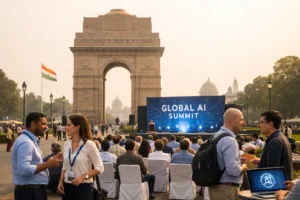
Beyond the Forecast: How Delhi’s Unseasonable Warmth Set the Stage for a Global AI Gathering
As the world’s most powerful tech leaders and dignitaries landed in the capital, they were greeted not by Delhi’s famed winter chill, but by a taste of an early summer—a subtle, yet telling prologue to a summit about the future.
The venue at Bharat Mandapam was immaculate. Flags fluttered in the mild breeze, and the red carpets were rolled out with military precision. Inside, Prime Minister Narendra Modi prepared to welcome French President Emmanuel Macron, OpenAI’s Sam Altman, and a constellation of global leaders for the fourth day of the India AI Impact Summit 2026. But as the limousines pulled up and the cameras flashed, one element of the day’s programming was beyond the control of even the most meticulous event managers: the weather.
According to the India Meteorological Department (IMD), Delhi was experiencing a day of “above normal” temperatures. With maximums hovering between 26°C and 28°C and minimums between 12°C and 14°C, the mercury sat nearly 3 degrees above the historical average for a February morning. For the dignitaries stepping out of aircraft, the capital offered not the biting cold of a North Indian winter, but the gentle warmth of a spring afternoon.
The 1.6-Degree Story
To the average attendee, the weather was simply pleasant. But for those who understand the rhythms of the Yamuna riverfront, it was a statistical anomaly. The IMD’s dry data—”1.6°C to 3.0°C above normal”—hides a more complex narrative of a city in climatic flux.
Just 48 hours prior, Delhiites were wiping a thin layer of sweat from their brows as temperatures flirted with 30°C, marking the earliest February day to hit that threshold in five years. It was a reminder that the capital’s weather is no longer just a backdrop; it is a headline in itself. Wednesday’s brief, 0.3 mm rainfall acted as a temporary coolant, a natural air conditioner that scrubbed the skies clean just in time for the summit’s curtain-raiser.
This brief reprieve from the heat was the city’s gift to the summit. It allowed for outdoor interactions, seamless transit between airports and hotels, and the perfect climate for the now-obligatory “family photo” of world leaders on the lawns of Bharat Mandapam—no overcoats required, no shivering smiles.
A ‘Satisfactory’ Welcome for World Leaders
Perhaps more significant than the temperature was the air. For a city that frequently makes global headlines for the wrong reasons in November and December, Delhi pulled off a minor miracle: an Air Quality Index (AQI) of 164, which the Central Pollution Control Board (CPCB) classifies as ‘moderate,’ but was widely reported as teetering on the edge of ‘satisfactory.’
For the visiting delegations, many of whom had read the briefings on Delhi’s infamous “gas chamber” winters, the clear skies were a revelation. The improved ventilation was a direct result of the shifting season. The combination of the light mid-week rain and stronger surface winds literally blew the pollutants away, leading to the immediate revocation of GRAP Stage-II restrictions by the Commission for Air Quality Management (CAQM).
It was a logistical blessing. When former UK Prime Minister Rishi Sunak joked the next day about how “AI can’t yet fix Delhi’s traffic,” he was speaking to a city that, at that very moment, was moving with uncharacteristic smoothness. The clear air meant fewer health-related travel delays, and the pleasant weather meant the city’s infamous dust was kept at bay.
The Bharat Mandapam Context
The choice of Bharat Mandapam as the venue was symbolic. This sprawling, modern convention centre—inaugurated in 2023 for the G20 Summit—represents India’s ambition to be a hub for global discourse. As the leaders gathered, the irony was not lost on the local attendees: they were discussing the most advanced, energy-intensive technology of the future inside a state-of-the-art complex, while nature outside was quietly demonstrating the very real effects of a changing climate.
The above-normal temperatures are not just a statistic; they are a lived reality for the city’s 20 million residents. For the vegetable vendor outside the venue’s secure perimeter, the warmth meant his winter stock of leafy greens was wilting faster. For the hotel staff catering to the delegates, it meant a shift in beverage demand—more chilled water, fewer cups of the traditional hot tea that defines a Delhi winter.
This juxtaposition—the global elite discussing the future of humanity within an air-conditioned bubble, while the city outside navigates the early impacts of climate variability—formed the unspoken backdrop of the summit’s second day.
The Summit Within the Summit
As PM Modi addressed the gathering, his words on “technology for all” resonated against the pleasant weather. The “family photo” that followed was a study in contrasts: world leaders in tailored suits, standing shoulder-to-shoulder under a sun that felt more like March than February.
Later, the day belonged to the tech titans. Sam Altman of OpenAI took the stage to discuss plummeting AI costs, suggesting that “India stands to gain” as the technology becomes more accessible. In the audience, delegates nodded along, many checking their phones for real-time updates on the pleasant 26°C forecast for the evening. The air inside the hall was electric with the promise of digital transformation, while the air outside was the cleanest it had been in weeks.
The absence of Bill Gates was a notable wrinkle. His foundation cited a desire to “keep the focus on the Summit’s key priorities.” While his deputy, Ankur Vora, stepped in, the move sparked quiet speculation. In the world of diplomacy and high-stakes tech, timing is everything—much like the timing of the rain that had just cleansed the capital’s skies.
A Human Insight: The City as a Host
For the people of Delhi, the summit was a moment of pride and disruption. Traffic was cordoned off, security was tight, and the eyes of the world were on their city. But the weather played the perfect host.
The absence of the usual winter fog meant zero flight diversions—a critical factor for busy executives on tight schedules. The roads leading to Bharat Mandapam, often clogged, were flowing. The famous Delhi smog, which often provides a moody, apocalyptic backdrop for photographers, was replaced by visibility so clear that the distant ridges were visible from the summit complex.
“I’ve been to Delhi in February before,” remarked a European Union delegate during a coffee break. “It’s usually a bit hazy and cold. This feels… different. It’s bright, it’s warm. It actually makes you want to be outside, to see the city.”
That sentiment is the heart of the story. Delhi, a city often maligned for its pollution and extreme weather, managed to show off its best face. The “above normal” temperatures, while a climate concern, were a human comfort.
Reading the Signs
As the summit moves into its subsequent days, the conversations will turn to AI safety, regulation, and the digital divide. But Day 2 will be remembered as the day nature cooperated.
The IMD’s prediction of a 26°C to 28°C range was more than just a weather report; it was the green light for a day of global diplomacy. It allowed for the pomp and circumstance that India does so well—the handshakes in the sun, the photo ops without umbrellas, the seamless flow of humanity from cars to conference halls.
Yet, for the observant, the warmth was a whisper of the challenges ahead. As we build intelligent machines to solve the world’s problems, the natural world is sending us signals in real-time. The fact that Delhi’s February feels like March is a data point that even the most advanced AI would flag as a trend worth watching.
The Takeaway
So, as the world leaders departed Bharat Mandapam for the evening, they took with them the images of India’s hospitality and the ambitious vision of its tech future. But they also carried the sensory memory of a perfect Delhi day—a day that was statistically abnormal, yet felt just right.
The India AI Impact Summit 2026 was never just about code and compute. It was about convergence: of people, of ideas, and of place. And on that Thursday in February, the place itself—Delhi, with its clear skies and gentle warmth—proved to be just as impactful as any keynote speech.
The rain on Wednesday washed the slate clean. The sun on Thursday wrote a story of global unity. And the mercury, sitting quietly at 27°C, reminded everyone that in the race to build the future, we must never forget the world we are building it in.
You must be logged in to post a comment.