
Beyond the Fog: Why India’s Pollution Crisis Demands More Than Seasonal Theater
Beyond the Fog: Why India’s Pollution Crisis Demands More Than Seasonal Theater
The Annual Cycle of Crisis
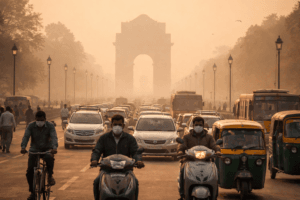
As winter descends upon Northern India, a familiar, deadly script unfolds. Dense fog blankets the Indo-Gangetic plains, transforming highways into danger zones and airports into hubs of chaos. This year, the headlines tell a grim story: at least 25 lives lost in Uttar Pradesh, a horrific inferno on the Yamuna Expressway, and over 200 flights cancelled in Delhi in a single day. Beneath the visible cloak of fog lies a more insidious reality—air quality indices (AQI) plunging into “severe” and “severe+” categories, crossing 400, a number that represents a profound public health emergency.
This phenomenon is often mistakenly labeled a “fog problem.” In reality, it is a pollution problem magnified by meteorology. The fog does not increase toxicity; it merely traps and reveals the year-round unabated emissions that characterize urban India. The particulates from vehicles, industry, construction, and agricultural residue meet cold, moist air, creating a toxic smog that chokes millions. The response from authorities has become a predictable seasonal theater: emergency bans under the Graded Response Action Plan (GRAP), hurried meetings, and vacuous threats that evaporate with the first signs of clearer skies.
The Flawed Emergency-Only Paradigm
The current approach treats pollution as a seasonal weather event, akin to a cyclone or a heatwave, to be managed with last-minute restrictions. GRAP Stage IV is activated—construction halts, schools move online, certain vehicles are banned. Delhi’s government threatens to deny fuel to vehicles without pollution certificates and bar non-BS-VI vehicles. These measures, while well-intentioned, are fundamentally reactive. They address symptoms, not the disease.
The critical flaw in this strategy is its temporary nature. It creates a cycle where economic activity and pollution-generating practices pause briefly, only to resume with renewed intensity once the AQI dips below the “severe” threshold. Construction dust settles only to be stirred again; industries powered down flare back up. This stop-start mechanism offers no long-term reduction in the emission load that is the root cause. It is a defensive rearguard action, fighting a losing battle against a problem that requires constant, strategic offense.
Furthermore, these emergency measures often place a disproportionate burden on the economically vulnerable—daily wage laborers in construction, owners of older vehicles—while failing to mandate systemic change from major, consistent polluters. The “residual emissions” from power plants, persistent industrial clusters, and the design of our cities themselves remain largely unaddressed.
The Case for Year-Round, Systemic Action
Tackling India’s air pollution requires a paradigm shift from crisis management to continuous governance. The goal must be to decouple air quality from the weather. This means ensuring that Delhi’s AQI remains below 350, and ideally much lower, regardless of whether it is windy, rainy, or still.
- Empower and Mandate the Commission for Air Quality Management (CAQM):The CAQM was conceived as an empowered, independent body. It must now flex that authority beyond the winter months. Its mandate should expand to:
- Enforcing continuous emission standards for industries and thermal power plants across the NCR and adjoining states, with real-time monitoring and automatic penalties.
- Overseeing a regional, year-round vehicle modernization plan, including robust incentives for scrapping old vehicles and accelerating the rollout of electric vehicle infrastructure.
- Mandating green urban design codes for new construction to reduce dust and improve dispersion, including mandatory green covers on building peripheries and continuous paving of roads.
- Address the Source, Not the Symptom, of Transport Pollution:Threatening to deny fuel is a enforcement nightmare. A more effective approach involves:
- Integrating PUC certification with vehicle insurance and annual taxes. No valid PUC? Insurance is void and taxes cannot be paid.
- Massive investment in comfortable, reliable, and integrated public transport that makes not driving a desirable choice, not a punitive measure.
- Reimagining freight movement through dedicated electric or cleaner-fuel corridors and incentivizing rail-based logistics over long-haul trucks.
- Transform Agricultural Practice, Not Just Blame Farmers:The post-monsoon stubble burning season is a major contributor. Short-term solutions like fines have failed. A year-round strategy requires:
- Creating a viable, decentralized market for crop residue. This means subsidizing and promoting on-site processing units that can create briquettes, biogas, or biochar.
- Direct income support for farmers who adopt no-burn practices, making sustainability economically rational.
- Promoting crop diversification policies at the state level to reduce the area under paddy, which generates the problematic residue.
- Build Public Resilience and Transparency:Citizens currently navigate between panic and resignation. We need:
- Hyper-local AQI monitoring and forecasting as precise as weather reports, allowing schools and workplaces to plan outdoor activities safely.
- Public health advisories integrated into community life, especially for vulnerable groups, that are active all year, not just in winter.
- A “Right to Clean Air” legal framework that allows for meaningful citizen action and holds authorities accountable for sustained progress, not just emergency responses.
The Human and Economic Imperative
The cost of inaction is staggering. The World Bank estimates that India’s air pollution crisis results in annual healthcare costs and productivity losses amounting to billions of dollars. The human toll is measured in shortened lifespans, exacerbated chronic illnesses, and diminished quality of life. The chaotic scenes on highways and airports are merely the most visible eruptions of a deep, systemic sickness.
Cities like Beijing and London, which faced similar catastrophic smog, did not find solutions in sporadic bans. They implemented sustained, multi-year action plans involving stringent fuel standards, radical industrial relocation, massive afforestation, and unwavering political commitment. Their air quality improved because the rules of the game were changed permanently, not temporarily suspended.
Conclusion: From Seasonal Theater to Unwavering Commitment
The fog will return next year. The temperatures will drop again. But whether this leads to another cycle of death, disruption, and panic is a choice. It is a choice between theatrical, last-minute gestures and the hard, unglamorous work of daily governance.
India’s fight for clean air must move from the control room during an emergency to the drawing board of city planning, the factory floor of industries, the fields of farmers, and the policy corridors of state and central governments—every single day. The true test of our commitment will not be measured on the days the AQI hits 500, but on the clear, sunny days when the invisible, consistent work of building a cleaner future continues, unabated and unseen. The need is not for more meetings or sharper threats, but for consistent, courageous, and year-round action. Our breath, and our future, depend on it.
You must be logged in to post a comment.