
Beyond the Flames: How the Israel-Iran Conflict is Redrawing the Map of Global Crisis
The escalating conflict between Israel and Iran has fundamentally shifted from territorial skirmishes to a war of economic attrition, with strikes on critical energy infrastructure like Iran’s South Pars gas field and Qatar’s Ras Laffan LNG complex sending global shockwaves that have spiked fuel prices as far away as Zimbabwe and threatened international shipping lanes. Amid this strategic targeting, diplomatic efforts remain fragmented—Europe calls for restraint while the U.S. reinforces Gulf alliances, and middle powers like Qatar and Turkiye scramble for a unified regional response—even as Lebanon suffers a silent humanitarian catastrophe with over 1,000 dead and a million displaced. Ultimately, the conflict is no longer contained; it is redrawing global economic stability, eroding international legal norms, and exacting a devastating human toll far beyond the immediate battlefields.
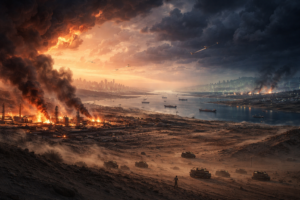
Beyond the Flames: How the Israel-Iran Conflict is Redrawing the Map of Global Crisis
The thin line between a regional skirmish and a global economic catastrophe has been violently erased. As emergency personnel in Israel sift through the rubble of a bombed refinery and Iranian officials warn of “no restraint” following strikes on their critical energy infrastructure, the world is waking up to a sobering reality: the war is no longer just about territory or retaliation. It has evolved into a sophisticated, multi-front war of economic attrition, where the targets are not just military installations but the very veins of the global economy—energy facilities, shipping lanes, and civilian infrastructure.
Over the past 24 hours, the reverberations of the escalating conflict between Israel, Iran, and their respective proxies have spread far beyond the Middle East. From the fuel lines in Zimbabwe to the boardrooms of European capitals, the war is demonstrating a terrifying new capacity to destabilize nations that have no direct role in the conflict. The latest developments, as detailed in the ongoing coverage, paint a picture of a region teetering on the edge of a broader conflagration, where diplomatic pleas are being drowned out by the sound of missile salvos and the grinding of geopolitical realignment.
The New Battlefield: Energy, Water, and the Economy
For months, analysts warned that the conflict would inevitably target energy infrastructure. That moment has now arrived with a vengeance. The Israeli strike on Iran’s South Pars gas field was not merely a tactical military action; it was a shot across the bow of the global energy market. South Pars is not just another gas field; it is the backbone of Iran’s economy and a critical node in regional energy supply. The strike represents a paradigm shift in the rules of engagement. By targeting energy production, both sides are now openly embracing a strategy designed to choke the other’s financial lifelines.
The immediate consequence was a ripple effect that reached the shores of Qatar. The attack on Qatar’s Ras Laffan energy complex—one of the world’s most vital liquefied natural gas (LNG) hubs—has effectively wiped out 17% of the country’s export capacity. The financial math is staggering: an estimated $20 billion in lost annual revenue for QatarEnergy alone. This is not just a loss for a single company; it is a blow to the global energy supply chain that Europe, in particular, has been relying on to wean itself off Russian gas.
The human cost of this economic warfare is already being felt in unexpected places. In Zimbabwe, fuel prices have surged past $2 per liter for the first time in history. For a country already grappling with economic fragility, this spike is a crisis multiplier. It turns the abstract concept of “geopolitical tension” into a tangible burden for a truck driver in Harare or a farmer in Bulawayo, demonstrating how a missile strike in the Persian Gulf can dictate the cost of living in Southern Africa. This is the true face of modern warfare—a conflict where the detonation is heard in one location, but the economic shockwave flattens livelihoods thousands of miles away.
The Diplomatic Vacuum and the Rise of “Proactive” Defense
As the conflict escalates, the diplomatic landscape is revealing a profound vacuum. The European Council’s call for a “moratorium on strikes against energy and water facilities” is a stark admission of the international community’s powerlessness to stop the fighting. It is a plea for restraint issued as the belligerents are doubling down on aggression. When global bodies are forced to ask warring parties to please stop blowing up the water, it signals a catastrophic failure of preventative diplomacy.
In the absence of a cohesive international peace plan, we are witnessing a scramble for security partnerships. The United States, while publicly distancing itself from specific Israeli actions—with President Trump stating he instructed Netanyahu to cease attacks on Iranian energy—is simultaneously solidifying its role as the region’s primary security guarantor. The phone call between President Trump and UAE President Mohamed bin Zayed, where the US affirmed “full support” for defending territories, underscores a return to traditional alliance structures. It suggests that while the US may try to set red lines for its ally Israel, it is doubling down on protecting its Gulf partners against perceived Iranian aggression.
Simultaneously, a new axis of consultation is forming. The meeting between Qatar’s Prime Minister and Turkiye’s Foreign Minister in Doha highlights the increasing importance of middle powers in navigating the crisis. Their joint condemnation of Iran’s “aggression” and their discussion of a “unified response” point to a potential bloc of nations—neither wholly aligned with Washington nor Tehran—that are trying to protect their sovereignty and economic interests from being collateral damage in a larger war. Their frustration is palpable; they are victims of sabotage (as Qatar was) and are demanding a collective regional stance against what they perceive as reckless escalation by Iran.
The Ground Truth: Lebanon’s Silent Catastrophe
While the world focuses on the energy war and missile exchanges, the ground war in Lebanon is producing a humanitarian disaster that risks becoming a forgotten tragedy. The death toll surpassing 1,000 people, with over 2,500 wounded and more than a million displaced in just a few weeks, paints a picture of a nation shattered. The imagery is haunting: families fleeing their homes in the Bekaa Valley after receiving threatening phone calls from foreign numbers, unsure if they are being warned or targeted.
This is not just a war between Hezbollah and Israel; it is a war that is systematically dismantling Lebanese civil society. The reports of Hezbollah attacking Israeli positions in Margaliot and Maroun al-Ras confirm that the front line is fluid and deadly. But the strategic objective of the Israeli campaign appears to be twofold: degrading Hezbollah’s military capabilities and creating a massive buffer zone inside Lebanese territory. The displacement of over a million people is not merely a byproduct of the conflict; for many analysts, it is the goal—a forced depopulation of the south to render Hezbollah’s presence untenable.
The human insight here is the psychological terror embedded in modern warfare. The use of phone calls to threaten civilians, the destruction of entire neighborhoods, and the indiscriminate nature of the attacks create a state of perpetual anxiety. The Lebanese people are not just suffering from bombs; they are suffering from the erosion of the social fabric, the loss of homes that took a lifetime to build, and the existential dread of being pawns in a geopolitical game they have no power to stop.
The Domino Effect: Maritime Choke Points and Global Alignment
The crisis is now metastasizing toward the Strait of Hormuz, the world’s most critical oil chokepoint. The expression of “readiness” by European leaders, Canada, and Japan to contribute to ensuring “safe passage” through the strait is a direct response to the threat that the conflict will spill over into international shipping lanes. This is a prelude to a potential militarization of maritime trade routes, which would inevitably lead to escalatory spirals. If a European warship intercepts an Iranian vessel, or vice versa, the conflict could rapidly internationalize beyond the current scope.
Furthermore, the domestic security dimensions are coming into sharp focus. The UAE’s announcement that it dismantled a Hezbollah-linked network operating within its borders, aimed at “infiltrating the national economy,” reveals the shadow war being fought in the financial and intelligence sectors. This is the quiet war—the one involving money laundering, espionage, and attempts to destabilize economies from within. The image of five blindfolded individuals released by state media is a powerful visual reminder that for Gulf states, the threat is not just ballistic missiles, but also the “sleeper cells” and financial operatives working to undermine their stability from the inside.
Conclusion: A New Era of Unrestrained Conflict
As the live coverage closes on this chapter, the story of this war is no longer just about Iran and Israel. It is a story about the vulnerability of global supply chains, the collapse of diplomatic guardrails, and the terrifying ease with which a regional conflict can create global inflation and human suffering.
The Iranian president’s warning that the US and Israel’s actions “will demolish the legal systems of the world” speaks to a profound sense of lawlessness that now defines this conflict. When the UN is warning of mass displacement, when energy facilities are treated as legitimate military targets, and when civilians are terrorized by anonymous phone calls, the foundational principles of international law and human dignity are under assault.
The war is no longer contained. It is on the streets of Harare in the price of fuel, in the corridors of power in Doha and Ankara as leaders scramble for a unified stance, and in the tens of thousands of Lebanese families huddled in makeshift shelters, wondering if they will ever return home. As the world watches the next phase of this conflict unfold, one thing is clear: the reverberations of these explosions will be felt for generations, reshaping alliances, economies, and lives far beyond the immediate battlefield. The only certainty is that the cost—in blood, treasure, and global stability—has only just begun to be counted.
You must be logged in to post a comment.