
Beyond the Factory Floor: Why Canon’s Engineers Are Flying to India to Learn From Copy Shops
Canon has turned the traditional R&D model on its head by sending Japanese engineers to India not to teach, but to learn from the ingenuity of local copy shops, wedding photographers, and small-town entrepreneurs. Observing how users pushed their machines beyond official specifications—such as printing on thick media for book covers—led Canon to modify its products to officially support these hacks, a move that boosted sales tenfold in India and was successfully replicated in other emerging markets like Indonesia. This reverse innovation, rooted in the corporate philosophy of Kyosei (living and working together for the common good), treats India’s 28 states as a complex, real-world testing ground that builds durability and adaptability into Canon’s global lineup. What began as a market for the 90-year-old brand has become a vital source of creativity, proving that necessity-driven local ingenuity can shape global products and keep a legacy company perpetually innovative.
Beyond the Factory Floor: Why Canon’s Engineers Are Flying to India to Learn From Copy Shops
For decades, the global technology playbook was simple: innovate in the West or in Japan, manufacture at scale, and then “localize” for emerging markets. The flow of knowledge was always unidirectional—from the high-tech lab to the dusty street.
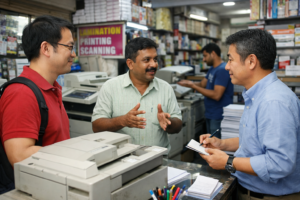
But in the offices of Canon’s Indian headquarters, that flow has reversed. In a move that defies conventional corporate hierarchy, Japanese R&D engineers are making regular pilgrimages not to Silicon Valley, but to the bustling, ink-stained copy shops of small-town India. Their mission isn’t to teach; it’s to watch. They stand in the humid chaos of local print hubs, observing how entrepreneurs push their machines beyond spec, using hacks and workarounds that the engineers never dreamed possible when the hardware was designed in Tokyo.
According to Toshiaki Nomura, President and CEO of Canon India, this isn’t just market research. It is a fundamental shift in how a 90-year-old company stays relevant. “Our R&D engineers from Japan often come to India to see real-world usage scenarios, and it is an eye-opening experience for them,” Nomura explains. “Indian customers know how to maximise the potential of our devices for their day-to-day needs.”
In an era where artificial intelligence and semiconductor miniaturization dominate headlines, Canon is quietly pursuing a different kind of innovation: frugal ingenuity, reverse-engineered from the streets of India and deployed globally.
The ‘Jugaad’ That Became a Global Product
The most compelling evidence of this shift lies in a seemingly mundane problem: book covers.
In India, print shops—often operating out of a 100-square-foot storefront—are the backbone of local publishing, education, and wedding stationary. A massive demand exists for printing on “coated thick media,” the glossy, durable paper used for wedding album covers, educational booklets, and religious texts. However, for years, Canon’s smaller, more affordable office printers were not designed to handle that specific substrate. The machines would jam, or the print quality would smear.
Technically, the machine’s specifications said it couldn’t be done. But the shop owners didn’t care about the spec sheet. Through trial and error, they found ways to force the media through, tweaking settings and manually adjusting feeds to get the job done. They were using the printer in a way that voided the warranty—but it worked.
Instead of sending in the legal team to enforce warranty rules, Canon’s India team saw a signal. They relayed this to Japan. The engineers, skeptical at first, flew in to witness it. What they saw was a market demand so fierce that users were willing to risk breaking the machine to meet it.
The result was a radical departure from standard product development. Canon’s engineers went back to the drawing board, not to invent a new machine, but to modify the existing one to officially support the “unauthorized” usage they had observed. They released a compatible version designed specifically to handle thick, coated media.
The commercial impact was staggering. Nomura notes that sales of these compatible units grew “10 to 30 times over.” But the story didn’t end in India. Recognizing that the need for durable, high-quality printing on thick stock wasn’t unique to India, Canon replicated the success in other emerging markets like Indonesia and the Philippines. A hack born in a cramped Indian shop became a standardized feature in Canon’s global portfolio.
The 28-Country Problem
For Nomura, managing Canon’s India operations is an exercise in extreme localization—not just for the nation, but for its 28 states. “It isn’t like managing one country; it feels more like 28 different countries in our portfolio,” he says.
A printing solution that works for a government office in Tamil Nadu might be irrelevant to a wedding photographer in Punjab. The imaging business, which accounts for a massive portion of Canon’s revenue, is famously propped up by India’s wedding industry—a sector that Nomura estimates drives roughly 60 percent of imaging sales. This isn’t just about taking pictures; it’s about the entire ecosystem of pre-wedding shoots, large-format prints, and albums that require the durability the copy shops were fighting for.
This complexity forces a level of resilience and adaptability that Canon’s global leadership finds invaluable. When Japanese engineers visit India, they aren’t just seeing how machines are used; they are seeing how a supply chain must function in a region with unpredictable power grids, how dust and humidity affect hardware longevity, and how service networks must reach rural pin codes.
It is a brutal, real-world testing ground that no climate-controlled lab can replicate. The lessons learned about durability, serviceability, and user adaptability in India are now being baked into products destined for markets far beyond the subcontinent.
Cameras, Cosmos, and the Content Boom
While the reverse innovation in printing is fascinating, Canon’s relationship with India is also evolving rapidly in imaging. The old narrative was that smartphones were killing the camera industry. Nomura rejects that outright, viewing the mobile phone as the ultimate gateway drug.
“Some see smartphones as a threat to imaging companies, but we see them as complementary,” he argues. “They invite more people to become comfortable with photography and videography. Eventually, those users want higher image quality, and that is where our products come into the picture.”
This is playing out in real-time with India’s explosive growth in OTT (Over-The-Top) content and filmmaking. A new generation of independent filmmakers, YouTubers, and content creators is emerging, hungry for gear that bridges the gap between a smartphone and a broadcast-quality cinema camera. Canon’s focus in India is shifting to capture this “pro-sumer” moment.
Moreover, Canon’s ambitions stretch to the stars. While consumers focus on the red-logo cameras, the company is a silent partner in the world’s most advanced industries. In India, as the government pushes to establish a domestic semiconductor manufacturing base, Canon provides the critical lithography equipment necessary to make those chips. The company has also entered the space industry, leveraging its optical expertise for miniature satellites.
India, with its growing cadre of engineers and its ambition to become a tech manufacturing hub, is not just a market for these high-end industrial products; it is a potential partner in their future development.
Kyosei: The Philosophy of Absorption
What makes this reverse innovation possible isn’t just a strategic decision; it’s cultural. Nomura attributes it to Kyosei, a Japanese corporate philosophy that translates to “living and working together for the common good.”
In practice, this means Canon is willing to sacrifice short-term efficiency for long-term ecosystem health. When Indian customers demanded the thick media support, it would have been easier for a global conglomerate to say, “Buy the more expensive industrial machine.” Instead, Kyosei demanded that they listen to the customer and modify the existing product to serve their actual needs.
This philosophy extends to pricing. Nomura acknowledges that India is fiercely value-conscious. “Indian people are not just looking for a cheap product. They are looking for value for money: reliability and consistency without compromise,” he says. Balancing that need with rising global component costs is a challenge, but the philosophy dictates that Canon must absorb costs where possible to maintain that trust.
It also dictates their approach to service. With over 600 authorized service centers covering nearly every pin code in India, Canon treats after-sales support as a product feature, not an afterthought. In a country where a broken printer can halt a small business’s income, the reliability of service is often more important than the initial price tag.
The Rebel Brand Stays Young
As Canon approaches its 90th anniversary, there is a risk of calcification. Legacy brands often become conservative, relying on past glory while being disrupted by nimbler competitors. But by treating India as an “eye-opener” rather than just a cash register, Canon has found a mechanism to stay agile.
When Japanese engineers fly back to Tokyo after a stint in Delhi or Mumbai, they carry more than data sheets. They carry a new perspective on resourcefulness. They learn that a machine’s potential is not defined by the spec sheet, but by the creativity of the user. They learn that the most valuable innovations often come not from chasing the next technological frontier, but from perfecting the experience at the grassroots level.
India, with its chaotic energy, its constraints, and its relentless drive for value, serves as the perfect antidote to corporate complacency. It forces a 90-year-old company to look at its own products with fresh eyes.
In this dynamic, Canon isn’t just selling to India anymore. In a very real sense, India is helping Canon reinvent itself. The relationship has matured from a transactional exchange of goods for currency into a symbiotic partnership where necessity—Indian jugaad—truly becomes the mother of global invention.
You must be logged in to post a comment.