
Beyond the Engine: How Russia’s Tech Transfer Propels India into Aerospace Sovereignty
Russia’s approval of full technology transfer for the Su-57E’s Izdeliye 177S engine to India marks a strategic shift driven by Moscow’s need for a reliable industrial partner amidst sanctions, while granting India the sovereign capability to manufacture fifth-generation fighter propulsion.
This deal provides India with critical technologies like single-crystal blade casting and advanced thermal coatings, enabling a major upgrade for its Su-30MKI fleet under the “Super Sukhoi” program and offering a credible interim stealth option with potential Su-57E acquisitions. Most significantly, mastering this engine technology accelerates India’s indigenous Advanced Medium Combat Aircraft (AMCA) project and transforms its defense identity from a buyer to a builder, securing long-term aerospace autonomy and reducing vulnerability to external supply chains.
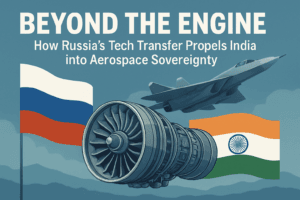
Beyond the Engine: How Russia’s Tech Transfer Propels India into Aerospace Sovereignty
The recent approval of full technology transfer for Russia’s Izdeliye 177S engine marks a watershed moment, not just for the Indian Air Force but for India’s entire aerospace and defense identity. This move, finalized around the time of President Vladimir Putin’s visit to New Delhi, is fundamentally about sovereignty—the ability to control the most complex and guarded technology in modern air combat on domestic soil.
This analysis explores the strategic calculus behind the deal, the immediate and future capabilities it unlocks, and how it repositions India from a buyer in the global arms market to a builder at the cutting edge of military technology.
The Engine of a New Partnership: Why Russia Is Sharing Its Crown Jewels
Russia’s decision to offer “the full playbook, no black boxes this time” represents a dramatic shift in its defense export philosophy. Historically, Moscow has been deeply protective of its core aerospace technologies, particularly engine hot-section metallurgy and source codes. India’s previous exit from the Fifth-Generation Fighter Aircraft (FGFA) program in 2018, after investing nearly $300 million, was largely due to “unmet expectations” in these very areas.
Today, geopolitical and economic realities have forced a recalibration. Western sanctions, intensified since the war in Ukraine, have constrained Russia’s access to advanced microelectronics, machine tools, and supply chains. In this environment, India is no longer seen merely as a customer, but as a vital long-term industrial partner. By enabling production at Hindustan Aeronautics Limited (HAL) in Koraput, Russia secures a stable manufacturing base outside the reach of Western sanctions, ensuring the sustainability of its own platforms and technologies.
For India, this addresses a persistent strategic vulnerability: dependence on foreign supply chains for critical spares, which can be weaponized during geopolitical crises. The deal is structured to increase indigenous content from about 54% in initial batches to over 80% within a decade, insulating the IAF from external disruptions.
Technical Powerhouse: Capabilities of the Izdeliye 177S
The Izdeliye 177S is more than an incremental upgrade; it is a bridge between proven fourth-generation powerplants and the future of fifth-generation propulsion. Here’s a breakdown of what it brings to the table:
Table: Izdeliye 177S vs. Current Indian Engine
| Feature | Izdeliye 177S (for Su-57E) | Current AL-31FP (Su-30MKI) | Operational Impact |
| Max Thrust (Afterburner) | 14,500 kgf | ~12,500 kgf | 15-18% greater thrust for faster acceleration, climb, and payload |
| Dry Thrust | 9,000 – 10,500 kgf | ~7,700 kgf | Enables sustained supercruise (Mach 1.6+ without afterburner) |
| Specific Fuel Consumption | <0.67 kg/kgf·h | ~0.78 kg/kgf·h (AL-31F) | 15-20% more efficient, extending combat radius and patrol time |
| Service Life / Overhaul | ~6,000 hours / ~1,500-4,000 hrs | ~2,000-4,000 hrs / ~1,000 hrs | Dramatically reduced lifecycle cost, higher fleet availability |
| Key Technology | 3D Thrust Vectoring, FADEC, Single-Crystal Blades | Limited TVC, Older FADEC | Superior dogfight agility and next-gen control systems |
Beyond raw performance, the transfer includes the “crown jewels” of engine technology: single-crystal turbine blade casting and advanced thermal barrier coatings that can withstand temperatures approaching 1,800°C. Mastery of these processes alone will elevate India’s metallurgical and materials science sectors to global standards.
Strategic Synergy: Filling Gaps and Empowering Indigenous Programs
The Izdeliye 177S deal brilliantly addresses multiple, overlapping challenges in India’s defense modernization.
- The “Super Sukhoi” and Fleet Modernization: The engine is designed as a near drop-in replacement for the AL-31FP engines in India’s 260+ Su-30MKI fleet. This makes it the perfect powerplant for the planned “Super Sukhoi” upgrade, giving these workhorse fighters a massive performance boost with minimal structural modification. A fleet of modernized, supercruise-capable Su-30MKIs would remain a formidable asset well into the 2040s.
- Bridging the Stealth Fighter Gap: The Indian Air Force has openly acknowledged a “critical operational gap” in fifth-generation capabilities, as its indigenous Advanced Medium Combat Aircraft (AMCA) is not expected until the mid-2030s. Acquiring 80-100 Su-57E fighters—powered by the same domestically produced 177S engine—provides a credible interim stealth solution. This directly counters the advancing capabilities of regional rivals, ensuring India does not fall behind in the stealth race.
- Accelerating the AMCA Program: Perhaps the most significant long-term benefit is the technological windfall for India’s own fifth-generation project. The knowledge gained in manufacturing the 177S—in materials, thermal management, and digital engine control (FADEC)—will directly de-risk and accelerate the development of a purpose-built engine for the AMCA. While India has a parallel engine co-development program with France’s Safran, the Russian tech transfer provides immediate, hands-on mastery of technologies that have taken decades to mature elsewhere.
The Broader Aerospace Ascent: From Assembly to Ecosystem
The decision to base production at HAL’s Koraput Division is strategic. Koraput already has over two decades of experience, having manufactured more than 1,100 AL-31FP engines from raw materials to flight-ready status. The estimated investment of ₹2,800 crore ($336 million) for upgrades is relatively modest for transforming this facility into a fifth-generation propulsion hub.
This transformation will catalyze a wider ecosystem:
- Supply Chain Development: A new network of private and public suppliers will emerge to meet the demands of high-precision, high-temperature engine manufacturing.
- Research & Development Spin-offs: Technologies like advanced coatings and single-crystal casting will find applications in civil aerospace, power generation, and other high-tech industries.
- Geopolitical Leverage: As a sovereign producer of fifth-gen engines, India’s strategic autonomy is enhanced. It reduces its vulnerability to geopolitical pressure and opens the possibility of becoming a regional maintenance and upgrade center for allied air forces operating Russian-origin aircraft.
Conclusion: A Decisive Leap Towards Self-Reliance
The transfer of the Izdeliye 177S technology is more than a defense procurement deal. It is a decisive step in India’s journey toward Atmanirbharta (self-reliance) in defense. By mastering the art and science of fifth-generation fighter propulsion, India is not just buying capability; it is building the intellectual and industrial foundation for its future as an aerospace power.
The first Izdeliye 177S engine rolling off the line in Koraput by 2029-30 will symbolize a profound shift: India moving from the periphery to the core of the global defense technology landscape, securing its sovereignty in the skies for decades to come.
You must be logged in to post a comment.