
Beyond the Electric Hype: Why India’s Road to Energy Independence Needs Multiple Lanes
Toyota Kirloskar Motor advocates for a diversified technological strategy to achieve India’s energy security and self-reliance, arguing that a singular focus on battery electric vehicles (BEVs) is inadequate given the nation’s geographical diversity, fragile supply chains for critical minerals, and varying infrastructure readiness.
The company emphasizes a multi-pronged approach incorporating strong hybrids for immediate emissions reduction in urban areas, flex-fuel vehicles to leverage domestic agricultural resources and cut oil imports, hydrogen for long-haul transport, and BEVs for specific urban use cases. This portfolio, underpinned by localization and scale for economic viability, aims to reduce fossil fuel dependency and carbon emissions while building a resilient, job-creating manufacturing base, ensuring a pragmatic and inclusive transition tailored to India’s unique challenges and opportunities.
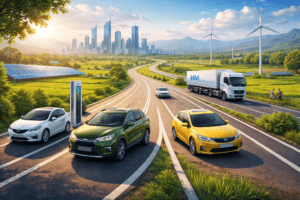
Beyond the Electric Hype: Why India’s Road to Energy Independence Needs Multiple Lanes
The narrative around sustainable mobility in India has, for years, been dominated by a single, shining protagonist: the Battery Electric Vehicle (BEV). Headlines champion record EV sales, new charging infrastructure projects, and ambitious government targets. Yet, in a significant and pragmatic intervention, Toyota Kirloskar Motor has shifted the conversation, arguing compellingly that an exclusive focus on electricity is a road to vulnerability, not security. Their call for a “multi-technology” path is not a rejection of progress, but a nuanced blueprint for achieving India’s complex goals of energy self-reliance, economic growth, and emissions reduction simultaneously.
This perspective moves beyond corporate strategy to touch the very core of India’s developmental challenges. It acknowledges a fundamental truth: a nation as geographically, economically, and infrastructurally diverse as India cannot be served by a one-size-fits-all solution. The quest for energy security is not a simple race with a single finish line; it is a multi-dimensional chess game requiring a varied arsenal of moves.
The Inherent Limitations of a BEV-Only Strategy
To understand Toyota’s argument, one must first confront the real-world constraints facing a rapid, wholesale transition to BEVs in India.
- The Grid and Energy Source Conundrum: An EV is only as clean as the grid that charges it. India’s power generation still heavily relies on coal. Mass adoption of BEVs without a concurrent, monumental shift to renewable energy sources like solar and wind simply transfers emissions from tailpipes to power plants. Furthermore, the existing grid in many regions struggles with current demand; adding millions of high-wattage EV chargers would require a foundational upgrade of staggering scale and cost.
- Supply Chain Geopolitics: The BEV revolution hinges on lithium-ion batteries, whose supply chains are concentrated and geopolitically fraught. Critical minerals like lithium, cobalt, and nickel are controlled by a handful of countries, with China dominating processing and refining. For India, aiming for Aatmanirbharta (self-reliance), swapping dependency on Middle Eastern oil for dependency on foreign-controlled battery minerals is a lateral move, not a strategic leap.
- The Affordability and Use-Case Gap: The upfront cost of a long-range EV remains prohibitive for the vast majority of Indian car buyers, even with subsidies. For the commercial vehicle sector—trucks and buses that log enormous distances—current battery technology presents challenges in weight, charging time, and payload capacity that are far from solved.
The Multi-Tech Portfolio: A Symphony of Solutions, Not a Solo Act
Toyota’s proposed portfolio—BEVs, hybrids, flex-fuel, and hydrogen—isn’t a scattered approach. It’s a targeted deployment of different technologies to solve different pieces of the puzzle, based on readiness, infrastructure, and user need.
- Strong Hybrids (HEVs): The Immediate, High-Impact Bridge. Often misunderstood as a mere stepping stone, strong hybrids like Toyota’s own Hyryder are a powerful decarbonization tool today. By seamlessly blending an electric motor with a petrol engine, they can improve fuel efficiency by 40-50%, drastically cutting urban pollutants and fossil fuel consumption immediately. As Vikram Gulati noted, in stop-start city traffic, they often operate in silent EV mode. Their genius lies in requiring no new infrastructure, no behavioral change from the driver, and using a fraction of the critical minerals of a BEV. They are a pragmatic workhorse for the present, delivering tangible emissions reductions while the wider ecosystem evolves.
- Flex-Fuel Vehicles: Harvesting Energy Independence. This is where energy security directly intersects with rural economic empowerment. Flex-fuel vehicles can run on a high blend of ethanol (derived from sugarcane and, promisingly, from agricultural waste like rice straw and corn stubble). India has a massive, ongoing program to increase ethanol blending in petrol. By investing in flex-fuel technology, India can literally grow its own fuel, redirecting agricultural surplus and waste into the energy pipeline. This reduces oil imports, addresses the perennial issue of farm stubble burning (a major cause of air pollution), and injects income into the rural economy. It’s a deeply strategic, homegrown solution.
- Hydrogen: The Heavy-Duty and Long-Range Contender. For the difficult-to-electrify segments, hydrogen fuel cell technology presents a compelling case. Hydrogen fuel cell vehicles (FCEVs) generate their own electricity on board, emitting only water vapour. Their advantages are rapid refuelling (comparable to petrol) and long range, making them ideal for long-haul trucks, interstate buses, and even industrial applications. While the production of “green hydrogen” via renewable energy is currently expensive and infrastructure is nascent, India has launched a ambitious National Green Hydrogen Mission. Developing this technology is a strategic bet on the future of heavy transport and industrial decarbonization.
- Battery Electric Vehicles: The Urban and Short-Range Specialists. Within this portfolio, BEVs find their optimal niche: as superb solutions for predictable, short-to-medium range urban commutes, especially for two-wheelers, three-wheelers, and fleet vehicles that can charge at depots overnight. They excel where use cases are defined and charging can be managed.
Localization and Viability: The Pillars of Sustainable Strategy
Toyota’s stance crucially highlights that sustainability must also be economic. A perpetual state of high subsidies and tax breaks is not a viable industrial policy. True viability comes from scale, and scale comes from offering a range of products that consumers willingly buy because they solve real problems—cost, convenience, range anxiety.
This is where localization becomes non-negotiable. Building not just vehicles, but the entire ecosystem of components—hybrid systems, flex-fuel engines, hydrogen fuel stacks, and yes, even battery cells—within India is the only way to create a resilient, job-generating automotive industry. It protects against global supply shocks, keeps value addition within the country, and aligns perfectly with the Make in India vision.
The Human Insight: It’s About Choice, Pragmatism, and National Interest
The core insight here is human and pragmatic. Indian consumers are not a monolith. A taxi driver in Mumbai, a farmer in Punjab, a logistics manager in Chennai, and a software professional in Bengaluru have wildly different mobility needs and financial constraints. A multi-tech strategy respects this diversity, offering pathways for everyone to participate in the energy transition, rather than waiting decades for a single technology to trickle down and become universally accessible.
Furthermore, it reframes the “enemy.” As Gulati stated, the common adversary is fossil fuel consumption and carbon emissions. Whether a vehicle is powered by bio-ethanol, a hybrid battery, green hydrogen, or grid electricity, the goal is the same: to reduce and eventually eliminate the use of imported petrol and diesel. By fostering a competitive, multi-technology landscape, India can accelerate the pace of innovation, drive down costs across all platforms, and build a truly robust, self-reliant automotive and energy sector.
Conclusion: Charting a Uniquely Indian Path
The global automotive discourse often presents a binary choice: go electric or be left behind. Toyota, drawing from its global experience and a deep understanding of the Indian context, offers a more sophisticated third way. It is a call for strategic pluralism.
India’s journey to energy security and sustainable mobility will not mirror that of Europe, China, or the United States. It must be its own. By investing in a symphony of technologies—leveraging hybrids for immediate impact, flex-fuels for agrarian integration, hydrogen for future-heavy transport, and BEVs for targeted urban applications—India can build a transportation system that is not only cleaner but also more sovereign, more economically inclusive, and ultimately, more resilient in the face of an uncertain global order. The multi-tech path isn’t a detour; it is, perhaps, the only route that gets the entire nation to the destination together.
You must be logged in to post a comment.