
Beyond the Ejection Seat: How a Rocket-Sled Test in Chandipur Fuels India’s Strategic Autonomy
Beyond the Ejection Seat: How a Rocket-Sled Test in Chandipur Fuels India’s Strategic Autonomy
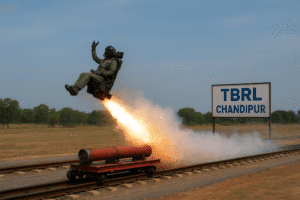
In a fleeting, thunderous moment on a specialized rail track in Chandigarh, a dummy pilot was violently propelled from a cockpit into the morning sky. To the casual observer, the recently released DRDO test footage is a dramatic, if clinical, spectacle of engineering. But for India’s defence and strategic community, this successful high-speed trial of a fighter jet ejection system at 800 km/h is far more than a routine safety check. It is a vivid, kinetic symbol of a deeper, more consequential journey: India’s determined march towards technological self-reliance in defence, one meticulously validated component at a time.
The test, conducted at the Terminal Ballistics Research Laboratory’s (TBRL) unique Rail Track Rocket Sled (RTRS) facility, represents a critical validation of what might be the most terrifying yet vital technology in a pilot’s cockpit—the escape system. In the split-second chaos of a fighter jet failure, this system must perform a sequence of life-saving actions with flawless precision. The DRDO’s trial successfully demonstrated three: canopy severance (blowing off the cockpit cover cleanly), ejection sequencing (the controlled firing of the ejection seat), and complete aircrew recovery (ensuring the dummy pilot’s safe trajectory and descent). At 800 km/h, the forces involved are extreme; any failure in timing or mechanics is catastrophic.
The Crucible of Chandigarh: Why a Rocket Sled?
This is where the story transcends the simple “test successful” headline. Why use a rocket sled instead of an actual aircraft? The RTRS facility is a controlled crucible for extreme science. It allows engineers to isolate and study the ejection mechanism under specific, repeatable conditions—in this case, a precise ground speed of 800 km/h—without risking a multi-crore aircraft and a human pilot. The sled, propelled by rockets along a heavy-duty track, simulates the aerodynamic and G-force stresses of a high-speed, low-altitude emergency, arguably the most dangerous scenario for ejection.
This capability to indigenously design, build, and validate such safety-critical systems is a cornerstone of true aerospace sovereignty. It means India is not dependent on foreign original equipment manufacturers (OEMs) for the testing and certification of ejection seats for its indigenous fighters like the Tejas Mk-1A and the future TEDBF, or for potential upgrades to its existing fleet. It grants the Indian Air Force (IAF) the confidence that the last resort for its pilots is built on homegrown, thoroughly vetted technology.
A Thread in the Larger Tapestry: From Operation Sindoor to Systemic Strength
The defence ministry’s announcement did not occur in a vacuum. It consciously wove this achievement into a broader narrative of indigenous capability. The mention of DRDO Chairman Dr. Samir V. Kamat’s earlier comments on Operation Sindoor is particularly telling. By linking a rocket-sled test with a complex, multi-domain military operation, the narrative shifts from a single product to an entire ecosystem.
During Operation Sindoor, systems like the Akash missile, BrahMos cruise missile, and advanced C4I networks—all indigenous platforms—were deployed in a coordinated manner. The ejection seat test, while less glamorous than a missile launch, is part of the same philosophical and industrial pipeline. It signifies strength in the entire value chain: from fundamental research at institutes like the Defence Institute of Advanced Technology (DIAT), to engineering by DRDO labs, to production by industry partners like Hindustan Aeronautics Limited (HAL), and finally, to validation and operationalization with the IAF.
Defence Minister Rajnath Singh’s congratulations to this consortium of organizations underscores this integrated approach. It’s not just about a DRDO lab; it’s about the health of the entire defence industrial triangle—the state, the private industry, and the armed forces.
The Human Element: The Ultimate Stakeholder
Beyond the geopolitics and industrial policy, the core of this test remains profoundly human. Every fighter pilot places ultimate trust in this technology. A reliable, indigenous ejection system does more than save lives; it bolsters operational confidence. Pilots pushing aircraft to their limits in training or combat need the assurance that the safety net beneath them is robust and dependable. This psychological comfort, born of technological reliability, directly enhances the operational effectiveness of the air force.
Furthermore, developing such systems indigenously allows for customization to the specific needs and anthropometry of Indian pilots, and better integration with other indigenous avionics systems, creating a more cohesive and optimized fighter platform.
The Road Ahead: Challenges and the Pursuit of Parity
The successful test is a milestone, not the finish line. The journey towards full-spectrum self-reliance faces ongoing challenges. The next steps involve more complex testing—at zero altitude (Z-axis), at various altitudes and speeds beyond 800 km/h, and in adverse flight attitudes (like spins or dives). The system must also be integrated seamlessly with next-generation aircraft designs. The global leaders in this field have decades of head-start, with ejection seats now incorporating advanced features like digital sequencing, multi-mode operation, and improved injury mitigation.
India’s endeavour is to close this gap. The push for Atmanirbharta (self-reliance) in defence is often discussed in terms of reducing import bills, which is a crucial economic and strategic imperative. However, as this test illustrates, its greater value lies in building sovereign problem-solving capacity. It is about cultivating a deep-rooted expertise that allows the nation to adapt, upgrade, and innovate on its own terms, without external constraints during times of crisis or strategic need.
Conclusion: More Than a Mechanical Act
The rocket sled test in Chandigarh, therefore, is a powerful metaphor. It is a controlled explosion of potential, propelling not just a dummy pilot, but India’s defence research and industrial base forward. It demonstrates a mature capacity to master the “full-stack” of complex defence technology—from concept to validation. In the high-stakes realm of aerospace and defence, where safety and sovereignty are inextricably linked, such capabilities are priceless. They form the unshakeable foundation upon which a nation’s strategic autonomy and the safety of its bravest men and women are secured. The path to self-reliance is long and demanding, but with each such successful trial, India is not just testing an ejection seat; it is asserting its right to navigate its own strategic destiny.
You must be logged in to post a comment.