
Beyond the Echo Chamber: Why Jammu University’s Syllabus Purge Betrays the Purpose of Education
The decision by Jammu University to remove Muhammad Ali Jinnah, Muhammad Iqbal, and Syed Ahmed Khan from the MA Political Science syllabus undermines the very purpose of higher education by prioritizing ideological comfort over critical inquiry. Rather than fostering the intellectual maturity to engage with complex, contradictory ideas—essential for understanding South Asian history, the Partition, and the evolution of secularism and rationalism—the university transforms the classroom into an echo chamber. Erasing these figures deprives students of the nuanced context needed to grasp the subcontinent’s syncretic heritage, the rise of identity politics, and indigenous traditions of rationalist reform, ultimately leaving graduates ill-equipped for rigorous analysis and democratic discourse.
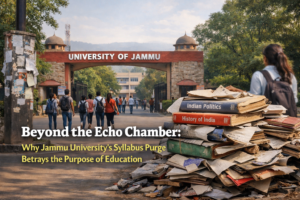
Beyond the Echo Chamber: Why Jammu University’s Syllabus Purge Betrays the Purpose of Education
In the annals of intellectual history, universities have stood as the last bastions against the tyranny of the unexamined life. They are supposed to be the arenas where ideas—no matter how contentious, uncomfortable, or historically fraught—are laid bare for dissection, debate, and understanding. When a committee at Jammu University recently recommended the removal of Muhammad Ali Jinnah, Syed Ahmed Khan, and Muhammad Iqbal from the MA Political Science syllabus, it did not merely alter a curriculum; it signaled a fundamental crisis in how India perceives the purpose of higher education.
The decision, ostensibly framed as a response to “public sentiment,” reveals a troubling fragility. It suggests that postgraduate students—individuals who have spent nearly two decades in formal education—are considered intellectually vulnerable. It implies that the mere presence of a thinker associated with the Partition of India in a textbook might act as a corrupting agent, a virus that must be quarantined to protect the “nationalist” purity of the classroom.
This is not education. This is the construction of an echo chamber.
To understand what Jammu University gets wrong, one must first understand what a university is supposed to get right. A university is not a temple of worship for state-approved ideology; it is a workshop for critical thinking. As Aristotle noted, the mark of an educated mind is the ability to entertain a thought without accepting it. By sanitizing the syllabus, the university is effectively admitting that it does not trust its own students to possess that mark.
The Architecture of the Subcontinent
The removal of these figures is akin to a cartographer deciding to erase the mountain ranges from a map because the terrain is difficult to traverse. Jinnah, Iqbal, and Syed Ahmed Khan are not peripheral footnotes; they are the tectonic plates that shaped the political geology of modern South Asia.
One cannot understand the trauma of 1947, the legal scaffolding of the Indian Constitution, or the complex dynamics of India’s secular framework without understanding the ideological currents that led to the demand for Pakistan. The Two-Nation Theory, advanced most famously by Iqbal and operationalized by Jinnah, is the counter-argument against which the idea of a composite, secular India was forged. To remove the thesis is to render the antithesis meaningless.
Consider Muhammad Ali Jinnah. In the popular imagination, he is often reduced to a caricature: the stern, monocled architect of Partition. But this reductionist view ignores the complex arc of his political career. In her seminal work, Secular and Nationalist Jinnah, scholar Ajeet Javed meticulously documents a different figure: the young lawyer who joined the Indian National Congress, who worked alongside Hindu leaders for self-rule, and who, for decades, was hailed as an “ambassador of Hindu-Muslim unity.”
What happens to a student’s understanding of history if they are denied the opportunity to trace Jinnah’s metamorphosis? They lose the ability to see the granular, tragic failure of elite political negotiations in the 1930s and 40s. They miss the lesson that identities, which seem fixed in retrospect, were once fluid. Removing Jinnah from the syllabus doesn’t erase the reality of Partition; it erases the nuanced context that explains why Partition happened. It leaves students with a historical vacuum, one easily filled by simplistic polemics rather than rigorous analysis.
The Erasure of Syncretism
Perhaps the most intellectually devastating casualty of this purge is the erasure of syncretic heritage, particularly in the case of Muhammad Iqbal.
Iqbal is celebrated in Pakistan as the national poet, the spiritual father of the idea of a separate Muslim homeland. But Iqbal’s relationship with India was far more profound and spiritually entangled than this label suggests. To excise him from an Indian syllabus is to deny students access to a crucial artifact of the subcontinent’s composite culture.
In his famous work Bang-e-Dara, Iqbal wrote a poem simply titled Ram. In it, he does not treat the Hindu deity as a “other” or an outsider. Instead, he elevates Ram to a position of supreme ethical and spiritual leadership, referring to him as the Imam-e-Hind—the spiritual leader of India. For Iqbal, Ram was not just a mythological figure; he was the embodiment of the moral soul of the land.
How do we reconcile the poet who wrote Tarana-e-Hindi (“Sare Jahan se accha, Hindustan hamara”) with the philosopher who later spoke of a separate Muslim state? This tension is not a contradiction to be erased; it is a historical question to be explored. It reveals the shifting anxieties of the 1930s, the communalization of politics, and the fears of a minority community in a transitioning colonial state. By removing Iqbal, Jammu University removes the record of this syncretic heritage. Students lose the chance to ask the vital question: How did a poet who praised Ram as the soul of India come to envision a separate state? Engaging with this transition is the very “dissection” of the mind that higher education is meant to cultivate.
The Rationalist Who Was Erased
The decision also reveals a profound ignorance regarding Syed Ahmed Khan. If the goal is to create “modern” and “rational” citizens, one would think a university would celebrate the inclusion of Khan rather than remove him.
Long before he became a political figure, Sir Syed was a radical rationalist and a pioneer of scientific temperament in the Indian subcontinent. In the aftermath of the 1857 rebellion, when the British viewed Muslims with deep suspicion and the Muslim community was largely hostile to Western education, Khan launched the Aligarh Movement. He founded the Muhammadan Anglo-Oriental College (later Aligarh Muslim University) with a revolutionary premise: faith and modern science could coexist, but only if tradition was subjected to the scrutiny of reason.
His approach to theology was heterodox and shocking for its time. In his Tafsir-ul-Quran (Commentary on the Quran), he argued that the “word of God” (scripture) could not contradict the “work of God” (nature). He insisted that if a traditional interpretation of a religious text conflicted with the proven laws of physics or empirical science, the interpretation must be re-evaluated. He was skeptical of supernatural miracles, often reinterpreting them as metaphors or psychological states. He argued that many legal injunctions in Islamic jurisprudence were specific to the socio-historical context of 7th-century Arabia and were not immutable laws for all eternity.
This was the intellectual engine of the Aligarh Movement. Khan wanted to create a generation of “learned minds” that could, as Aristotle suggested, entertain modern Western scientific thought without losing their cultural identity. By removing Syed Ahmed Khan from the political science syllabus, the university is erasing the history of indigenous rationalism and secular reform within the South Asian Muslim community. How can a student claim to understand the nuances of identity politics in modern India if they are denied the context of the very movements that tried to bridge the gap between tradition and modernity?
The Cost of Curation
The head of the Political Science Department at Jammu University, Baljit Singh Mann, rightly noted that the inclusion of these thinkers was consistent with the norms of the University Grants Commission (UGC) and the curricula of other premier universities. This highlights a critical point: the decision was not an academic one; it was an ideological one.
When a university allows “public sentiment” to dictate curriculum, it abdicates its primary responsibility. Public sentiment is fleeting, often driven by the politics of the moment. Academic inquiry is supposed to be timeless, driven by the pursuit of truth. By capitulating to external pressure, the university sets a dangerous precedent. It signals that any group with sufficient political clout can demand the excision of ideas they find uncomfortable.
The cost of this sanitization is ultimately borne by the students. They will enter the world as graduates with a fragmented understanding of the subcontinent’s history. They will be ill-equipped to defend the values of democratic secularism because they will have never studied the counter-arguments that sought to dismantle it. They will be more susceptible to propaganda because they were never trained to hold two opposing ideas in their heads at the same time and evaluate them critically.
Education is not about protecting students from discomfort; it is about preparing them to navigate a complex and often uncomfortable world. By purging the syllabus of Jinnah, Iqbal, and Khan, Jammu University has failed in that mandate. It has chosen to build a wall around the classroom rather than a window to the world. In doing so, it turns the university from a crucible of critical thought into a mere instrument of indoctrination—a transformation that serves neither the students nor the long-term health of Indian democracy. The mark of an educated mind is not the ability to recite approved names, but the courage to engage with the forbidden ones.
You must be logged in to post a comment.