
Beyond the Dust: Decoding Delhi’s Alarming March Heat and the “Toxic Cloud” Panic
Delhi-NCR is currently shrouded in a dusty haze and experiencing record-breaking March heat due to a combination of factors: strong westerly winds carried desert dust from Balochistan and Rajasthan into the region, where a subsequent drop in wind speed has trapped the pollutants, causing low visibility and a spike in poor air quality; meanwhile, the absence of rain-bearing Western Disturbances and the heat-trapping effect of the dust itself have pushed temperatures to a 50-year high for early March. Despite rampant social media rumors, meteorological authorities have confirmed the haze is natural dust and not toxic smoke from the conflict in Iran, with relief expected by March 12 when stronger winds are forecast to clear the air.
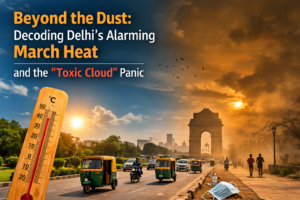
Beyond the Dust: Decoding Delhi’s Alarming March Heat and the “Toxic Cloud” Panic
If you’ve stepped out in Delhi-NCR over the last few days, you’ve likely been greeted by an unfamiliar sight for early March: a sky shrouded in a dusty haze, a sun that feels more like May, and a persistent scratchiness in the throat. The national capital is currently in the grip of a complex weather phenomenon that has blanketed the city in dust, shattered half-century-old temperature records, and sent social media into a frenzy with fears of a “toxic cloud” drifting in from war-torn Iran.
This isn’t just another news bulletin about Delhi’s pollution. It’s a story about atmospheric mechanics, the very real human impact of a changing climate, and how to separate fact from fiction in a hyper-connected world. Here’s an in-depth look at what is really happening over Northwest India.
The Brown Sky Explained: A “Perfect Storm” of Dust
If you woke up on March 9 or 10 wondering if you were in the middle of a desert, you weren’t far off. The air turning a thick, greyish-brown wasn’t a figment of your imagination; it was a massive transport of desert dust.
Meteorologists point to a specific event between March 5 and 7. Strong westerly winds, clocking speeds of 30 to 35 kilometers per hour, originated in the arid regions of Balochistan and Central Pakistan. As these winds barreled eastward, they swept across the Thar Desert in Rajasthan, acting like a giant vacuum cleaner and lifting vast quantities of loose sand and dust particles into the atmosphere .
This dust-laden air was then carried directly toward the Indo-Gangetic plains, with Delhi-NCR bearing the brunt of it. However, the story doesn’t end with the dust’s arrival; it’s about why it has overstayed its welcome. According to Dr. Mahesh Palawat, Vice President of Meteorology at Skymet Weather, a sudden change in wind dynamics has trapped the dust in a holding pattern over the city.
“In the last 24 to 36 hours, wind speeds have plummeted to a mere 5-12 km/h,” Dr. Palawat explained in an interview . Without strong winds to act as a “broom” and push the particles away, the dust remains in suspension in the lower atmosphere. This “stall” is the primary reason for the significantly low visibility and the sudden spike in pollution levels . This phenomenon is not unprecedented; a similar event in May 2025 saw dust from Rajasthan blanket Delhi due to a strong pressure gradient, temporarily dropping visibility at the IGI Airport to just 1,200 meters .
Fact Check: Did the Iran War Poison Delhi’s Air?
Amidst the dust, a far more sinister rumor began circulating on platforms like Twitter and WhatsApp. Claims emerged that the haze wasn’t just dust, but a “toxic cloud” or chemical smoke resulting from the bombing of oil refineries in Iran, with some reports even mentioning “black acid rain” in Tehran .
It’s a terrifying thought—that the smoke of a foreign war could drift over 2,500 kilometers and rain poison on your city. But is it true? According to every major weather authority, the answer is a resounding no.
Dr. Palawat has officially dismissed these rumors, and the science backs him up for several reasons :
- The Distance is Immense: The affected areas in Iran are roughly 2,500 to 3,000 kilometers away from India. For context, that’s the distance from London to the Sahara Desert.
- Dilution is Inevitable: Even if a concentrated plume of smoke and sulphur dioxide were to travel that far, it would be massively diluted by the atmosphere, dispersing into harmless concentrations long before reaching the Indian border.
- The Wind Direction is Wrong: This is the most critical factor. For the smoke to reach India, we would need sustained, powerful westerly winds blowing directly from Iran. Currently, the upper-atmosphere winds are blowing from the southwest, which would steer any potential fumes away from India and toward Central Asia, China, and Russia .
So, while the situation in Iran is a humanitarian and environmental tragedy, the haze over Delhi is a natural, albeit intense, dust storm. The rumors serve as a potent reminder to rely on verified meteorological data rather than unverified social media chatter.
Sweating in March: Why is it So Hot?
The dust isn’t working alone. It’s accompanied by a sweltering heat that feels weeks ahead of schedule. Delhi just recorded its hottest first week of March in 50 years . On March 7, the Safdarjung Observatory logged a maximum temperature of 35.7 degrees Celsius, shattering a record that had stood since 1999 .
Even the nights offer little respite. The minimum temperature on March 9 settled at 19 degrees Celsius, a staggering five degrees above normal, marking the season’s hottest night so far .
Why is this happening? Meteorologists point to a “perfect storm” of climatic factors :
- Absence of Western Disturbances: These are weather systems that originate in the Mediterranean and bring vital winter and pre-monsoon rain to North India. This year, they have been conspicuously absent, leaving the plains exposed to relentless sunshine.
- Clear Skies and Dry Winds: Without cloud cover to block solar radiation and no moisture to cool the air, the ground heats up rapidly, pushing daytime temperatures into late-April territory.
- The Dust Factor: Ironically, the very dust blanketing the city might be contributing to the heat. The suspended particles absorb and trap solar energy, acting like a thermal blanket and contributing to warmer nights .
When Will This End? A Glimmer of Hope on the Horizon
For Delhiites desperate for clean air and cool breezes, there is a forecast on the horizon. Relief is expected to arrive in the form of a new weather system.
According to Skymet, strong westerly and northwesterly winds are predicted to pick up pace again around March 12 . These faster winds will act as a natural dispersant, finally sweeping the accumulated dust out of the Delhi-NCR atmosphere. This should lead to a significant improvement in visibility and a drop in the Air Quality Index (AQI) from its current ‘poor’ and ‘severe’ levels back into the ‘moderate’ category.
Furthermore, a fresh Western Disturbance is expected to impact the Himalayan region around March 11. While it may not bring significant rain to the plains, it is likely to pull down maximum temperatures by a few degrees, offering some thermal relief from the ongoing heatwave .
How to Protect Yourself: A Guide for Residents
Until the winds change, Delhi-NCR remains a health hazard zone. The AQI has fluctuated between ‘poor’ and ‘severe’, with PM10—the coarse particulate matter found in dust—being the primary pollutant . For the 20 million people living here, this isn’t just an inconvenience; it’s a public health crisis.
Dr. Nikhil Modi, a Delhi-based pulmonologist, warns that exposure to such dusty air can have immediate effects. “Dust exposure can irritate the lungs, causing cough and breathing difficulties, and may also trigger sinus issues and headaches if the nose and eyes are affected,” he told Hindustan Times .
Based on expert advice, here is a practical survival guide for the coming days :
- The Golden Rule: Stay Indoors: This is the most effective protection. If you don’t need to go out, don’t. Keep your doors and windows securely closed. If possible, stay in a room with minimal windows.
- Mask Up, Properly: If you must venture outside, do not rely on a cloth mask. Wear a high-filtration N95 mask to filter out the fine dust particles.
- Protect Your Eyes: Wear protective eyewear or wraparound glasses to prevent dust from causing irritation, redness, and watering.
- Post-Exposure Hygiene: If you feel irritation, do not rub your eyes. Rinse them with clean, cool water immediately. Inhaling steam can help clear dust particles from your respiratory tract and soothe an irritated throat.
- Boost Your Immunity: Sip on warm fluids throughout the day. Traditional remedies like ginger-honey tea or ‘kadha’ can help soothe the throat and provide relief.
- Watch for Red Flags: If you develop a fever, persistent breathlessness, or severe coughing, it could indicate a secondary infection. Do not hesitate to consult a doctor immediately.
Delhi’s tryst with dust and heat is an annual affair, but the intensity of March 2026 serves as a stark reminder of our vulnerability to large-scale weather patterns and climate change. As we wait for the winds to change, staying informed and taking precautions is the only way to breathe easy.
You must be logged in to post a comment.