
Beyond the Drill: Why America’s New ‘Tech Corps’ Is Its Most Important Digital Diplomacy Gambit
The United States has launched the “Tech Corps,” a new initiative housed within the Peace Corps framework that will deploy skilled technology volunteers—such as engineers and data scientists—to developing nations for up to 27 months, where they will provide on-the-ground support for implementing American AI systems aimed at solving grassroots challenges in agriculture, healthcare, and education. This strategic move directly counters China’s growing influence in the Global South through inexpensive open-source models like DeepSeek, and reframes the concept of “AI sovereignty” by arguing that true technological independence comes not just from control, but from accessing and effectively utilizing best-in-class American technology with hands-on American expertise—a diplomatic gambit that merges the human-centric legacy of the Peace Corps with the high-stakes geopolitical competition for global AI dominance.
Beyond the Drill: Why America’s New ‘Tech Corps’ Is Its Most Important Digital Diplomacy Gambit
In the annals of American soft power, few institutions are as iconic as the Peace Corps. Since 1961, it has sent hundreds of thousands of idealistic volunteers to the far corners of the earth, armed with little more than a college degree, a crash course in a local language, and an earnest desire to teach English, build wells, or consult on farming techniques. It was, and is, a deeply human endeavor.
Now, in a move that feels ripped from the pages of a near-future techno-thriller, the White House is merging that spirit of grassroots volunteerism with the cold, powerful logic of artificial intelligence. The launch of the “Tech Corps,” announced at the India AI Impact Summit 2026, signals a profound shift in how the United States intends to compete in the 21st century. It’s not just about chip bans and research funding anymore. It’s about winning hearts and minds, one line of code at a time.
This isn’t merely a policy update; it’s a recognition that the next great battle for global influence will be fought not on physical battlefields, but in the digital ecosystems of developing nations. And the weapon of choice? American-made AI.
From Building Bridges to Building Algorithms
The structure of the Tech Corps is its most ingenious, and potentially most impactful, feature. By nesting it within the existing Peace Corps framework, the U.S. government is attempting to graft the agility and human touch of a volunteer organization onto the high-stakes, high-tech world of geopolitics.
The traditional Peace Corps volunteer lives and works at the “last mile”—the village clinic, the rural schoolhouse, the agricultural extension office. They don’t just implement policy from a capital city; they understand the local context, the community dynamics, and the unspoken needs of the people they serve. The Tech Corps aims to replicate this model with a new kind of volunteer: the software engineer, the data scientist, the AI ethicist, the agritech specialist.
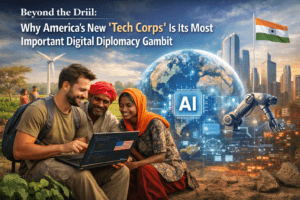
Imagine a volunteer not with a shovel, but with a laptop, working alongside a farmers’ cooperative in Kenya to fine-tune an American-built AI model that predicts drought patterns and optimizes irrigation. Or a team in a clinic in rural Colombia deploying a diagnostic tool, built on a U.S. platform, to help community health workers screen for diseases with limited resources. This is the promise of the Tech Corps: to provide the “last-mile” support that turns a powerful, but generic, AI solution into a practical tool that solves a “real-world grassroots problem.”
This focus on the application layer is critical. China has made significant inroads by providing accessible, open-source models like Qwen3 and DeepSeek. These models are cheap, highly customizable, and can run on local hardware—a huge advantage for nations with underdeveloped cloud infrastructure. The U.S. strategy, via the Tech Corps, is a direct counter to this. It moves the conversation from “whose model is cheaper?” to “whose model, when implemented correctly, can actually improve crop yields, literacy rates, or public health outcomes?”
The Geopolitics of Code
At the heart of this initiative is a subtle but powerful reframing of the concept of “AI sovereignty.” For many nations, particularly in the Global South, sovereignty means control. It means not being beholden to the technological whims of a superpower. This has made the Chinese open-source model, which can be downloaded, modified, and run on a local server, incredibly attractive. It feels like ownership.
But Michael Kratsios, director of the White House Office of Science and Technology Policy, offered a compelling counter-argument at the Delhi summit: “Real AI sovereignty means owning and using best-in-class technology for the benefit of your people.”
The argument is simple. Sovereignty isn’t just about control; it’s about capability. A country can have complete control over a subpar, underpowered AI system—but that does little to advance its national interests. By sending American experts to help integrate and deploy its most advanced systems, the U.S. is offering a different kind of sovereignty: the sovereignty of being on the cutting edge. It’s a pitch that says, “Don’t settle for the technology you can build alone. Gain the power of the world’s best AI, with our experts right there beside you to ensure it works for your people.”
This is further reinforced by the creation of the “National Champions Initiative.” This program aims to weave leading American AI companies—the OpenAIs, Googles, and Anthropics of the world—into a customized “American AI export stack” for partner nations. It’s a full-suite offering: not just the model, but the hardware, the integration expertise, the financing, and now, through the Tech Corps, the on-the-ground, human-powered support system to make it all function.
A New Kind of Volunteer, A New Kind of Challenge
The Tech Corps represents a radical departure for the Peace Corps, and it will inevitably face significant hurdles. Recruiting, training, and deploying highly skilled tech professionals for 12 to 27 months in developing nations is a different proposition than recruiting generalists. These are individuals who command six-figure salaries in the private sector. What incentive—beyond patriotism and a sense of purpose—will be compelling enough to bring them into government service for a living stipend?
The program will need to appeal to a sense of mission that resonates deeply with a generation of technologists who are increasingly concerned about the ethical implications and societal impact of their work. The chance to ensure AI is used to solve hunger, not just sell more ads, could be a powerful motivator.
Furthermore, the presence of American tech volunteers will inevitably raise complex questions about data privacy, cultural imperialism, and digital dependency. Will these volunteers be seen as altruistic experts or as advance scouts for American corporate interests? The White House has signaled its intent to use other soft-power institutions, like the World Bank and the U.S. International Development Finance Corporation, to help partners overcome financing obstacles. But financial support must be paired with robust frameworks for data governance and local capacity building to ensure that the “AI sovereignty” being offered is not just a cleverly marketed form of dependency.
The partnership with India is telling. As a core member of the “Pax Silica” initiative—a U.S.-led coalition focused on securing the global silicon supply chain—and a major recipient of American tech investment, India is the proving ground for this new model. It’s a democratic nation with a massive tech talent pool of its own, eager to build its native AI industry. The success of the Tech Corps in India, where the volunteers will be working alongside a highly sophisticated local tech sector, will be a bellwether for the program’s viability elsewhere.
Conclusion: The Human Element in a Digital War
The launch of the Tech Corps is a recognition that the race for AI dominance cannot be won by government fiat or corporate R&D alone. It requires a human touch. As China pushes out its cost-effective, adaptable models through digital pipes, the U.S. is betting that its greatest asset is still its people: the engineers, thinkers, and problem-solvers willing to pack a bag and live in a community far from home to make a difference.
This initiative is more than a clever geopolitical strategy; it is an acknowledgment that technology, in its purest form, is about people. By embedding American expertise directly into the societies it hopes to influence, the U.S. is attempting to build not just markets, but relationships. It is a gamble that the trust forged in a village over 27 months of shared work will be far more durable than any advantage gained by providing cheaper code. The Tech Corps is a bid to ensure that as the world rebuilds itself in the image of AI, it does so with a distinctly American accent. The first volunteers are set to deploy in the fall of 2026, and the world will be watching to see if they carry a shovel, a laptop, or both.
You must be logged in to post a comment.