
Beyond the Dragon Belt: How Sea Dragon 2026 Forged an Unbreakable ASW Alliance in the Indo-Pacific
Exercise Sea Dragon 2026 concluded on March 28 at Andersen Air Force Base, Guam, after 20 days of intensive anti-submarine warfare training involving P-8A aircraft from the U.S., Australia, India, Japan, and New Zealand. Hosted by Commander, Task Force 72, the exercise featured complex tracking drills against a mobile target and a live U.S. Navy submarine, strengthening interoperability and shared maritime awareness among the allies. A competitive component awarded the Dragon Belt to the JMSDF’s VP-3, which dethroned the RAAF as the previous holder. U.S. aviators underscored that such multilateral drills build not only technical skill but also cohesive multinational teams capable of deterring aggression in the Indo-Pacific, reflecting the 7th Fleet’s ongoing commitment to regional security and partnership.
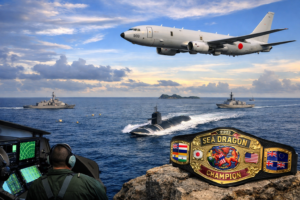
Beyond the Dragon Belt: How Sea Dragon 2026 Forged an Unbreakable ASW Alliance in the Indo-Pacific
In the vast, blue expanse of the Pacific Ocean, silence is a weapon, and sound is the key to survival. For 20 days in March 2026, that silent world became a bustling arena of high-stakes competition and cooperation as five nations concluded Exercise Sea Dragon, the premier multinational anti-submarine warfare (ASW) training event in the Indo-Pacific.
As the exercise officially wrapped up on March 28 at Andersen Air Force Base, Guam, the surface of the water gave no indication of the underwater chess match that had just unfolded. But beneath the waves, a coalition of the U.S. Navy, Royal Australian Air Force (RAAF), Royal New Zealand Air Force (RNZAF), Indian Navy (IN), and Japan Maritime Self-Defense Force (JMSDF) had spent nearly three weeks honing the most complex and unforgiving domain of modern naval warfare: the hunt for the silent hunter.
While the official press release notes the conclusion of 20 days of intensive training, the reality of Sea Dragon 2026 is a story of strategic deterrence, technological interoperability, and the quiet forging of a submarine-hunting brotherhood—one that culminated in a Japanese victory and the passing of the coveted Dragon Belt.
The Unseen Battlefield
For the uninitiated, anti-submarine warfare is often described as a global game of “hide and seek” played at marathon pace. Unlike surface engagements, where radar and optics provide near-instantaneous situational awareness, ASW relies on patience, acoustic analysis, and the meticulous processing of data from sonobuoys, magnetic anomaly detectors, and advanced onboard sensors.
This year, the playground was the waters surrounding the Commonwealth of the Northern Mariana Islands, specifically near Saipan. The environment offered a complex acoustic landscape—a dynamic and challenging arena that forced the multinational crews to contend with varying water temperatures, salinity gradients, and marine life that can often mimic enemy contacts.
Central to the exercise was the MK-30 “Sled,” a mobile ASW training target that served as the initial training wheel for the crews. But the real test—the ASWEX (Anti-Submarine Warfare Exercise)—involved a far more elusive quarry: an active U.S. Navy nuclear-powered submarine. For the crews of the P-8A Poseidon maritime patrol aircraft participating from the U.S., Japan, Australia, India, and New Zealand, finding that submarine was the ultimate validation of their tactics.
“The ocean is a massive acoustic cloak,” explained Lt. Paolo Aguilar, a naval aviator assigned to Patrol and Reconnaissance Squadron (VP) 4, the “Skinny Dragons.” “What we do in Sea Dragon builds more than skill—it establishes an ASW team across nations. The shared experience empowers us to fight together more effectively.”
Aguilar’s words cut to the core of the exercise’s purpose. A submarine, by its nature, operates alone. But the forces arrayed against it in a conflict would not. Sea Dragon 2026 ensured that when the time comes, the data sharing between a Japanese P-8A, an Australian P-8A, and a U.S. Navy command center will be seamless, instantaneous, and intuitive.
The Human Element: “Together, We’re Stronger”
Behind the sensors and sonobuoys are the aviators, analysts, and tacticians. For Lt. Caitlin Tucker, a naval aviator with VP-45, the value of Sea Dragon is measured in the relationships built in the briefings and debriefings as much as the tracks logged on the tactical display.
“Exercises like Sea Dragon highlight the strength of our partnerships and alliances,” Tucker said. “They show that together, we’re stronger, more capable, and ready to deter any aggressor in the Indo-Pacific.”
Tucker’s squadron, the “Pelicans,” alongside VP-4, represented the U.S. Navy’s forward-deployed maritime patrol and reconnaissance force in the 7th Fleet area of operations. Operating out of Kadena Air Base in Okinawa and Misawa Air Base in Japan respectively, these squadrons live on the front lines of the region’s strategic competition.
But this year, they were not alone. The Indian Navy brought its own P-8I (a variant of the Poseidon) long-range maritime reconnaissance aircraft, demonstrating New Delhi’s deepening integration into the Pacific security architecture. The RAAF and RNZAF brought their expertise, honed in the vast maritime approaches to Oceania, while the JMSDF—the winner of this year’s competition—brought a relentless focus that reflects Japan’s strategic imperative to secure its sea lanes.
The Dragon Belt: A Symbol of Excellence
Unlike many multilateral exercises that conclude with a simple handshake and a “job well done,” Sea Dragon retains a fiercely competitive edge: the Dragon Belt award.
This isn’t a mere participation trophy. It is a metric of tactical superiority. Throughout the 20-day evolution, each nation’s performance is assessed and graded. Analysts evaluate speed to solution, accuracy of localization, tactical decision-making, and the efficiency of prosecution against the target—whether it be the MK-30 “Sled” or the elusive U.S. Navy submarine.
This year, the belt changed hands. VP-3 of the Japan Maritime Self-Defense Force emerged victorious, securing the Dragon Belt for 2026. They dethroned the Royal Australian Air Force, who had held the title since their victory in 2025.
The victory is more than a morale booster for the JMSDF; it is a statement of capability. As the nation on the front line of regional maritime security, Japan’s proficiency in ASW is critical to the stability of the Indo-Pacific. The Dragon Belt now residing with the JMSDF serves as a tangible reminder of the high level of readiness maintained by the alliance network.
Strategic Implications: Why Sea Dragon Matters
While the tactical maneuvers and the competition for the belt are captivating, the strategic underpinnings of Sea Dragon 2026 are what resonate across the capitals of the Indo-Pacific.
The exercise has been held annually since 2019, evolving from a bilateral U.S.-Australian event into a cornerstone multilateral operation. Its growth mirrors the increasing complexity of the security environment. The Indo-Pacific is defined by water—millions of square miles of it. In any potential conflict scenario, controlling the undersea domain is paramount. The ability to detect, track, and if necessary, neutralize adversary submarines is the linchpin of keeping sea lanes open for commerce and military reinforcement.
By operating the P-8A Poseidon—a platform now shared by the U.S., Australia, India, Japan, and New Zealand—these five nations have achieved a level of interoperability rarely seen among coalition forces. They speak a common “language” of data links, sensor processing, and tactical doctrine.
Hosted by Commander, Task Force (CTF) 72, Sea Dragon 2026 demonstrated the U.S. Navy’s commitment to that interoperability. CTF 72, which oversees maritime patrol and reconnaissance assets in the region, understands that the vast distances of the 7th Fleet area of operations—the largest forward-deployed numbered fleet in the Navy—cannot be covered by any single nation.
The Path Forward
As the P-8A Poseidons from VP-4 and VP-45 return to their forward-deployed hubs in Okinawa and Misawa, and as the Indian, Japanese, Australian, and New Zealand crews depart Guam, the data collected over these 20 days will fuel analysis for months to come.
For Lt. Aguilar, Lt. Tucker, and the hundreds of sailors and airmen involved, the exercise was a reminder of the shifting nature of maritime warfare. The submarine threat is evolving, becoming quieter, more lethal, and more sophisticated. To meet that threat, the response must evolve as well—becoming more integrated, more agile, and more unified.
“The shared experience empowers us to fight together,” Aguilar had said. And for five nations operating in the world’s most dynamic maritime theater, that shared experience is not just a training objective; it is the foundation of deterrence.
In the silent depths of the Pacific, the hunter-killer teams of Sea Dragon 2026 proved that when the waters are contested, the strength of the alliance is the loudest signal of all.
About the Forces:
VP-4 (Skinny Dragons) and VP-45 (Pelicans) operate under Commander, Task Force 72. While home-ported in Whidbey Island, Washington, and Jacksonville, Florida, respectively, their forward presence in Japan places them at the tactical tip of the spear for the U.S. 7th Fleet, ensuring a free and open Indo-Pacific.
You must be logged in to post a comment.