
Beyond the Diplomatic Call: Decoding the India-Brazil Strategic Handshake and Its Reshaping of the Global South
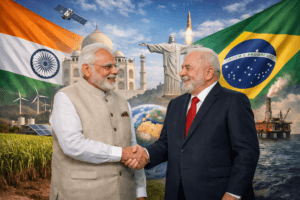
Beyond the Diplomatic Call: Decoding the India-Brazil Strategic Handshake and Its Reshaping of the Global South
A routine readout of a telephone call between world leaders often slips under the radar, a diplomatic formality lost in the noise of daily news. Yet, the recent conversation between Indian Prime Minister Narendra Modi and Brazilian President Luiz Inácio Lula da Silva, detailed in a PIB release dated January 2026, is anything but routine. It is a concise manifesto of a rapidly evolving partnership that stands to recalibrate axes of influence in a fracturing world order. This isn’t merely about two leaders chatting; it’s a strategic update from the frontlines of a new, assertive Global South.
The Context: A Partnership Rekindled
To understand the significance, one must look at the trajectory. The India-Brazil relationship, historically cordial and anchored in forums like BRICS, IBSA, and the G20, has often been described as one of unfulfilled potential. Both are continental-scale democracies, agricultural powerhouses, and leaders of the developing world. However, geographical distance and differing immediate regional priorities sometimes led to a partnership that operated in episodic bursts, often during multilateral summits.
The Modi-Lula dialogue, following their 2023 meetings in Brasília and South Africa, signals a deliberate shift from episodic to sustained engagement. President Lula’s return to power in Brazil marked a re-engagement with traditional Global South alliances, finding a natural and willing partner in a India that has, under Modi, aggressively pursued a policy of “multi-alignment” and vocal South-South cooperation. The phone call is the maintenance check for an engine that both nations have decided to rev up.
Deconstructing the “Significant Progress”: A Multi-Sectoral Deep Dive
The press release’s mention of progress across trade, technology, defence, energy, health, and agriculture is a data-rich claim worth unpacking.
- Trade & Investment: The traditional commodity complementarity (Brazilian soybeans and crude oil for Indian pharmaceuticals, auto parts, and refined diesel) is being upgraded. The real story lies in value-added trade and cross-investment. Indian IT giants are embedding themselves in Brazil’s digital transformation, while Brazilian aerospace major Embraer and Indian aviation are in constant dialogue. Brazilian investment in renewable energy in India and Indian pharmaceutical production in Brazil for the Latin American market point to a mature, strategic economic relationship moving beyond simple exchange.
- Technology & Defence: This is the frontier of the partnership. In technology, collaboration spans digital public infrastructure (Brazil’s interest in India’s Aadhaar and UPI models), space (shared satellite data for Amazon and deforestation monitoring), and bio-technology. In defence, it moves past buyer-seller dynamics. The focus is on joint development, production, and technology sharing—areas where both nations seek to reduce external dependencies and leverage each other’s niche strengths, whether in naval systems, surveillance, or cyber capabilities.
- Energy & Agriculture: Here, the partnership addresses global existential challenges. In energy, it’s a synergy of biofuels (Brazil’s world-leading ethanol program) and renewables (Indian solar technology). Together, they offer a powerful template for decarbonization for the developing world. In agriculture, cooperation is about climate-resilient crops, tropical agro-technology, and ensuring food security—a powerful political tool for two nations that feed billions.
- Health & People-to-People Ties: Forged in the fire of the COVID-19 pandemic, health cooperation is about pharmaceutical supply chains and vaccine diplomacy. The people-to-people pillar, often the weakest link, is being strengthened through simplified visas, academic exchanges, and cultural diplomacy, building a social substrate for the strategic partnership.
The Geopolitical Chessboard: “Reformed Multilateralism” as a Battle Cry
The most profound part of the readout is perhaps the shortest: “They also underscored the importance of reformed multilateralism in addressing shared challenges.” This is diplomatic code for a shared, profound frustration with the post-World War II global governance architecture.
The United Nations Security Council’s permanent membership, the voting power structures of the IMF and World Bank, and the club-dominated norms of global trade are seen by India and Brazil as anachronistic. Their joint push for reform is not mere rhetoric; it is a coordinated campaign. As vocal members of the G4 (seeking UNSC permanent membership), their alliance gives heft to the demand for a seat at the high table. When they speak together in the G20, BRICS, or at the UN, they amplify the voice of the developing world on issues from climate finance to digital governance rules.
Their mutual interest extends to regional stability—India watches Brazil’s role in South America, and Brazil values India’s perspective on the Indo-Pacific. This cross-continental insight is invaluable in an interconnected world.
The Invitation: Symbolism and Substance
PM Modi’s invitation for President Lula to visit India “at an early date” is a key takeaway. High-level visits are the punctuation marks in diplomatic narratives; they force bureaucracies to create deliverable outcomes. A potential 2026 visit would likely see a significant expansion of existing agreements, possibly in defence technology, energy transition partnerships, or a joint initiative on tropical science and innovation. It would also be a powerful visual of Global South solidarity.
The Road Ahead: Challenges and the Promise of a New Axis
The path isn’t without obstacles. Domestic economic priorities can sometimes clash (e.g., in agricultural trade at the WTO). Both nations have complex relationships with other major powers (the US, China, EU) that require careful balancing. The sheer bureaucratic inertia in implementing ambitious joint projects is a universal challenge.
However, the compelling force driving this partnership is a convergent strategic vision. In a world increasingly defined by blocs and zero-sum politics, India and Brazil represent a third way: a commitment to strategic autonomy, democratic governance, and inclusive development. They are building a partnership not against anyone, but for their own development and for a more equitable global system.
The 583-visitor counter on the original PIB release belies the true weight of the conversation it documented. The Modi-Lula call is a testament to a partnership finally coming of age. It is no longer just about shared identities as developing nations, but about shared capabilities and a shared ambition to co-author the rules of the coming century. As the world stumbles toward a new order, the steady, deliberate strengthening of the India-Brazil axis may well be one of the most significant, yet understated, geopolitical stories of our time. Their partnership is a laboratory for South-South cooperation, and its success or failure will offer a blueprint for how the world’s majority seeks to carve its own destiny.
You must be logged in to post a comment.