
Beyond the Delays: Unpacking the Systemic Storm Behind IndiGo’s Operational Meltdown
Beyond the Delays: Unpacking the Systemic Storm Behind IndiGo’s Operational Meltdown
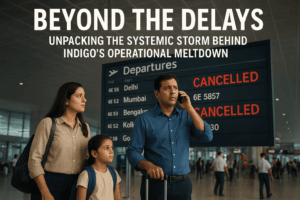
For thousands of travelers across India last week, a simple journey turned into a logistical nightmare. Imagine a family, bags packed, excitement brimming for a long-awaited wedding in Goa, staring helplessly at a departure board flashing “CANCELLED” beside their IndiGo flight number. Frantic calls to customer service yield only busy signals. Scrambling for alternatives reveals sky-high last-minute fares on other carriers. This scene, repeated at terminals from Delhi to Bengaluru, Chennai to Kolkata, was the human face of a colossal operational breakdown at India’s largest airline.
IndiGo’s recent crisis, which led to the cancellation of over 2,000 flights in a matter of days, was more than just a “bad week” in aviation. It was a stark revelation, a perfect storm that exposed the fragile seams of an airline system pushed to its limits. While the carrier’s confidential letter to the government cited five key factors—technical glitches, winter schedule rollout, weather, airspace congestion, and new pilot duty rules—a deeper dive suggests a more fundamental narrative: a collision between breakneck growth and the intricate realities of running a massive, complex network.
The Five-Pronged Perfect Storm: Symptoms of a Larger Imbalance
IndiGo’s explanation points to a compounding effect, where individual manageable issues converged to create an avalanche. Let’s dissect each, not as excuses, but as symptoms of systemic pressures.
- Technical Glitches: The Spark in a Tinderbox. The airline described “minor technical snags.” In aviation, there is no “minor” snag. Every aircraft discrepancy requires protocol, checks, and often, parts and certified engineers. For an airline operating a homogenized fleet of over 350 Airbus A320 family aircraft, a cluster of such snags across the network can quickly pull multiple planes out of rotation. The strain is amplified when the backup margin—the spare aircraft ready to deploy—is thin, a common reality in airlines running ultra-lean operations to maximize asset utilization.
- The Winter Schedule Rollout: A Precariously Balanced Domino Set. Every seasonal schedule change is a monumental re-calibration of aircraft, crew, airport slots, and maintenance plans. It’s a carefully sequenced domino chain. IndiGo, with its vast domestic footprint adding new routes and frequencies, operates one of the most complex schedules in the country. Any initial disruption, whether from point one (snags) or point three (weather), means those dominoes don’t fall as planned. The subsequent re-rostering of crews and aircraft is a computational nightmare, often done under intense time pressure, leaving room for error and further downstream delays.
- Weather and Congestion: The External Squeeze. North India’s winter fog is an annual adversary, but its impact is now more severe. Pre-COVID, air traffic and airport infrastructure were in a different balance. Today, with record-breaking domestic passenger numbers, the cushion is gone. A fog-induced ground stop at Delhi doesn’t just delay Delhi flights; it aircraft and crew out of position across the entire network. Congested airspace and saturated airport aprons mean recovery is slower. A one-hour delay on the first flight of the day for a pilot can legally cascade, under duty time rules, into a cancellation of their fourth and final flight.
- The FDTL Phase II Rules: The Regulatory Catalyst. This is perhaps the most critical, and least understood, factor. The Directorate General of Civil Aviation’s (DGCA) new Flight Duty Time Limitations (FDTL) Phase II rules are designed with pilot wellness and safety at their core—a non-negotiable priority. They impose stricter limits on pilot duty hours and mandate longer, scientifically-backed rest periods. However, implementing these in a vast, tight-margin operation requires a significant buffer in pilot staffing. IndiGo had reportedly flagged challenges in smooth implementation to the regulator. When the other factors hit, the airline’s roster, built for efficiency under previous norms, likely became non-compliant overnight. Pilots maxed out their legal duty hours quicker, leaving flights without certified crew. As Civil Aviation Minister Ram Mohan Naidu stated in Parliament, the airline “failed to maintain their roster.” This wasn’t merely poor planning; it was a system built for one regulatory environment struggling to adapt instantly to another, while under acute operational stress.
The Human and Trust Cost: More Than Just Refunds
The Ministry’s directive to expedite refunds—over ₹610 crore processed so far—addresses the financial grievance but not the erosion of trust. For the modern traveler, reliability is as valuable as price. The viral video of an IndiGo pilot emotionally apologizing to passengers wasn’t just a PR moment; it was a poignant glimpse of frontline employees bearing the brunt of systemic failure. These disruptions have a domino effect on the broader economy: business deals postponed, tourism receipts lost, and connecting international journeys missed.
The government’s response—high-level review meetings, airport inspections, a four-member DGCA committee, and a summons to CEO Pieter Elbers—signals the seriousness with which this is viewed. It’s no longer just an airline’s internal matter but a concern for national transport infrastructure.
The Path Forward: Insights for an Industry at an Inflection Point
This crisis offers crucial insights for the entire aviation ecosystem:
- For Airlines (Especially IndiGo): The era of pure, unadulterated growth-at-all-costs must evolve. The next phase requires “Resilience-by-Design.” This means investing in larger operational buffers—more spare aircraft, larger pilot and crew reserves, and more robust contingency planning. Technology investment must shift beyond sales and revenue management to supremely intelligent, real-time operational control centers that can dynamically manage disruptions. Transparency during crises is key; proactive, clear communication can retain passenger goodwill even when flights are canceled.
- For Regulators: The DGCA’s safety-first mandate is paramount. The FDTL rules are a progressive step. The learning here is the need for a collaborative, phased implementation framework for major regulatory changes in an industry as dynamic as India’s. Working with airlines on transition roadmaps, with clear milestones and interim checkpoints, can ensure safety enhancements don’t inadvertently trigger operational collapses.
- For Infrastructure Providers: The crisis underscores the urgent need to decongest skies and airports. Accelerating the implementation of the Airspace Modernization plan, improving runway capacities, and ensuring smoother ground handling processes are national imperatives. No airline, no matter how efficient, can fly smoothly through clogged infrastructure.
- For Travelers: This episode is a reminder to build personal buffers. Travel insurance, flexible booking options where possible, and avoiding extremely tight connections for critical journeys are prudent measures. When booking, consider the airline’s recent operational performance as a factor, not just the ticket price.
Conclusion: A Wake-Up Call, Not a Terminal Diagnosis
IndiGo’s crisis is not a sign of an airline in terminal decline. It is the growing pains of a carrier that has grown at a phenomenal, unprecedented rate to become the world’s third-largest by domestic capacity. The challenge it faces is the classic corporate evolution from a disruptive, fast-growing challenger to a mature, systemically resilient market leader.
The return to normalcy—1,500-1,650 flights a day over a weekend—shows the underlying strength of the organization. However, true recovery will be measured not in daily flight numbers, but in the lessons learned and the systems rebuilt. The coming DGCA committee report and IndiGo’s own Root Cause Analysis must translate into tangible changes in operational philosophy.
For the Indian aviation sector, this is a pivotal moment. It highlights that the sector’s future success depends not just on selling more tickets, but on building a more robust, flexible, and collaborative ecosystem. The skies are open for growth, but as last week proved, they demand a new altitude of operational excellence and preparedness. The journey ahead requires flying not just full, but smart and resilient.
You must be logged in to post a comment.