
Beyond the Deal: Decoding Piyush Goyal’s “Delta of Opportunity” and the New Blueprint of India-U.S. Ties
In his address at the Raisina Dialogue, Union Minister Piyush Goyal redefined the India-U.S. relationship as a multidimensional alliance far beyond traditional trade, anchored instead in high-tech collaboration, critical minerals, and defense partnership—a bond he asserted will “define the future.” Goyal introduced the concept of India’s “$26 trillion delta of opportunity,” the projected growth from a $4 trillion to a $30 trillion economy by 2047, which he positioned as India’s ultimate leverage in negotiations, arguing that developed nations need access to this explosive growth more than India needs their static markets. He detailed his “mantra” for Free Trade Agreements, which balances international ambition with domestic protection through exhaustive stakeholder consultations to prevent local industries from being harmed, citing the deal with the EFTA nations as a prime example where India secured a legally binding $100 billion investment commitment with clawback provisions. Ultimately, Goyal’s message was one of a confident, rising India that now negotiates from strength, demanding not just trade concessions but investment, technology transfer, and fair treatment for its skilled workforce abroad.
Beyond the Deal: Decoding Piyush Goyal’s “Delta of Opportunity” and the New Blueprint of India-U.S. Ties
For decades, the narrative of India-U.S. relations was a predictable pendulum, swinging between the heavy weights of trade disputes (think Harley Davidson tariffs and intellectual property rights) and the lofty rhetoric of a “natural alliance” between the world’s two largest democracies. On Saturday, at the prestigious Raisina Dialogue in New Delhi, Union Minister Piyush Goyal didn’t just dismiss that old binary; he incinerated it.
Speaking with the conviction of a man who has spent years at the negotiating table, Goyal painted a picture of a partnership that has fundamentally evolved. It’s no longer just about the balance of trade in goods; it’s about the balance of power in a technology-driven world. His address offered a rare, unvarnished look into the mind of India’s chief dealmaker, revealing a strategic philosophy that marries aggressive ambition with a deeply ingrained protective instinct for the domestic economy.
This isn’t just a story about another diplomatic soundbite. It’s about how a rising economic power is redefining the rules of engagement for the 21st century, moving from being a rule-taker to a rule-shaker.
The “Tech-tonic” Shift in the Alliance
When Minister Goyal described the relationship as having a “huge technology overlay,” he was pointing to a transformation that is reshaping geopolitics. The old model of trade was about ships crossing oceans with finished goods. The new model is about bits, bytes, and brainpower crossing borders instantaneously.
The India-U.S. partnership is now anchored in the industries that will define the next fifty years: critical minerals, defense, and high-tech semiconductors. This is a partnership of resilience. As the world scrambles to de-risk from concentrated supply chains (a polite term for reducing dependence on China), India and the U.S. are positioning themselves as the reliable, democratic alternative.
- Critical Minerals: This isn’t just about mining; it’s about the lifeblood of the green transition. From the lithium in your EV battery to the cobalt in your smartphone, a partnership here ensures that the democratic world isn’t reliant on authoritarian regimes for its clean energy future.
- Defense Cooperation: The relationship has moved from a buyer-seller dynamic (where India simply purchased U.S. weapons) to one of co-development and co-production. This involves sharing sensitive technology, a sign of profound trust and strategic alignment.
- The Semiconductor Saga: The recent approval for a $11.6 billion chip plant in Gujarat, set up in partnership with the U.S.-based semiconductor giant Micron, is the physical manifestation of this “technology overlay.” It’s a bet that the future of computing will be built with a hyphen: Indo-U.S.
By framing the partnership as one that will “define the future,” Goyal is signaling that India is no longer content to be a balancing power; it intends to be a defining one, in lockstep with Washington.
The ‘Delta of Opportunity’: India’s Ultimate Negotiating Chip
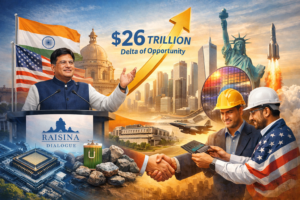
Perhaps the most compelling concept Goyal introduced was the “$26 trillion delta of opportunity.” In the world of high finance, “delta” represents the rate of change. For Goyal, it is the ultimate ace up India’s sleeve.
Here’s the logic that underpins India’s new negotiating confidence: Developed nations like the UK, Switzerland, or the U.S. are mature economies. They are hoping to grow from, say, $4 trillion to $5 trillion over the next two decades. That’s a $1 trillion opportunity for them. India, on the other hand, is projected to balloon from a $4 trillion economy today to a $30 trillion economy by 2047 (the centenary of its independence). That is a $26 trillion increase.
“I’m giving you a delta of opportunity,” Goyal was effectively telling his Western counterparts. “You are giving me a static market. Who needs whom more?”
This reframes the entire FTA negotiation. It’s no longer about India begging for market access for its textiles or leather. It’s about developed nations needing a front-row seat to the greatest growth story of the 21st century. India is essentially saying: “If you want to be part of this rocket ship of growth, you have to pay the fare. And the fare is investment, technology transfer, and fair treatment for our people.”
The ‘Goyal Mantra’: No More ‘Throwing Industry Under the Bus’
Behind the confident rhetoric lies a cautious, data-driven negotiator. Goyal’s “mantra” for Free Trade Agreements reveals a government that has learned hard lessons from the past. The ghost of RCEP (the Regional Comprehensive Economic Partnership) looms large over his strategy.
India’s decision to walk away from RCEP in 2019 was a watershed moment. Goyal reaffirmed that walking in would have been “disastrous,” primarily because it would have created a backdoor for Chinese goods to inundate the Indian market, devastating small manufacturers and MSMEs.
This has led to a non-negotiable principle: Stakeholder Consultation.
Before India signs on the dotted line, the government now engages in exhaustive consultations with domestic industry bodies, farmer unions, and trade associations. The goal is to identify “sensitive” sectors—the ones that could be hurt by a sudden flood of cheap imports. This is economic nationalism with a human face. It acknowledges that while free trade can lift a nation, it can also crush a village if not managed carefully.
The deal with the European Free Trade Association (EFTA) —comprising Switzerland, Norway, Iceland, and Liechtenstein—is the poster child for this new approach. India didn’t just open its market for Swiss watches or Norwegian fish. In exchange for tariff concessions, India demanded—and secured—a legally binding commitment for $100 billion in investment over a defined period.
This is a revolutionary clause. As Goyal pointed out, there’s a clawback mechanism. If the investment doesn’t flow in, the trade benefits can be revoked. It transforms an FTA from a static document into a dynamic, performance-based partnership. India is trading access to its massive consumer base not just for goods, but for the capital and expertise needed to build its industrial future.
The Human Element: Fighting for the ‘Demographic Dividend’
While trade in goods and investments grabs the headlines, Goyal highlighted a crucial, often overlooked battleground: the movement of people. In an aging world, India’s young, skilled workforce is its greatest asset.
In negotiations with the UK, a major sticking point has been the issue of social security contributions.
The current system in many Western nations creates a “double taxation” of talent. An Indian software professional or management consultant working in the UK for three or four years is forced to pay into the UK’s social security system. However, because they haven’t worked long enough to qualify for a British pension, and they cannot withdraw those funds when they leave, they end up subsidizing a system from which they will never benefit. This amounts to billions of dollars in free money flowing out of the pockets of Indian professionals into foreign treasuries.
By fighting to reclaim these contributions or create “totalization” agreements (where time spent working abroad counts toward a home pension), Goyal is fighting for the financial dignity of the individual Indian worker. It’s a recognition that in the knowledge economy, the “product” being exported is the Indian professional, and they deserve a fair deal.
Conclusion: The Confidence of a Rising Power
Piyush Goyal’s address at the Raisina Dialogue was more than a ministerial update; it was a declaration of India’s arrival on the world stage as a confident, strategic power. The message to the world, and particularly to the United States, is clear.
Gone are the days of defensive negotiations. India is now playing offense. It is leveraging its immense size, its demographic energy, and its political stability to secure deals that were unthinkable a decade ago. The partnership with the U.S. is the cornerstone of this vision—not as a client state, but as a co-architect of the future.
As India marches toward its goal of becoming a developed nation by 2047, the “Goyal Mantra” of balancing ambition with protection, and leveraging its “delta of opportunity,” will likely become the defining template of its economic statecraft. The world doesn’t just have to listen anymore; it has to deal. And dealing with India, as the Minister has made clear, means showing up with more than just trade concessions—it means showing up with respect, investment, and a vision for a shared future.
You must be logged in to post a comment.