
Beyond the Dark Factory: Why India’s Automation Future Can’t Copy the West
In a recent address, SOLIDWORKS CEO Manish Kumar emphasized that India must forge its own path on automation rather than simply copying the labor-scarce, “dark factory” model of the United States, arguing that the country’s massive workforce and demographic realities make this a profound social challenge as much as an engineering one. While acknowledging that advanced automation is unavoidable in cutting-edge sectors like defense, drones, and semiconductors, Kumar advocates for a balanced “hybrid” approach in traditional manufacturing—using software and targeted automation to enhance human productivity and safety rather than wholesale replace workers. This strategy, he suggests, allows India to pursue its manufacturing ambitions and global competitiveness without undermining its social contract, where factory jobs remain a vital source of employment and upward mobility for millions.
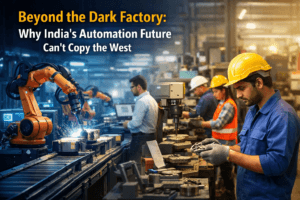
Beyond the Dark Factory: Why India’s Automation Future Can’t Copy the West
As global manufacturing races toward lights-out production, India faces a more complex equation where engineering ingenuity must serve social reality—not replace it.
The phrase “dark factory” conjures a particular kind of futuristic imagery: cavernous manufacturing floors illuminated only by the blinking lights of machines, robotic arms moving in synchronized precision, and not a single human presence for miles. In parts of the United States, Japan, and Germany, this isn’t science fiction—it’s an economic necessity born of labour shortages that have left manufacturers with few alternatives.
But when Manish Kumar, CEO and Vice President of R&D at SOLIDWORKS, stood before attendees at the company’s annual 3DEXPERIENCE WORLD event in Houston, he offered a reality check that resonated far beyond the conference hall. For India, he argued, blindly following this automation-heavy model would be not just impractical but potentially destabilising.
“India faces a very different challenge,” Kumar said. “The US lacks manpower and therefore has no option but to automate aggressively. On the other hand, India has a large workforce and must also consider employment and social factors. This becomes a social problem as much as an engineering problem.”
It’s a distinction that cuts to the heart of India’s manufacturing ambitions—and one that policymakers, business leaders, and engineers across the subcontinent are only beginning to grapple with.
The Demographic Divergence
To understand why automation poses such different questions in India versus the West, you need only look at the numbers.
The United States is hurtling toward a demographic precipice. With birth rates below replacement level and Baby Boomers retiring in unprecedented numbers, manufacturers across the country report chronic labour shortages. The National Association of Manufacturers consistently cites workforce challenges as its top concern, with hundreds of thousands of positions going unfilled. In this context, dark factories aren’t a choice—they’re survival.
India, by contrast, continues to add millions to its working-age population each year. The country possesses one of the youngest populations on earth, with a median age of around 28 compared to 38 in the United States and 48 in Japan. For the next two decades, India will have one of the largest workforces in human history.
This demographic dividend is simultaneously India’s greatest asset and its most pressing challenge. Every month, roughly a million young Indians turn 18 and begin seeking employment. The economy must generate jobs at an unprecedented scale simply to keep pace.
“Engineers have to solve both together,” Kumar emphasised. “You have to apply the social context of a country along with the engineering context.”
This framing—that automation decisions carry social weight—represents a significant departure from how manufacturing technology is typically discussed. In most global forums, automation is presented as an inevitable progression, a linear path from human labour to machine optimisation. The only question is how quickly companies can get there.
Kumar’s argument suggests something more nuanced: that the optimal level of automation depends entirely on context, and that for countries like India, the goal isn’t eliminating human involvement but enhancing human productivity.
The Hybrid Factory Model
What might this balanced approach look like in practice? Industry observers point to what could be called the “hybrid factory”—facilities where automation targets specific pain points rather than entire production lines, where machines handle dangerous or precision-intensive tasks while humans manage oversight, quality control, and exception handling.
Consider the automotive components sector, one of India’s manufacturing success stories. Tier-one suppliers have increasingly adopted robotic welding and painting—operations that pose health risks to humans and require extreme consistency. But assembly operations, where flexibility and visual inspection matter most, remain heavily staffed. The result is higher quality and safer working conditions without wholesale workforce displacement.
Medical device manufacturing, another area where SOLIDWORKS maintains a strong presence—Kumar notes that nearly 66% of medical device companies use their software—offers similar examples. Sterile environments benefit from reduced human contact, but the customisation and small-batch production characteristic of many medical devices require human judgment that machines still can’t replicate.
“Beyond this, we have a strong presence in high-tech industries,” Kumar said. “Whether it is semiconductors or the machines used to manufacture semiconductors, those systems are designed using software where we have a significant market share.”
The semiconductor industry provides perhaps the clearest illustration of automation’s double-edged nature. Chip fabrication requires cleanroom conditions and precision that demand near-total automation. Yet the equipment used to manufacture semiconductors—the lithography systems, etching tools, and inspection machines—requires skilled engineers for design, assembly, and maintenance. Automation in one domain creates skilled employment in another.
The New Industries Imperative
While Kumar counsels caution on widespread factory automation, he’s equally clear that certain sectors leave no room for ambivalence.
“When it comes to newer fields like defence, drones, and advanced manufacturing, automation will play a very important role,” he stated.
These industries operate under different constraints than traditional manufacturing. Defence contracts increasingly demand precision that only computer-controlled systems can deliver. Drone manufacturing, still in its relative infancy, requires the kind of consistency and scalability that manual processes struggle to achieve. Advanced materials and miniaturisation push the boundaries of human capability.
India’s ambitions in these sectors have grown sharply. The government’s push for domestic defence production, the Production Linked Incentive schemes spanning 14 key sectors, and the recent focus on semiconductor fabrication all point toward a future where India competes not on labour cost but on technological sophistication.
“You may not automate everything on a factory floor, but in new industries, automation is inevitable,” Kumar said.
This creates an interesting paradox: the same country that must preserve employment in traditional sectors must simultaneously embrace the most advanced automation available in emerging ones. Managing this duality—maintaining two parallel manufacturing philosophies—will test policymakers and business leaders in the coming decade.
Software as the Mediator
If automation is inevitable in some contexts and problematic in others, the question becomes how to strike the right balance. For Kumar, part of the answer lies in the software that sits between human intent and machine action.
Design and simulation platforms like SOLIDWORKS enable what might be called “productivity without displacement.” When engineers can model products digitally, simulate performance under real-world conditions, and identify potential manufacturing issues before a single chip of metal is cut, they accomplish two things simultaneously: they compress development cycles and reduce waste, and they create high-value cognitive work for skilled professionals.
The industrial equipment sector, which Kumar identifies as SOLIDWORKS’ largest segment accounting for approximately 50% of its India business, illustrates this dynamic. Complex machinery requires extensive design iteration, and the companies producing it employ thousands of engineers across the subcontinent. These aren’t factory-floor jobs in the traditional sense, but they’re manufacturing jobs nonetheless—and they’re precisely the kind of employment India needs to expand.
“Industrial equipment is our largest segment, and we have a strong presence in high-tech industries,” Kumar noted. The same software that enables automation also enables the design work that keeps engineers employed.
This reframes the automation conversation from one of replacement to one of augmentation. The goal isn’t to eliminate human involvement but to elevate it—to move workers from repetitive physical tasks to cognitive ones, from following instructions to creating them.
The Social Contract of Manufacturing
Behind Kumar’s comments lies a deeper truth about manufacturing’s role in developing economies. In countries like India, factories don’t just produce goods—they produce stability. They provide entry points into the formal economy for rural migrants, skill development for young workers, and middle-class trajectories for millions of families.
The Western model of manufacturing, particularly in its most automated forms, assumes a different social context. When US companies invest in dark factories, they’re responding to a labour market where workers have options—and increasingly choose not to work in manufacturing. The social contract has already shifted; automation merely reflects that reality.
India’s social contract remains fundamentally different. Manufacturing employment is aspirational, not avoided. Factory jobs represent upward mobility, not last-resort options. The expectation that manufacturing will absorb workforce growth isn’t nostalgia—it’s demographic necessity.
This doesn’t mean India should resist automation entirely. As Kumar notes, certain industries require it, and global competitiveness demands continuous productivity improvement. But it does mean that automation decisions carry weight beyond the balance sheet. Every machine that replaces a human worker represents not just a cost-saving measure but a social choice.
The Road Ahead
As India pushes forward with its manufacturing ambitions—the defence sector alone has seen record allocations in recent budgets, while semiconductor policy aims to position India as an alternative to existing global supply chains—the automation question will only grow more pressing.
The path forward likely isn’t a single model but a portfolio of approaches. Traditional sectors with high employment potential may see selective, targeted automation focused on quality improvement rather than headcount reduction. New industries like defence, drones, and advanced electronics will operate at the technological frontier, embracing automation where required for precision and competitiveness. And across both categories, software platforms will increasingly mediate between human workers and automated systems, enabling productivity gains without wholesale displacement.
Kumar’s message to Indian engineers and business leaders is ultimately one of responsibility. The choices made today about what to automate, how much to automate, and where to draw the line between human and machine will shape not just manufacturing productivity but employment patterns, social stability, and economic opportunity for decades.
“You have to apply the social context of a country along with the engineering context,” he said.
In an era when technology often seems to advance with its own momentum, that reminder—that engineering serves society, not the other way around—may be the most valuable insight of all.
You must be logged in to post a comment.