
Beyond the Courtroom: The Battle Over Palestine Speech on Campus and the Future of Academic Freedom
A federal appeals case is challenging the University of Pennsylvania’s handling of pro-Palestinian speech, with a lawsuit from pro-Israel groups claiming the university violated Title VI civil rights laws by permitting campus protests, chants like “From the River to the Sea,” and cultural events critical of Israel. After a district judge dismissed the case for lacking evidence of antisemitic intent by the university, advocacy groups Palestine Legal and the Center for Constitutional Rights filed an amicus brief urging the Third Circuit to uphold the dismissal, arguing that the speech in question is political expression protected by the First Amendment rather than targeted harassment. The case has become a flashpoint in the broader debate over campus free speech, particularly regarding the controversial use of the IHRA definition of antisemitism, which critics argue conflates legitimate political criticism of Israel with bigotry and could violate Palestinian students’ rights if used to suppress their expression.
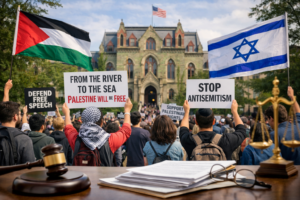
Beyond the Courtroom: The Battle Over Palestine Speech on Campus and the Future of Academic Freedom
On a crisp March morning in 2025, Radhika Sainath sat in her office reviewing legal documents that would soon make their way to the Third Circuit Court of Appeals. As Litigation Director at Palestine Legal, she had seen this pattern before—lawsuits targeting universities for permitting speech critical of Israel, each one framed as civil rights enforcement but carrying implications far beyond the courtroom walls.
The case before her, Eyal Yakoby et al vs. The Trustees of the University of Pennsylvania, represented something larger than a single lawsuit. It embodied a growing conflict playing out on college campuses across America, where the boundaries between protected political speech and actionable harassment have become increasingly blurred.
The Lawsuit That Shook Penn’s Campus
When the lawsuit was filed in November 2023, tensions were already running high. The Palestine Writes Literature Festival had brought together poets, scholars, and artists celebrating Palestinian culture. Students had organized sit-ins and study-ins, their chants echoing across campus greens. “From the River to the Sea, Palestine Will Be Free”—a phrase with decades of history—became a flashpoint.
The plaintiffs, led by Eyal Yakoby, a Penn student affiliated with pro-Israel advocacy groups, alleged that the university had failed to protect Jewish students from a hostile environment. They invoked Title VI of the Civil Rights Act of 1964, which prohibits discrimination based on race, color, or national origin in federally funded programs.
But when U.S. District Judge Mitchell Goldberg examined the case in June 2025, he found something missing: evidence that Penn itself had acted with antisemitic intent. The judge granted the university’s motion to dismiss, noting “no allegations” that Penn took actions “which could be interpreted as antisemitic with the intention of causing harm to the Plaintiffs.”
The plaintiffs appealed, setting the stage for the amicus brief filed this week by Palestine Legal and the Center for Constitutional Rights.
When Political Speech Meets Civil Rights Law
The heart of the matter, as Sainath and her colleagues argue, lies in distinguishing between harassment and political disagreement.
“Title VI was never intended to silence political speech,” Sainath explained in a recent interview. “The students chanting pro-Palestinian slogans aren’t targeting their Jewish peers—they’re expressing opposition to Israeli government policies. That distinction matters, both legally and morally.”
The brief filed with the Third Circuit draws a careful line. Yes, universities must address genuine antisemitic harassment when it occurs. No, they cannot punish students for expressing political views, even when those views are deeply offensive to some listeners.
This distinction becomes particularly important when examining the incidents cited in the lawsuit. The plaintiffs pointed to chants, protests, and cultural events—all forms of expression that courts have historically protected under the First Amendment. The amicus brief argues that these incidents “do not implicate Title VI because they are political speech on a matter of public concern and do not target any student on the basis of a protected identity.”
The IHRA Definition Controversy
Perhaps the most contentious element of the case involves the definition of antisemitism itself. The plaintiffs urged the court to adopt the International Holocaust Remembrance Alliance (IHRA) working definition, which has become a flashpoint in debates over campus speech.
The IHRA definition includes examples that critics say conflate criticism of Israel with antisemitism. For instance, it characterizes “claiming that the existence of a State of Israel is a racist endeavor” as potentially antisemitic. For many Palestinian rights advocates, this language threatens to label their core political beliefs as bigotry.
“We’ve seen this play out across campuses,” said a university professor who requested anonymity to discuss the sensitive topic. “Students who want to critique Israeli policy find themselves accused of antisemitism. It creates a chilling effect where people self-censor rather than risk being labeled as bigots.”
The amicus brief warns that adopting the IHRA definition “conflates virtually all criticism of Israel’s human rights violations with antisemitism.” If Penn were to embrace this standard, the brief argues, it “would not only run afoul of the First Amendment, but would also risk violating the Title VI rights of Palestinian students on campus by discriminating against them.”
Human Voices, Human Stakes
Beyond the legal arguments lie real human experiences. Sarah, a Palestinian-American student at Penn who asked to use a pseudonym, described the emotional weight of watching her campus become a battleground.
“When I hear ‘From the River to the Sea,’ I think about my grandmother’s stories of leaving Jaffa in 1948,” she said. “For me, it’s about return and justice. But I’ve had people tell me that chanting this makes me antisemitic. It’s painful to have your family’s history reduced to a hate slogan.”
Across the ideological divide, Jewish students describe their own pain. David Cohen, a Penn senior active in Jewish campus life, struggled with how to respond to the protests.
“I have friends who feel genuinely unsafe when they hear these chants,” he said. “But I also have friends who are critical of Israel and feel silenced. The challenge is that both experiences can be true simultaneously. The question is how universities respond without picking sides in a political debate.”
These competing narratives highlight why the legal questions before the Third Circuit matter far beyond Penn’s campus. How courts resolve these cases will shape campus climate for years to come.
The National Context
The Penn case is not isolated. Since October 2023, Israel advocacy groups have filed numerous complaints attempting to use Title VI to suppress speech critical of Israel. The American Association of University Professors and the Middle Eastern Studies Association recently documented this strategy in a detailed report.
“This is a coordinated effort to reshape campus discourse,” said a legal expert familiar with the trend. “By framing political speech as harassment, these groups hope to force universities to police student expression in ways that would be unconstitutional if attempted by the government.”
The strategy has met with mixed success in courts. Some judges have been sympathetic to claims that certain anti-Israel rhetoric crosses into antisemitic harassment. Others, like Judge Goldberg, have insisted on clear evidence that speech targets individuals based on identity rather than expressing political views.
What’s at Stake for Universities
For university administrators, these cases present a nearly impossible balancing act. Federal law requires them to address discriminatory harassment. The First Amendment prohibits them from punishing protected speech. And politically active groups on both sides stand ready to sue regardless of which way they lean.
“If Penn had cracked down on the protests, they’d face First Amendment lawsuits from civil liberties groups,” noted a university attorney who advises multiple institutions. “By allowing the protests, they face Title VI claims from pro-Israel groups. Universities are caught in the middle of a political conflict that courts haven’t fully resolved.”
The amicus brief urges the Third Circuit to provide clearer guidance. By affirming the district court’s dismissal and clarifying that political speech about Israel generally falls outside Title VI’s scope, the court could help universities navigate these treacherous waters.
The Broader Implications for Free Speech
Beyond the immediate case, the Penn lawsuit raises fundamental questions about the future of campus speech. If expressing solidarity with Palestinians can constitute harassment, what other political views might become legally risky?
“We’re seeing an effort to weaponize civil rights law against political dissent,” said a free speech advocate not directly involved in the case. “That’s dangerous regardless of your views on Israel-Palestine. Once we accept that people can be silenced because others find their political views offensive, everyone loses protection.”
This concern resonates across the political spectrum. Conservative students who oppose campus diversity initiatives, liberal students who criticize U.S. foreign policy, and students across ideologies who express unpopular views all benefit when courts protect political speech.
The Path Forward
As the Third Circuit prepares to consider the appeal, both sides await guidance that could reshape campus discourse for years to come. The amicus brief from Palestine Legal and the Center for Constitutional Rights urges the court not only to dismiss this case but to establish principles that protect political speech while addressing genuine discrimination.
“The speech at issue targets a state over its actions and is clearly protected under the First Amendment,” Sainath said. Her hope is that the court will recognize that protecting Jewish students from antisemitism and protecting Palestinian students’ right to advocate for their rights are compatible goals—not competing ones.
For students on both sides of the conflict, the legal proceedings can feel abstract compared to the daily reality of navigating a divided campus. But the principles established in this case will shape whether future students can express their views freely or must weigh every word against the threat of litigation.
As one Penn student put it: “We’re all just trying to figure out how to talk about something that matters deeply to us. Having courts tell us what we can and can’t say doesn’t solve anything—it just moves the conflict to a different arena.”
The Third Circuit’s decision, expected later this year, will determine whether that arena continues to expand or whether courts will draw clearer boundaries around protected political speech. For now, universities, students, and advocates on all sides wait and watch, knowing that the outcome will ripple far beyond Philadelphia.
You must be logged in to post a comment.