
Beyond the Condolence Post: When Grief for a Foreign Leader Becomes a Geopolitical Flashpoint
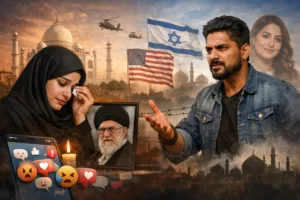
The controversy surrounding Rocky Jaiswal’s criticism of Farrhana Bhatt for mourning Ayatollah Ali Khamenei’s death transcends a simple celebrity dispute, serving as a profound case study on the complexities of public grief in the digital age, where personal sorrow expressed online becomes an immediate geopolitical statement. Jaiswal’s pointed remark about the absence of comparable public mourning for Indian figures tapped into a deep-seated sentiment about national loyalty and selective empathy, questioning why a controversial foreign leader—whose ideology often clashed with India’s strategic allies—would elicit such visible emotion. This incident underscores how social media has transformed mourning into a performative act open to public judgment, how geopolitical awareness shapes the interpretation of condolence, and how public figures face heightened accountability for their expressions, ultimately illustrating that in today’s hyper-connected world, a public tear is never just a tear but a weighted statement of identity and allegiance.
Beyond the Condolence Post: When Grief for a Foreign Leader Becomes a Geopolitical Flashpoint
In the hyper-connected, emotionally volatile ecosystem of social media, a personal expression of grief is rarely just that. It is a statement, a political alignment, and often, a lightning rod for controversy. This reality was thrust into the spotlight recently when a seemingly personal act of mourning ignited a firestorm in the Indian digital sphere.
The trigger was the public mourning of Iranian Supreme Leader Ayatollah Ali Khamenei’s death by Farrhana Bhatt, a figure now in the public eye. This act of remembrance was met with swift and severe criticism, most pointedly from Rocky Jaiswal, husband of late television actress Hina Khan. Jaiswal’s rebuke—”Never did I see such love or tears for any Indian”—cut to the heart of a complex debate about public grief, national identity, and the tangled web of international geopolitics.
But this incident is far more than a celebrity spat. It is a prism through which we can examine the unspoken rules of public mourning, the performative nature of online grief, and the delicate balance between personal freedom and public responsibility in an increasingly polarized world.
The Anatomy of a Controversy: More Than Just a Post
To the casual observer, the incident might seem straightforward: a person mourns a death, and another person criticizes them for it. However, the layers beneath the surface are what give this story its weight. Rocky Jaiswal’s comment was not merely a critique of mourning; it was an accusation of misplaced loyalty. The underlying question he posed was potent: why is there a well of public emotion for a foreign leader, particularly one with a complex and often adversarial relationship with India’s allies, while similar public grief for Indian figures—be they soldiers, leaders, or even fellow citizens—is seemingly absent?
This line of questioning taps into a deep-seated sentiment in many countries, including India: a demand for visible, prioritized patriotism. It suggests that public grief is a zero-sum game. Tears shed for one are tears stolen from another, more deserving, cause. It forces us to confront a difficult question: Is grief allowed to be apolitical, or does the object of our sorrow automatically thrust us into a political arena?
The Geopolitics of Mourning: Why Khamenei is a Loaded Symbol
To understand the backlash, one must understand the man at the center of it. Ayatollah Ali Khamenei was not just a religious leader; he was the formidable Supreme Leader of Iran for decades, a man whose policies and pronouncements have shaped the modern Middle East. For many in the West and in nations allied with the West, including India’s strategic partners like Israel and the United States, Khamenei was a symbol of a theocratic regime often at odds with liberal democratic values.
India has historically walked a tightrope in its relationship with Iran. On one hand, Iran is a crucial source of energy and a strategic partner for access to Afghanistan and Central Asia, bypassing Pakistan. On the other, India’s burgeoning strategic, defense, and technological ties with Israel and the U.S. create a natural counterbalance. Khamenei’s vocal opposition to Israel, a key ally for India in areas of defense and counter-terrorism, puts him directly at odds with a significant pillar of India’s foreign policy.
Therefore, when a public figure in India mourns Khamenei, it is not perceived as a neutral act. For many Indians, it feels like a tacit endorsement of a regime whose ideology runs counter to that of their nation’s close friends. It raises a red flag, prompting questions about where one’s sympathies truly lie in a world of clear geopolitical alliances. Jaiswal’s retort was a stark reminder of this reality: your private grief, when made public, is subject to the scrutiny of a nation that has its own collective memory and political consciousness.
The Digital Memorial: From Sacred Space to Public Square
The platform on which this grief was expressed is just as important as the grief itself. Social media has transformed mourning. It has moved it from the private, intimate spaces of the home, place of worship, or funeral gathering to the vast, cacophonous public square of the internet.
Once upon a time, grief was a sacred, quiet space. Today, it is often a performance. A condolence post is not just for the deceased; it is for one’s followers, for one’s community, for the world to see. It is a way of signaling one’s identity, values, and affiliations. The “RIP” comment, the black-and-white photo, the heartfelt caption—these have become the new rituals of public mourning.
This shift brings with it a host of new social contracts. By posting publicly, the mourner implicitly invites public reaction. The line between a private memorial and a public statement blurs. When you post about a divisive political figure, you are not just grieving in a vacuum; you are placing a marker in the ground. You are telling your audience, “This person mattered to me,” and in doing so, you invite the question, “Why?”
Farrhana Bhatt’s post, whatever its intent, became a part of this public discourse. It was no longer a private tear shed in solitude; it was a digital artifact, open to interpretation, debate, and, as we saw, fierce condemnation. The public’s reaction, while harsh, is a predictable consequence of performing grief in a hyper-political digital arena.
The Charge of Selective Empathy: A Question of Consistency
Rocky Jaiswal’s most potent jab was the accusation of selective empathy. “Never did I see such love or tears for any Indian,” he stated. This is a powerful and emotionally charged argument that resonates with many. It speaks to a perceived imbalance, a sense that some people are quick to mobilize their sympathy for international causes or figures while remaining silent on domestic struggles, tragedies, and losses.
This criticism is not unique to this incident. It surfaces whenever a celebrity or public figure speaks out on global issues like the Palestine-Israel conflict, the war in Ukraine, or climate change. The counter-argument often is: “Why do you care so much about what’s happening thousands of miles away when there are problems right here at home?”
This line of thinking, however, presents a false dichotomy. It presupposes that empathy is a finite resource—that caring about one thing inherently means you cannot care about another. The human heart is capable of holding immense compassion for multiple causes, both near and far. A person can genuinely be moved by the death of a foreign leader they admired while also feeling deep sorrow for victims of a local disaster.
Yet, Jaiswal’s point transcends the logic of finite empathy. It is about public performance. His argument is not necessarily that Bhatt cannot feel sorrow for Khamenei, but that her public expression of it feels disproportionate and inconsistent with her public persona regarding her own country. It highlights a public relations problem: if you are going to use your platform to mourn a controversial foreign figure, your audience will rightfully look for a pattern of comparable public empathy for issues closer to home. When they don’t find it, the grief is not seen as genuine sorrow but as a political statement, making it a fair target for criticism.
The Celebrity Platform: Influence and Accountability
The fact that both individuals in this controversy are public figures—one a well-known actress’s husband, the other a personality in her own right—adds another layer of complexity. Celebrities and influencers operate in a unique space. Their platforms, built on public interest and engagement, grant them a megaphone that ordinary citizens do not possess.
With that amplified voice comes a heightened level of accountability. When a private citizen mourns Khamenei on their personal, locked Facebook page, the ripples are minimal. But when a public figure does so on an open platform, they are broadcasting that sentiment to thousands, if not millions, of followers. They are, intentionally or not, shaping discourse and influencing opinions.
Jaiswal’s criticism can also be seen as a reminder of this accountability. He was essentially telling another public figure: “You have a platform. Be mindful of how you use it. Your words have weight and consequence.” In an era where influencers are quick to weigh in on everything from fashion to foreign policy, the expectation is that they should be prepared for the blowback when their opinions clash with the prevailing sentiments of their audience or the nation at large.
Finding the Nuance: Respect vs. Endorsement
In the heat of the online outrage, nuance is often the first casualty. Was Farrhana Bhatt’s post an endorsement of Khamenei’s entire political legacy, including his government’s human rights record and its opposition to India’s allies? Or was it a simple, human expression of respect for a religious leader who held significance for her community?
This distinction is crucial. In many cultures, particularly within religious communities, expressing condolences upon the death of a senior religious figure is a matter of faith and tradition, separate from a political endorsement. It is possible to respect the leader of a faith or a nation without agreeing with every policy enacted under their watch.
However, in a world where the personal is political, this nuance is easily lost. For a vast majority of observers, Khamenei was not a spiritual guide; he was a political adversary. His image is inextricably linked with a regime that is often at odds with the values and alliances of their own country. In this context, a condolence post is stripped of its spiritual or personal meaning and is read purely as a political text.
This is the tragedy of our times. The space for private, nuanced feeling is shrinking. Public expression is immediately flattened into a binary: you are either with us or against us. You either mourn our heroes or you are celebrating our enemies.
Conclusion: The Weight of a Public Tear
The conflict between Rocky Jaiswal and Farrhana Bhatt is a quintessential 21st-century drama, played out in the unforgiving glare of social media. It is a story that goes far beyond two individuals, touching upon the very nature of identity, grief, and public discourse in a globalized world.
It forces us to confront uncomfortable truths about the performative nature of online life, where even sorrow can be weaponized. It highlights the powerful lens of geopolitics, through which even the most personal acts are filtered and judged. And it underscores the heavy burden carried by those with public platforms, whose every word is scrutinized for hidden meanings and political allegiances.
Ultimately, the incident serves as a stark reminder that in the digital public square, a tear is never just a tear. It is a symbol, a statement, and for better or worse, a reflection of where one stands in a deeply divided world. The backlash against Farrhana Bhatt was not just about a single post; it was a collective, if harsh, assertion of the idea that public grief is a public trust, and that its object should be chosen with an acute awareness of the world we live in. It is a lesson in the profound weight of a public tear.
You must be logged in to post a comment.