
Beyond the Code: Why the Next Wave of Indian Innovation Is Being Built by 22-Year-Olds in College Labs
The article highlights a significant shift in India’s startup landscape, driven by a new generation of young, technically proficient founders (as young as 15) who are building “deep-tech” companies in fields like space, defence, and AI, moving beyond the country’s traditional focus on IT services and business-model innovation. This wave is fueled by geopolitical tailwinds and government procurement mandates, creating a path to market that didn’t exist a decade ago. While venture capital firms like Lightspeed are taking notice—evidenced by a 1% acceptance rate for their deep-tech programme—the ecosystem remains nascent, presenting a major opportunity. The piece underscores that the most under-appreciated potential lies in “AI for India”—building hyper-local applications for Indian consumers and businesses in areas like voice and financial advisory—rather than competing in the global race to build foundational AI models.
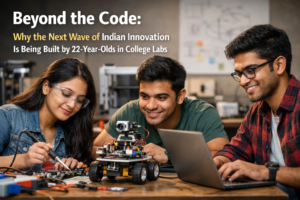
Beyond the Code: Why the Next Wave of Indian Innovation Is Being Built by 22-Year-Olds in College Labs
The gleaming high-rises of Bengaluru’s tech parks have long been the symbol of India’s IT prowess—a story of scale, efficiency, and global services. But if you want to see the future of Indian innovation, you might need to look somewhere else entirely. Perhaps at a cluttered college lab in IIT Madras, a garage in a Delhi suburb, or a co-working space in Pune where a 15-year-old is sketching blueprints for a space-tech component.
This is the new, audacious frontier of “deep tech” in India, and according to those watching the trend from the front lines, it’s not just arriving—it’s exploding with a youthful energy that the world hasn’t yet fully appreciated.
Multi-stage venture capital firm Lightspeed, backers of household names like Acko, Zepto, and PineLabs, recently put this phenomenon under a microscope with its “India Ascends” programme, a fast-track initiative designed to find India’s most promising deep-tech founders. The results were staggering. They received nearly 1,400 qualified applications. They selected just 12.
A 1% acceptance rate. That’s tougher than getting into Harvard, and it signals a profound shift in the subcontinent’s startup ecosystem.
We sat down with Dev Khare, a Partner at Lightspeed, to decode what this surge really means, why the youngest generation of founders is skipping the “software-as-a-service” (SaaS) playbook to build hardware that flies and drugs that cure, and why the biggest opportunity—”AI for India”—remains the market’s best-kept secret.
The Rise of the 22-Year-Old Visionary
For decades, the archetype of a successful Indian entrepreneur was often a seasoned professional with decades of industry experience, leveraging connections and capital to build a business. The “India Ascends” cohort shatters that mould.
“There’s a 15-year-old in the cohort, and the average age is about 22,” says Khare. “These are young founders with mission orientation.”
This isn’t just about being young; it’s about a fundamental shift in mindset. This generation has grown up in a post-liberalization India, with access to the world’s information through a smartphone. They are less interested in building the next IT outsourcing firm and more captivated by the challenges of space, defence, and climate technology.
“We’re getting founders who are not executives who’ve been in industry for 20 years,” Khare notes. “These are much younger folks.”
This new breed is technically fluent, often straight out of research labs or having spent years “tinkering” as undergrads. They are builders first, and businesspeople second. This is a stark contrast to the previous wave of Indian startups, which often prioritized business model innovation—like quick commerce or edtech—over core technological invention.
Lightspeed’s own portfolio reflects this bet. Pixxel Space, founded by two graduates from PES University in Bengaluru, is building a constellation of hyperspectral earth-imaging satellites. Airbound is designing a logistics drone that can carry heavy payloads. Sarvam AI is building full-stack generative AI solutions, including their own models. These aren’t just companies applying technology; they are companies creating it at the deepest levels.
The Geopolitical Tailwind: From Boardrooms to Battlefields
Building a satellite or a defence drone ten years ago in India would have been an act of sheer stubbornness. The ecosystem for funding, mentorship, and—most importantly—customers simply didn’t exist. Today, it does, thanks in large part to a powerful new force: geopolitics.
“What’s different now is that there’s also a whole geopolitical angle to this that makes funding sources and customers available now, that weren’t necessarily there 10 years ago,” Khare explains.
The push for “Atmanirbhar Bharat” (Self-Reliant India) has translated into real procurement mandates. Governments and the military are no longer just looking to buy off-the-shelf hardware from global vendors. They have experimental budgets and a genuine desire to foster indigenous innovation in areas like unmanned drones, submarines, robotics, and cybersecurity.
This creates a clear, immediate path to market for deep-tech founders. A proof-of-concept isn’t just a slide deck for a venture capitalist; it’s a potential demo for a government agency with a real problem to solve. This de-risks the investment to a certain extent and provides a non-commercial validation that is crucial in the early stages.
The Venture Capital Art of Betting on the Impossible
For Khare and his team, evaluating these startups requires a different lens than the one used for a typical SaaS company. You can’t look at month-over-month revenue growth when the product is a prototype that hasn’t been tested in orbit.
“We look at non-commercial milestones,” he says. “Proof of concept is one—does the thing even work? It may not be commercially or economically viable yet, but it should function.”
From there, the markers of progress shift to design partners, regulatory approvals, and certifications—especially critical in heavily regulated fields like defence and healthcare. A drug-discovery AI startup’s success might hinge on a positive interaction with the US Food and Drug Administration (FDA) or an Indian regulatory body, long before a single rupee of revenue is generated.
The question of timing is perhaps the most delicate art in deep-tech investing. Venture capital funds typically have a 10-year life cycle. They need an exit, whether through an acquisition or an IPO, within that window. Betting on a technology that is 20 years away from commercialisation is a recipe for failure.
“The art lies in not picking companies that will take 20 years to commercialise,” Khare admits. “That’s more for governments, foundations or grants. Venture capital works best when technologies are within roughly a 10-year time frame.”
He points to nuclear fusion as a cautionary tale—a field that has captivated and frustrated VCs for two decades. The key is to distinguish between fundamental science experiments and technologies that are on the cusp of engineering viability.
The Underdog Opportunity: AI for India
While global attention is fixated on the battle between frontier models from the US and China, a quieter, more profound opportunity is taking shape in India. It’s not about building the next GPT-5; it’s about solving uniquely Indian problems with AI.
“AI for India is under-appreciated,” Khare states emphatically. “Everyone talks about AI from India for the world. But what about AI built for Indian consumers and businesses? Voice AI, financial advisory, consumer applications—these are meaningful areas.”
There is a prevailing narrative that India is “behind” in the AI race because it lacks its own OpenAI. This perspective misses the point entirely. The real value in AI won’t just come from the models themselves, but from the applications built on top of them. And for that, India is a goldmine.
Consider the complexities of the Indian market: dozens of languages, a massive population with low digital literacy, unique cultural nuances, and a price-sensitive consumer base. An AI model trained primarily on English internet data is ill-equipped to serve a vegetable vendor in Tamil Nadu or a small business owner in Uttar Pradesh.
This is where the “under-appreciated” opportunity lies. Startups building voice-first AI interfaces that can converse in Hinglish, AI-powered financial advisors that can demystify insurance for a first-time buyer, or diagnostic tools that can work in low-resource settings—these are the innovations that will define the “AI for India” wave.
“There are things happening in India that aren’t happening elsewhere,” Khare insists. This hyper-local focus isn’t just a defensive moat; it’s a potential export opportunity. The solutions built for India’s chaotic, diverse, and mobile-first environment could be surprisingly effective in other emerging markets across the Global South.
Room to Grow: The Ecosystem is Still Nascent
Despite the surge in interest and the high-profile applications to programmes like India Ascends, the deep-tech funding ecosystem in India is still in its infancy. The competition for deals may feel intense among the small group of active investors, but relative to the size and ambition of the country, there is a massive gap.
“If you zoom out, India still has a limited number of firms doing solid Series A and seed investing,” Khare points out. “There are less than 10 venture capital funds that do solid Series A’s, maybe 10 to 20 funds that do seeds. In a country of this scale, that’s a very small number.”
This scarcity of capital creates both a challenge and an opportunity. It’s a challenge for founders who must navigate a thin pool of potential backers. But for the market as a whole, it signals that the current excitement is just the beginning. As more success stories emerge—as a Pixxel satellite actually launches, or an Airbound drone gets a massive government contract—more capital will inevitably flow in.
The 15-year-old in the cohort, the college researchers, the tinkerers in their garages—they are not anomalies. They are the vanguard. They represent a belief that India can be a creator of foundational technology, not just a consumer or an efficient outsourcer.
For the rest of the world, still looking at India through the lens of IT services and consumer internet clones, the message from Lightspeed’s 1% acceptance rate is clear: pay attention. The most audacious ideas are no longer coming from just Silicon Valley. They are being coded, wired, and assembled in college labs across India, by the youngest, most mission-oriented founders the country has ever produced. And they are just getting started.
You must be logged in to post a comment.