
Beyond the Cleared Fog: Delhi’s Air Quality “Improves” to Very Poor, Exposing a Cycle of Crisis and Complacency
Delhi’s recent shift from “severe” to “very poor” air quality represents not a solution but a fleeting meteorological reprieve, driven by changing winds and temperatures rather than lasting policy action. This marginal improvement, which led to the lifting of emergency curbs, reveals a reactive cycle where the city oscillates between crisis and managed decline, normalizing hazardous air as a baseline. True progress requires moving beyond temporary measures to address the perennial sources of pollution through sustained, systemic change, as the coming weekend’s forecasted temperature drop threatens to restart the entire toxic cycle once again.
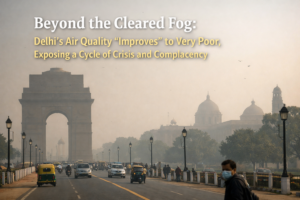
Beyond the Cleared Fog: Delhi’s Air Quality “Improves” to Very Poor, Exposing a Cycle of Crisis and Complacency
For the first time in over a week, Delhiites on Wednesday morning woke up to a headline that didn’t contain the word “severe.” The city’s Air Quality Index (AQI), a constant source of dread and discomfort, had dialed back from the emergency red zone to a—still alarming—“very poor” category of 339. This shift, however marginal, was significant enough for authorities to revoke the strictest curbs under the Graded Response Action Plan (GRAP). But to interpret this as “improvement” is to misunderstand the relentless, cyclical nature of Delhi’s winter air pollution crisis. This isn’t a problem solved; it’s a crisis temporarily paused by the wind.
The data tells a story of precarious fluctuation. The minimum temperature nudged slightly above normal to 7.7°C, with a forecast predicting a rise to 9-11°C by Friday before plummeting again over the weekend. This thermal rollercoaster is not a meteorological sidebar; it’s the central driver of the air quality drama. The shallow to moderate fog reported isn’t just picturesque morning mist—it’s a lid of moisture trapping pollutants closer to the ground. The expected cloudy skies and the yellow alert for light rain and gusty winds by Friday are the actors waiting in the wings, capable of scrubbing the air or stirring up dust, respectively.
The Mechanics of a Marginal “Improvement”
Why the shift from severe to very poor? The primary engineer is meteorology, not policy. A slight increase in wind speed and a change in wind direction can act as the city’s temporary ventilation system, dispersing the toxic cocktail of particulate matter (PM2.5 and PM10), nitrogen oxides, and carbon monoxide that had stagnated for days. The Commission for Air Quality Management (CAQM) operates within this framework of natural variability. The revocation of Stage 4 GRAP—which entails bans on certain commercial vehicles, construction, and the entry of polluting trucks—is a calibrated economic relief, acknowledging that the immediate meteorological crisis has slightly abated.
Yet, the Air Quality Early Warning System’s (AQEWS) forecast is a sobering reality check. It predicts the AQI will linger in the “very poor” category until Friday, and hover between “very poor” and “poor” for the subsequent six days. This is the purgatory Delhi residents know all too well: a space where the emergency sirens are silent, but the silent, slow-motion public health emergency continues unabated. An AQI of 339 is not clean air; it’s air that poses a significant risk to the vulnerable—children, the elderly, and those with respiratory or cardiac conditions—and discomfort to everyone else.
The Human Cost Behind the Index
To live in Delhi during this season is to develop a sophisticated, often grim, internal weather and pollution model. The marginal improvement means a construction worker might resume their job, but still labor through a gritty haze. A parent might allow their child an hour in the park, but with a wary eye on the grey sky. The morning walker, who had abandoned their routine, might venture out again, yet return with a faint metallic taste in their mouth. The respite is relative and fraught with anxiety because the memory of “severe” days is fresh, and the forecast promises another dip in temperatures over the weekend.
This dip is critical. Colder, calmer conditions are the perfect recipe for the return of a temperature inversion—a layer of warm air acting as a cap over cooler air near the surface, preventing vertical mixing and turning the city into a sealed pollution chamber. The expected weekend temperature drop to 6-8°C is not just a cue for pulling out warmer clothes; it’s a potential trigger for the AQI to climb back into the “severe” zone, restarting the GRAP ladder all over again.
A Cycle, Not a Solution
This incident lays bare the reactive nature of Delhi’s air pollution management. The system is designed to respond to peaks, not to create a permanent baseline of clean air. The GRAP is an emergency brake, not a steering wheel. The real, intractable sources—vehicle emissions, industrial pollution, dust from unregulated sites, and the complex, cross-state issue of agricultural stubble burning—remain largely unaddressed at a transformative level.
The annual narrative has become predictable: a descent into toxic air, public outrage, knee-jerk reactions (like bans and odd-even schemes), a favorable wind that brings temporary relief, a sigh of relief and complacency, followed by the next inevitable downturn. Each cycle normalizes higher levels of baseline pollution and erodes public faith in long-term solutions.
What Does “Genuine Improvement” Require?
Moving beyond this cycle demands a shift in mindset from “managing a crisis” to “ensuring a right.” It requires:
- Year-Round, Aggressive Policy Action: Not just winter curbs, but a relentless, multi-year push for cleaner public transport, stringent enforcement on industrial and construction norms, and viable economic solutions for farmers to move away from stubble burning.
- Hyper-Localized Monitoring and Solutions: A city-wide AQI average masks micro-environments. Pollution levels can vary dramatically between a leafy enclave and a traffic corridor. Solutions need granular data and targeted interventions.
- Transparent, Long-Term Communication: Instead of just daily AQI numbers, the public needs clear, accessible information on long-term trends, source contributions, and the tangible health benefits of sustained clean air policies.
- Individual Agency Within Systemic Change: While systemic change is paramount, the “reprieve” days are when collective habits—opting for public transport, conserving energy, supporting sustainable products—can be strengthened, creating a culture of demand for cleaner air.
Delhi’s air quality dropping from “severe” to “very poor” is a meteorological footnote. The real headline is that millions of people are being asked to accept a “very poor” baseline as a sign of progress. The lifted fog reveals not just the city’s skyline, but the stark clarity of the challenge ahead: until the response moves from seasonal reaction to unwavering, systemic action, Delhi’s winters will remain a predictable, and breathless, cycle of crisis and fleeting, inadequate relief. The weekend’ cold is coming, and with it, the next test.
You must be logged in to post a comment.