
Beyond the Classroom: How a Business Professor and His Students Are Weaving a Tapestry of Empowerment in Rural India
International business professor David Wernick was honored with a 2025 Changemaking Education Award for his leadership of the student-led Bandhwari Women’s Project, a decade-long initiative that transforms business education into a force for global good.
After witnessing profound poverty in rural India, Wernick established a partnership between FIU’s International Business Honor Society and a women’s cooperative in Bandhwari, creating a sustainable social enterprise where students manage the import and sale of the women’s handicrafts and reinvest all proceeds back into the community for education and healthcare.
This model empowers the women economically through dignified work while providing students with immersive, real-world experience in ethical supply chains and cross-cultural collaboration, culminating in a trip to India to witness the impact firsthand, thereby redefining business leadership as a vehicle for mutual growth and profound human connection.
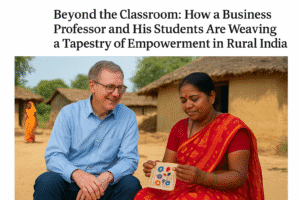
Beyond the Classroom: How a Business Professor and His Students Are Weaving a Tapestry of Empowerment in Rural India
Meta Description: Discover the decade-long story of FIU’s Bandhwari Women’s Project—a powerful case study in how student-led social enterprise can break cycles of poverty and redefine business education. Professor David Wernick’s changemaking model proves impact is the ultimate teacher.
From Lecture Halls to Lifelines: The Genesis of a Changemaking Project
In an era where business education is often critiqued for being too theoretical, too detached from the messy realities of the global economy, the story of Professor David Wernick and the Bandhwari Women’s Project stands as a powerful rebuttal. It’s a narrative that proves the most profound lessons aren’t just learned in classrooms, but are co-authored in collaboration with communities thousands of miles away.
Recently honored with a 2025 Changemaking Education Award, Wernick’s work transcends the typical curriculum. It’s a living, breathing ecosystem of mutual growth, connecting his students at Florida International University (FIU) with the women of Bandhwari, a village on the outskirts of New Delhi, India. This isn’t a charity case; it’s a sophisticated, student-run social enterprise that has, for over a decade, redefined what it means to be an international business leader.
The project’s origin reads like a catalyst of conscience meeting opportunity. During a research trip to India, Wernick visited Bandhwari and witnessed firsthand the stark challenges of rural poverty, which disproportionately burdened women and limited opportunities for children. Yet, within this landscape of need, he found a spark of hope in Anup Nair and his wife, who had “adopted” the village through their Incentive Foundation. They had built a women’s center—a physical space that represented potential.
“I saw an opportunity,” Wernick reflects, a sentiment that understates the profound vision that followed. He didn’t just see a village to be pitied; he saw a partner. He recognized the untapped entrepreneurial spirit of the women and the untapped potential of his own students, who were hungry for purpose-driven, real-world experience.
The Engine of Empowerment: More Than Just Crafts
At its core, the Bandhwari Women’s Project is elegantly simple in its mission and complex in its execution. It operates as a partnership between FIU’s International Business Honor Society (IBHS) and a women’s cooperative in Bandhwari. The model is a closed-loop system of sustainable impact:
- Product Co-Creation: The women in Bandhwari, leveraging traditional skills, create beautiful, exportable handicrafts. These are not generic trinkets; they are artifacts embedded with cultural significance and artisan pride.
- Student-Led Global Marketing: FIU students take on the roles of global supply chain managers, marketers, and sales directors. They import the handicrafts and sell them throughout the academic year at campus events and pop-up markets, navigating everything from customs paperwork to digital marketing strategies.
- 100% Reinvestment: Every dollar of profit from the sales is sent back to the Incentive Foundation in Bandhwari. This is the crucial linchpin. The money isn’t a handout; it’s capital. It funds critical initiatives like children’s education, healthcare programs, and vocational training, directly addressing the root causes of poverty as identified by the community itself.
This model shatters the traditional donor-recipient dynamic. The women in Bandhwari are not passive beneficiaries; they are producers and business partners. The students are not mere volunteers; they are accountable executives managing a real international business with tangible human consequences.
The Immersive Bridge: When Data Becomes a Human Face
The academic year of planning, logistics, and sales culminates in a transformative capstone: a student trip to Bandhwari. This is where the project transcends business and becomes human.
“You can study poverty rates and GDP per capita in a textbook, but it’s an entirely different thing to shake the hand of the woman who wove the tapestry you sold, to meet the children whose school fees your work provided,” Professor Wernick often emphasizes.
This immersion is the final, critical piece of the educational puzzle. Students walk the dusty paths of the village they’ve only seen in photos. They share meals, listen to stories, and witness the direct impact of their labor. The line-item “proceeds” on a spreadsheet suddenly has a name and a smile. This experience cultivates a deep sense of global citizenship and cultural humility—traits that are invaluable in today’s interconnected business world.
The project becomes a two-way mirror of empowerment. The women in Bandhwari gain financial independence, confidence, and a louder voice in their community. The FIU students gain an unparalleled education in ethical supply chains, cross-cultural communication, and the immense power of business as a force for good.
The Ripple Effect: Lessons in Sustainable Changemaking
The Bandhwari Women’s Project offers a masterclass in sustainable development that extends far beyond its immediate circle. For other educators, social entrepreneurs, and business leaders, its success is built on several key principles:
- Partnership Over Pity: The project was not imposed; it was invited and built alongside local leaders (the Incentive Foundation) who understood the community’s needs and strengths. This ensures relevance and longevity.
- Dignity Through Enterprise: By creating a business model, the project empowers through trade, not aid. It affirms the skills and agency of the women, fostering pride and self-sufficiency.
- Education as Experiential Immersion: Wernick’s approach moves beyond case studies. It throws students into the deep end of real-world problem-solving, teaching resilience, adaptability, and empathy alongside profit-and-loss statements.
- The Power of a Closed Loop: The 100% reinvestment model builds trust and ensures transparency. Donors—in this case, the students and those who purchase the crafts—can see exactly where their money goes and the direct change it enables.
As Professor Wernick looks to the future, his vision is to scale this “remarkable journey of cross-cultural friendship and discovery.” Scaling doesn’t necessarily mean replicating the model in a dozen other villages overnight. It could mean deepening the impact in Bandhwari, expanding the product line, exploring e-commerce channels, or creating a formal curriculum toolkit so other universities can launch similar initiatives.
The 2025 Changemaking Education Award is not an endpoint; it’s a validation of a decade of quiet, consistent work. It celebrates an educator who understood that the ultimate measure of his success would not be his students’ grades, but their capacity to become compassionate, effective leaders.
In the end, the Bandhwari Women’s Project weaves together more than just handicrafts. It weaves together lives, futures, and a new, more hopeful paradigm for what business—and business education—can truly achieve. It’s a vivid tapestry where every thread represents a student’s effort, a woman’s resilience, and a professor’s belief that the classroom has no walls.
You must be logged in to post a comment.