
Beyond the Circuit Board: OMRON’s Human-Centric Blueprint for a Data-Driven 2030
OMRON Corporation’s “Shaping the Future 2030 2nd Stage” plan outlines a strategic transformation from a traditional devices manufacturer into a data-driven “GEMBA DX” company that partners with customers on the factory floor and in healthcare settings, with “Trusted Growth” serving as the guiding philosophy. The strategy involves restructuring its portfolio to focus investments on 13 core businesses—primarily in Industrial Automation and healthcare data services—while leveraging Europe as a crucial hub for advancing industrial intelligence through collaborative Automation Centers, and positioning India as a major growth engine for both manufacturing automation and hypertension management through localized production and physician endorsements.
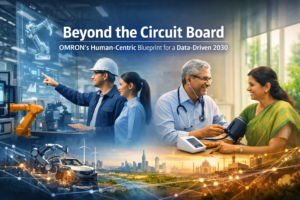
Beyond the Circuit Board: OMRON’s Human-Centric Blueprint for a Data-Driven 2030
In the quiet hum of a factory floor or the steady beep of a home blood pressure monitor, technology often feels impersonal—a cold exchange of electricity and data. But for OMRON Corporation, a global giant in automation and healthcare, the future isn’t just about faster processors or more sensitive sensors. It’s about trust. It’s about understanding the messy, complex, human reality of the “GEMBA”—the Japanese term for the place where value is actually created, whether that’s a bustling manufacturing line in Stuttgart or a family clinic in Mumbai.
OMRON’s recently unveiled medium-term roadmap, Shaping the Future 2030 (SF2030) 2nd Stage, is more than a corporate slide deck filled with ambitious CAGR targets. It is a strategic manifesto for a company in metamorphosis. It’s a plan to shed its skin as a traditional devices manufacturer and emerge as a data-driven partner, with Europe and India serving as the twin crucibles for this transformation. The core of the plan, “Trusted Growth,” isn’t just a tagline; it’s the philosophical engine designed to power a pivot from selling products to solving humanity’s deepest operational and health challenges.
The Great Pivot: From Components to Context
For decades, OMRON has been the silent hero inside other people’s successes. Its sensors, controllers, and switches are the unseen nervous system of factories worldwide. Its blood pressure monitors are the vigilant sentinels in millions of homes. But in the SF2030 plan, the company is making a bold bet: that its future lies not just in the collection of data, but in its interpretation.
President & CEO Junta Tsujinaga’s vision of a “GEMBA DX (on-site digital transformation) company” is a profound shift in perspective. It acknowledges that data, in its raw form, is just noise. The true value lies in fusing OMRON’s high-quality device data with the tacit knowledge of the people on the ground—the machine operator who hears a hiccup in a motor before it breaks, or the physician who understands why a patient’s readings spike on Monday mornings.
This is the “multiplication” Tsujinaga speaks of. It’s the alchemy of turning technical information into actionable wisdom. This isn’t about replacing human intuition with AI; it’s about augmenting it. It’s a recognition that the most efficient factory and the healthiest life are not achieved by machines alone, but through a symbiotic dance between human insight and digital precision.
Restructuring for Resilience: The 13 Pillars of Growth
To fund this ambitious transformation, OMRON is taking a hard look in the mirror. The SF2030 plan is as much about what the company will stop doing as what it will start. By designating 13 “focus businesses”—ranging from industrial controllers and energy storage systems to digital health solutions—OMRON is effectively placing its bets. The decision to funnel 70% of investments into these areas by 2030 is a declaration of identity. It signals a streamlined, more agile company focused on domains where it can truly lead.
This portfolio restructuring is a defensive move with an offensive edge. It’s about pruning the branches to let the strongest limbs flourish. In a volatile global economy, this laser focus provides a crucial buffer, allowing OMRON to channel resources into innovation rather than spreading them thin across disparate units. The goal is sustainable, resilient growth, powered by a core that is both deep and defensible.
Europe: The Crucible of Industrial Intelligence
When OMRON looks at Europe, it doesn’t just see a market; it sees a masterclass in complexity. European manufacturing, particularly in Germany, is defined by the Mittelstand—highly specialized, family-owned machine builders who are the backbone of the global economy. These are not companies looking for off-the-shelf, one-size-fits-all automation. They need partners who understand the nuance of their craft.
Fernando Colás, CEO of OMRON Industrial Automation Europe, captures this perfectly by emphasizing support for German machine builders to “manage increasing complexity.” This isn’t about selling them a robot; it’s about giving them the tools to build a better one themselves. The investment in Automation Centers, like the hub in Stuttgart, is a testament to this hands-on philosophy. These aren’t showrooms; they are collaborative workshops where OMRON engineers and customer teams get their hands dirty, testing concepts and building proof-of-concept solutions side-by-side. It’s a strategy built on proximity and practical expertise.
Across the channel in the UK, the narrative shifts from supporting builders to empowering users. British manufacturers are grappling with a perfect storm: the pressure to boost productivity, a persistent shortage of skilled labor, and the daunting task of integrating new tech with legacy systems. Colás’s mention of moving customers “from fragmented automation toward more autonomous and efficient operations” speaks directly to this pain point.
Here, OMRON’s role evolves from vendor to educator. By offering training programs and on-site support, they are helping to bridge the UK’s critical skills gap. They are empowering local teams not just to use new technology, but to master it, turning a potential point of failure into a source of competitive advantage. It’s a human-centric approach to a technological problem, ensuring that the adoption of automation strengthens the workforce rather than rendering it obsolete.
India: The Engine of Scale and Social Impact
If Europe represents the refinement of industrial intelligence, India represents its explosive scaling. The country’s ambition to grow its manufacturing sector from 12-15% of GDP to 23% is not just a government target; it’s a tectonic shift that creates a vacuum for technology, expertise, and infrastructure. OMRON’s target of a 12.0% Revenue CAGR in its Industrial Automation segment in India is a direct response to this national ambition.
Sameer Gandhi, Managing Director of OMRON Automation, India, frames this not as a business opportunity, but as a partnership in nation-building. By helping Indian manufacturers build “safer, more efficient, and globally competitive operations,” OMRON is positioning itself as an enabler of the “Make in India” vision. The focus on sectors like automotive, electronics, and food production taps directly into the arteries of a modernizing economy. The Automation Center in India serves a similar purpose to its European counterparts, but with a different context: it’s a place to demonstrate how world-class automation can be adapted to the unique scale and challenges of the Indian industrial landscape.
But perhaps the most profound human insight in OMRON’s India strategy lies in its healthcare ambitions. Hiroshi Ogawa, Managing Director of OMRON Healthcare India, points to the stark reality: a vast population affected by hypertension. In this context, a blood pressure monitor is not a consumer gadget; it is a frontline diagnostic tool in the fight against a silent killer.
OMRON’s strategy here is a masterclass in localized trust. The “Made in India” manufacturing structure is about accessibility and affordability, but the emphasis on “endorsements from key opinion leader physicians” is about cultural credibility. In a country where the doctor’s word is often law, building a bridge between the clinic and the consumer is paramount. OMRON isn’t just selling a device; it’s embedding itself within the healthcare ecosystem, becoming a trusted tool recommended by the very people patients trust most. This is “GEMBA” applied to healthcare—meeting the patient and the physician exactly where they are.
The Road Ahead: Trust as the Ultimate Currency
As OMRON charts its course to 2030, the common thread weaving through its European industrial strategy and its Indian growth engine is the concept of trust. Trust is not built in a boardroom; it is forged in the “GEMBA.” It’s the confidence a German machine builder feels when testing a prototype in Stuttgart. It’s the reassurance a British factory manager has when her team completes an OMRON training course. It’s the peace of mind an Indian patient feels when their doctor recommends a specific monitor.
The transformation into a “GEMBA DX company” is, at its heart, a commitment to deepening this relationship. It’s a promise that OMRON’s technology will not be a black box, but a transparent tool that empowers human potential. By focusing its portfolio, investing in data services, and tailoring its approach to the unique cultural and industrial landscapes of Europe and India, OMRON is placing a calculated bet.
The company is betting that in an increasingly automated world, the most valuable commodity will not be the data itself, but the wisdom to use it, and the trust required to apply it. The path to 2030 is paved with silicon and software, but its direction is guided by a deeply human understanding of the places where work gets done and lives are lived.
You must be logged in to post a comment.