
Beyond the Chill: Unpacking the Significance of Bhubaneswar’s Record-Breaking Cold November Night
Bhubaneswar recently endured itscoldest November night in 25 years, with temperatures plunging to 12.9°C, a dramatic 6.1 degrees below normal, as a severe cold wave gripped Odisha. This intense chill, driven by dry northw esterly winds carrying cold air from northern India, saw even starker drops in the interior, with G Udayagiri recording 5.4°C and Jharsuguda entering a severe cold wave category at 9.8°C. While historically not unprecedented, the event significantly disrupted daily life, especially for vulnerable populations, and highlighted the powerful reach of continental weather patterns. Mercifully, the regional met office forecast a break in the cold spell within a day, expecting temperatures to gradually rise with the return of moderating easterly winds from the Bay of Bengal.
Beyond the Chill: Unpacking the Significance of Bhubaneswar’s Record-Breaking Cold November Night
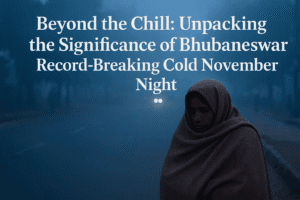
The familiar hum of Bhubaneswar’s morning traffic was accompanied by an unfamiliar bite in the air this past Monday. As the sun struggled to burn through the persistent haze, the numbers confirmed what every resident, wrapped tightly in shawls and jackets, already felt in their bones: at 12.9 degrees Celsius, the city had just experienced its coldest November night in a quarter of a century.
This wasn’t just a slight dip in the mercury; it was a pronounced meteorological event that saw the state capital’s temperature plummet 6.1 degrees below the normal average for this time of year. The cold wave, intensifying over several days, has gripped Odisha, rewriting local weather narratives and forcing a conversation about the forces behind this uncharacteristic deep freeze.
The Epicentre of the Chill: A State Shivers in Unison
While Bhubaneswar’record grabbed headlines, it was merely the most prominent indicator of a statewide phenomenon. The India Meteorological Department (IMD) data painted a stark picture of a state in the throes of an early and severe cold spell.
The real epicentre of the cold lay in the interior regions. G Udayagiri in the Kandhamal district recorded a bone-chilling 5.4°C, transforming the landscape into a scene more reminiscent of a North Indian hill station than coastal Odisha. Jharsuguda, an industrial hub, earned the dubious distinction of being the first location in the state this winter to officially enter a “severe cold wave” category, with the mercury dropping to 9.8°C.
Across the state, from Cuttack (13.2°C) to other coastal and interior districts, minimum temperatures registered a staggering 5 to 7 degrees below normal. This uniform dip suggests a powerful, large-scale weather pattern at work, not just a localized anomaly.
The Meteorological Machinery: Why is Odisha So Cold?
To understand this cold wave, we must look beyond Odisha’s borders. Weather experts from the IMD have pinpointed the primary culprit: persistent, dry northwesterly winds blowing down from the Himalayan foothills and across the plains of North India.
During winter, large parts of North India experience intense cold due to a phenomenon called “radiational cooling,” where the earth’s surface loses heat rapidly on clear, dry nights. The northwesterly winds act as a conveyor belt, transporting this chilled, continental air mass deep into the Indian peninsula.
“For coastal cities like Bhubaneswar, which are more accustomed to the moderating influence of sea breezes, the influx of this dry, continental air is what leads to such sharp drops in temperature,” explains a meteorologist from the Bhubaneswar Meteorological Centre. The absence of cloud cover further facilitates the escape of whatever residual heat exists, allowing the mercury to plunge unchecked through the night.
This is a classic recipe for a cold wave in this region, but the intensity and duration observed this November have been notable.
A Historical Perspective: How Does This Chill Stack Up?
The phrase “coldest in 25 years” immediately invites a look back at the history books. The last time Bhubaneswar felt a November night this cold was in the year 2000. This context is crucial—it separates a notable weather event from a once-in-a-lifetime occurrence.
Delving deeper into the archives reveals an even more fascinating picture. The all-time lowest minimum temperature for Bhubaneswar in November since record-keeping began in 1952 was a frigid 9.7°C, recorded on November 30, 1970. The city also came close on November 26, 1968, logging 10.9°C.
This historical data is vital. It tells us that while the current cold wave is severe and disruptive for a generation unaccustomed to such chill, it is not entirely unprecedented in the longer-term climate record of the region. It serves as a reminder of the natural variability inherent in our weather systems, cycles that operate on decadal timescales.
The Human Element: Life in the Grip of the Cold
Statistics and wind patterns tell one story; the reality on the ground tells another. The human impact of this cold wave is palpable and profound, particularly for the most vulnerable.
Outside institutions like AIIMS Bhubaneswar, the scene was one of quiet endurance. Families waiting for medical care huddled together, using thin shawls and blankets as their only defence against the relentless cold. For the homeless and those living in informal settlements without adequate shelter or heating, the cold is not an inconvenience but a genuine health hazard.
Street vendors, who typically thrive in the pleasant November weather, saw a drop in footfall. Early morning commuters on two-wheelers navigated the streets with an extra layer of caution and clothing. The demand for winter wear, often a seasonal novelty in Odisha’s markets, has surged, putting a strain on household budgets.
This sudden chill also has agricultural implications. While the full impact on winter crops is still being assessed, a prolonged cold spell can damage certain sensitive horticultural crops, affecting local farmers whose livelihoods depend on predictable seasonal patterns.
The Silver Lining: A Forecast of Warmer Days
In a welcome relief for the shivering state, the IMD has forecast a break in the cold wave within the next 24 hours. Manorama Mohanty, Director of the Bhubaneswar Meteorological Centre, attributes this expected shift to a change in wind patterns.
“The night temperature is expected to gradually rise by 2 to 3 degrees Celsius under the influence of easterly winds flowing towards the state,” Mohanty stated.
This is the other side of the meteorological coin. Easterly winds originate from the Bay of Bengal, carrying moisture and the moderating influence of the sea. As these winds replace the dry northwesterlies, they will act as a thermal blanket, trapping some of the day’s heat and preventing the dramatic temperature drops witnessed over the past week.
Conclusion: A Lesson in a Shiver
Bhubaneswar’s record-breaking cold night is more than just a talking point; it’s a stark lesson in the dynamic and interconnected nature of India’s climate. It demonstrates how a weather event originating in the Himalayas can directly impact life on the shores of the Bay of Bengal.
While not an unprecedented historical event, its severity for the current generation underscores our vulnerability to sharp deviations from the climatic norm. It highlights the need for robust public health responses to protect the vulnerable during such extremes and reminds us of the complex and often powerful dance of atmospheric forces that govern our daily lives. As the easterlies prepare to bring relief, the memory of this deep freeze will linger, a crisp, cold reminder of nature’s formidable power.
You must be logged in to post a comment.