
Beyond the Chill: How Srinagar’s Winter Frost Reveals the Resilient Heart of Kashmir
Despite the severe cold wave gripping Srinagar, with temperatures plunging to -1°C and Dal Lake shrouded in dense fog, the harsh winter has revealed a deeper narrative of resilience and allure, where undeterred tourists seek an authentic, serene experience of the valley stripped of its seasonal vibrancy, while their reflections—from appreciating the heightened sense of security and cleanliness to expressing concern over absent snowfall and the lake’s ecological needs—highlight a complex interplay between climate change, sustainable tourism, and the enduring livelihood and cultural fabric of Kashmir that continues to thrive and adapt even amidst the freeze.
Beyond the Chill: How Srinagar’s Winter Frost Reveals the Resilient Heart of Kashmir
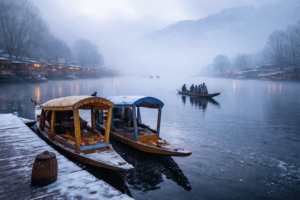
A silent transformation sweeps over Srinagar in the heart of winter. The vibrant shikaras, usually bursting with flowers and colour, sit still, their hulls lightly dusted with morning frost. The famed Mughal gardens sleep under a crisp, quiet blanket. And Dal Lake, the eternal centrepiece of Kashmir’s beauty, doesn’t freeze over with a dramatic, solid sheet, but rather breathes through a thick, spectral fog that swallows the horizon whole. On a Wednesday in January, as the mercury dipped to -1°C, this wasn’t just a weather report—it was the stage for a poignant, deeply human experience that transcends the simple binary of ‘cold wave.’
The India Meteorological Department’s (IMD) bulletins speak of minimum temperatures, forecasts of light rain, and advisories for limited outdoor activity. But on the misty banks of Dal Lake, a different story unfolds. Here, the cold is not merely a meteorological phenomenon to be endured; it is a sensation to be embraced, a filter that changes everything. Tourists, layered in vibrant pherans and borrowed woollen caps, aren’t just “braving” the cold—they are seeking a version of Kashmir stripped bare of its usual adornments. They come for the silence, broken only by the soft lapping of water against wooden boards. They come for the way the weak, winter sun struggles through the fog, casting a diffused, silver light that makes the world feel both intimate and immense.
The Allure of the Austere
Vikas Yadav, a Delhiite on a work trip, encapsulates this paradoxical attraction. “It is bitterly cold here,” he admits, a statement of fact without complaint. His appreciation, however, swiftly moves from the temperature to the experiential and the social: the cleanliness, the visible security, the supportive police presence. His words highlight a critical insight often lost in travel brochures: for many visitors, especially from urban India, the profound peace and order they find in Srinagar’s winter is as captivating as its landscapes. The cold becomes a purifying element, sharpening the senses and making the city’s managed calmness even more palpable. It’s a reminder that tourism, in its deepest sense, is as much about the feeling of a place as its sights.
Conversely, Gulshan Kumar’s slight disappointment at the absent snowfall speaks to a changing climatic narrative. “Maybe that’s due to global warming,” he muses, connecting his personal experience to a planetary pattern. His observation is astute. The irregularity of snowfall in the Valley is a growing concern, impacting not just tourist expectations but agriculture, hydrology, and the very cultural rhythm of life. His praise for the city’s clean roads, followed by a pointed call for the cleaning of Dal Lake, underscores a visitor’s evolving gaze—from passive sightseer to engaged observer. He recognizes the lake not just as a scenic backdrop for photographs, but as a living, breathing economic artery. “It is a source of livelihood for many people here,” he notes, touching on the symbiotic relationship between Kashmir’s environment and its economy.
Dal Lake: A Mirror to Deeper Currents
This brings us to the heart of the matter: Dal Lake in winter is a powerful metaphor. The fog that limits visibility mirrors the complex, often obscured challenges the region faces. The lake’s need for sustained cleaning and ecological attention, as noted by Kumar, is a decades-old story. The livelihoods tied to it—from shikara rowers and hoteliers to artisans and farmers—are particularly vulnerable in the winter lull, making conservation not an abstract ideal but a direct social and economic imperative.
Yet, within this challenge lies an incredible resilience. The very presence of tourists in “the dead of winter” is a testament to the enduring, magnetic pull of Kashmir. It speaks of a tourism sector that is slowly diversifying beyond the spring blossoms and summer boating, finding value in the introspective quiet of the off-season. This is sustainable tourism in the making: one that spreads economic benefit across more months of the year and attracts visitors seeking authentic connection over perfect weather.
The Fabric of Life in a Freeze
Beyond the tourist gaze, life for Srinagar’s residents adapts with a practised grace. Kangris (traditional fire pots) glow beneath pherans. Kahwa, the local saffron-infused tea, steams on stoves, its aroma a weapon against the chill. The morning fog, while a nuisance for visibility, also holds a soft beauty, muting the city’s sounds and slowing its pace. This daily adaptation is a masterclass in resilience. The authorities’ advisories to limit outdoor activities and heed health warnings are necessary, but they overlay a community already deeply attuned to the rhythms of its climate.
The concurrent news snippets listed alongside the article—about temple security in Puri, a Bodo dance performance, or a handwritten calendar tradition—are not random. They collectively paint a picture of an India where local identity, heritage, and daily life persist with vigour amidst broader national and global narratives. Srinagar’s winter story is one thread in this rich tapestry.
Conclusion: The Cold That Warms
Srinagar at -1°C is more than a dateline. It is a space where the environment forces a pause, inviting reflection. For the visitor, it offers a purer, quieter engagement with a place often discussed only in political or seasonal terms. For the local, it is a season of tough beauty and adaptation. The cold wave, therefore, is not just a period of low temperatures. It is a lens.
It magnifies the ongoing dialogue between nature and livelihood, between tourist expectation and local reality, between the challenges of ecological change and the unwavering human spirit. The tourists enjoying the “frosty beauty” at Dal Lake are participating in a quiet act of solidarity and discovery. They are choosing to see Kashmir in its entirety—not just in its easy summer glory, but in its resilient winter vulnerability. And in doing so, they find what many travel the world seeking: not just a change in scenery, but a change in perspective. The real story isn’t that it’s cold; it’s that, even in the deep freeze, life here is vibrant, welcoming, and profoundly worth experiencing.
You must be logged in to post a comment.